Accountant General Thief
Attorney General Thief
Minister for Aviation Thief
SGF Thief
CBN Gov Thief.
These are BUHARI’s Legacy.
BUHARI was a calamity that should never had happened to this country.
Nigeria is officially a joke
An EIA is a prerequisite before you start a project
The EIA of the coastal road was only completed 1 month before the coastal road was commissioned
The coastal was commissioned in May 2025
EIA was completed in April 2025
Mr Umahi has more questions to answer
It’s obvious when we asked for the EIA they didn’t have it
Construction on this highway officially began in March 2024. Releasing or finalizing EIA components a year later (April 2025) and commissioning the first phase in May 2025 means the project was built retrospectively. This defeats the legal purpose of an EIA, which is to prevent harm rather than document it after construction.[1, 2, 3, 4]
1.3 billion naira released to a fake agency in Nigeria but 36 million was released to the Ministry of Health.
They prioritize stealing over your well-being.
The APC.
POOJA lost his phone in an American stadium after the Congo game, and he recovered it within an hour. He celebrated it with all praise to the American system.
But here in Nigeria, he is supporting those stealing our commonwealth. He's happy America works, and happy his own country does not work.
Which kind of self hate is this?
To open a personal bank account in Nigeria is so stressful but someone,
forged documents,
forged his way to the national budget,
had a CBN account,
attending embassy meetings and occasions,
This APC government led by Yorugbas truly thinks you all Nigerians are FOOLS
In trying to exonerate the #ThiefOfStaff, Bayo Onanuga has implicated the @cenbank Governor, the NSA, the AGF and other top govt functionaries, including the SGF.
Finally, APC will learn the adage “when in the hole, stop digging”.
This is Dolapo Babatunde Tanimola, the only witness in the case between Femi Gbajabiamila, Tinubu’s govt, and Prince Adeniyi Adeyemi, who died mysteriously in a hotel where he was lodging.
He was said to be the “principal” witness and only source of proof in the entire saga. Unfortunately, his mysterious death came only four (4) days after the Presidency arrested Prince Adeniyi Adeyemi.
The official report claimed that he died in a fire incident at the hotel.
What is the name of this hotel and where is it located? No one knows yet. What sort of fire incident killed only Dolapo Babatunde Tanimola in the entire hotel? No answer still.
Well, I sense what you people are thinking. But it won't come from my mouth.✍️
It’s obvious that Prince Adeniyi Adeyemi was scammed by the Bola Tinubu Regime. That Femi Gbajamiabila still has a job is alarming.
PRINCE ADENIYI MUST NOT BE SILENCED!
He was captured in the budget.
He had account domiciled in CBN.
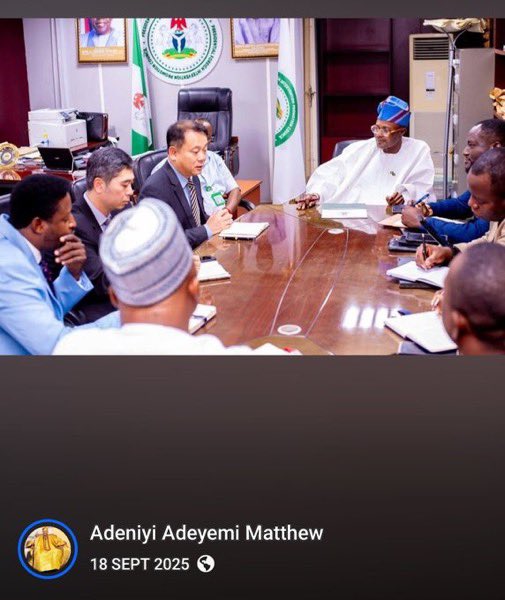
He had office in federal secretariat.
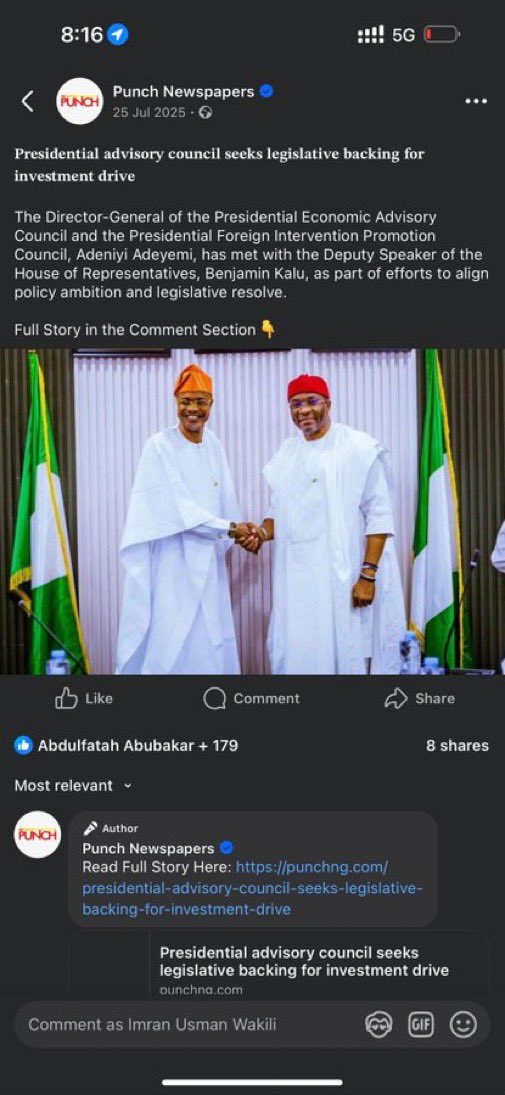
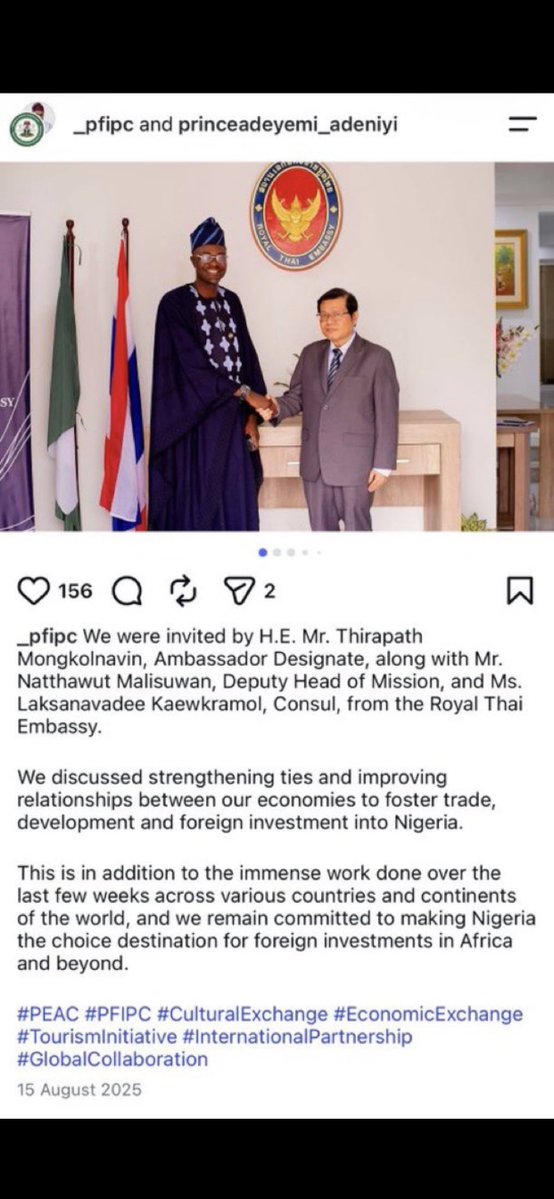
He met with government officials, Consuls & Ambassador designates of other countries, & their Head of Missions. Including the Deputy Speaker & the Chairman of the EFCC (who is supposed to be probing Femi Gbajamiabila).
This is scandalous. This is proof that Asiwaju Bola Ahmed Tinubu is running a CARTEL.
I posted Peter Obi or nothing on my Whatsapp status.
An APC supporter chatted me asking me why are Peter Obi and Obidients so desperate?
I asked him "...Do you how desperate it is for a political party to import terrorists and bandits into the same country they want to govern Just in case GEJ doesn't handle over?
He argued and I sent him evidence.
Since yesterday he hasn't replied me😭😭😭
Femi Gbajabiamila's Law license was revoked for stealing client's money in the US.
Tinubu forfeited $460,000 drug funds in Chicago.
Dapo was guilty of credit card scam abroad.
Won't be surprised if Hushpuppy comes back, joins the APC and wins an election.
APC and CRIMINALITY 5 & 6
Tinubu is more popular than Obi in Nigeria but nah Obidient dey push for Nigerians to get their PVCs
Tinubu is more eloquent than Obi but nah Obidients Dey push for Debates to happen.
The Nigerian Story.
For decades, they pushed an evil narrative that "Igbos are the problem of Nigeria."
They used everything in their arsenal to push the evil narrative even to the international community.
But today, look at Nigeria!
Let me ask them:
Are "Igbos" still "the problem of Nigeria"?😄
There was a time in Nigeria when the man carrying a sewing machine on his shoulder was called Obioma.
Because almost all the artisanal tailors were Easterners of Igbo descent.
After the Civil War, many Easterners emerged from one of the most devastating chapters in Nigerian history with almost nothing but skill, mobility, discipline, and a survival instinct.
Some carried sewing machines from street to street, patching clothes, repairing trousers, adjusting school uniforms, and moving from compound to compound looking for work.
That image became so common that the name stuck.
Obioma.
A man with a sewing machine on his shoulder, moving under the sun and doing work many people looked down on.
But the same people who were once reduced in the public imagination to street tailoring slowly began to move.
From roadside tailoring to shops.
From shops to markets.
From markets to importation.
From importation to manufacturing.
From apprenticeship to industrial clusters.
From survival to ownership.
Go to Nnewi.
Go to Aba.
Go to Onitsha.
Go to Alaba.
Go to Ladipo.
Go to Ariaria.
You will still see poverty, struggle, disorder, bad roads, poor power supply, and all the normal Nigerian problems. Nobody is pretending the Southeast has become Singapore.
But you will also see something powerful.
You will see a people who took humiliation, displacement, and economic ruin and built a survival machine around trade, apprenticeship, mobility, and family capital.
And this is what makes my heart sink as a Northerner.
Today, the mai guard, mai ruwa, mai shayi, mai kaya, shoe repairer, the man pushing a wheelbarrow, carrying loads, shining shoes, patching clothes, riding okada, clearing construction sites, packing refuse, digging soakaway pits, hawking small goods, or sleeping beside a kiosk in Lagos, Abuja, Port Harcourt, Ibadan, Onitsha, and other cities is often called "Aboki."
That is the story we don't want to face.
One people moved from grass to grace.
Another moved from grace to grass.
This is not to take anything away from the Igbo people. I have nothing but admiration for them.
And it is not an insult to the Hausa people or to menial jobs. I am a proud son of Arewa, and in Arewa we do not look down on any vocation earned through halal means.
This is a history lesson.
Now look at us in the North.
We did not begin from the bottom.
Long before colonial Nigeria existed, Kano was already one of the great commercial cities of West Africa. Merchants from Tripoli, Fez, Agadez, Timbuktu, and Bornu passed through its markets. Caravans crossed the Sahara carrying leather goods, textiles, kola nuts, salt, and livestock. The city walls of Kano were not built around a village. They were built around a thriving urban economy that connected West Africa to North Africa.
We had cities that were centres of commerce when many parts of modern Nigeria were still organized around smaller local economies.
We had emirates that provided administration, taxation, courts, and political order across vast territories.
We had centres of Islamic scholarship that attracted students from across the region. In places like Kano, Katsina, Sokoto, and Borno, generations of scholars produced manuscripts and taught jurisprudence, theology, grammar, astronomy, and history. The reputation of northern scholarship travelled far beyond Nigeria's borders.
We had trade routes that linked us to the wider world. For centuries, merchants moved goods across the Sahara and across the savannah belt. Northern markets were not isolated local markets. They were part of international commercial networks.
We had cattle wealth on a scale few regions could match. Fulani pastoralists moved millions of cattle across grazing routes stretching from Senegal to Cameroon. Livestock was not merely food. It was wealth, trade, transport, status, and economic security.
We had one of the most respected leather industries in Africa. Kano leather was famous across the continent. Tanned hides from northern Nigeria found their way into trans-Saharan commerce and international markets. The famous red goatskin known as Morocco leather often originated from skins processed through West African leather networks in which Kano played a major role.
We had textile industries that employed thousands long before modern factories arrived. Hand-spun cotton was woven into cloth across northern towns. Entire communities depended on spinning, weaving, dyeing, trading, and transporting textiles.
We had the famous dye pits of Kano.
Not one or two pits.
Dozens of them.
For centuries, the Kofar Mata dye pits transformed locally woven cloth into richly coloured fabrics using indigo. Traders came from different parts of West Africa to buy these textiles. The dye pits became one of the oldest continuously operating industrial sites on the continent. They supported craftsmen, traders, transporters, farmers growing indigo, and entire commercial networks built around textile production.
We had the groundnut economy.
There was a time when the groundnut pyramids of Kano were not merely tourist attractions on postcards.
They were symbols of enormous agricultural wealth.
Thousands of farmers cultivated groundnuts across the North. Rail lines carried produce southward for export. Groundnut exports generated foreign exchange, supported industries, created jobs, and helped finance government revenues. The pyramids themselves represented mountains of produce waiting to enter global markets.
And if we move into the colonial and post-colonial era, the advantages become even harder to ignore.
We had numbers.
The North occupies roughly three-quarters of Nigeria's landmass. Depending on how one defines the region, the nineteen northern states account for well over half of Nigeria's population. Kano State alone has a population larger than many African countries.
We had manpower.
For decades, millions of young people entered the labour force every year. We were not a small minority struggling to find relevance. We were one of the largest demographic blocs in Africa.
We had land.
Hundreds of thousands of square kilometres of territory stretching across the Sudan and Sahel savannahs.
Land suitable for millet, sorghum, maize, rice, cotton, groundnuts, and livestock.
Land crossed by major river systems such as the Niger and Benue, and supported by irrigation projects in several states.
We had agricultural potential that many countries would envy.
We had political influence.
From independence onward, northern politicians, military officers, civil servants, traditional rulers, and power brokers occupied some of the most influential positions in the Nigerian state for long periods.
Prime ministers.
Heads of state.
Presidents.
Military rulers.
Senior ministers.
Powerful bureaucrats.
Influential legislators.
Whether one likes that fact or not, the North was never politically invisible.
We had religious authority.
The Sultanate of Sokoto remains one of the most influential Islamic institutions in Africa.
The emirates commanded legitimacy that extended beyond politics.
Mosques, Islamic schools, scholars, judges, and religious networks shaped social life across millions of households.
We had institutions.
Not perfect institutions.
But institutions nonetheless.
Emirate councils.
Traditional courts.
Islamic learning centres.
Agricultural boards.
Marketing boards.
Regional administrations.
Cooperative systems.
Educational establishments.
Commercial associations.
Structures that survived for generations.
We had a head start.
That is what makes the present situation so painful.
Because today, when millions of young Hausa and northern boys enter any big city, what work are many of them known for?
These boys are not lazy.
A lazy man does not leave Kano, Katsina, Zamfara, Sokoto, Jigawa, Bauchi, Kebbi, or Borno and sleep under a bridge in Lagos just to survive.
A lazy man does not push water from street to street.
A lazy man does not carry cement until his back bends.
A lazy man does not guard another man's house all night and still open a kiosk by morning.
The problem is not laziness.
The problem is that too many of our people enter the modern economy from the lowest possible point.
No certificate.
No skill that scales.
No capital.
No protection.
No formal training.
No strong educational foundation.
No industrial ladder waiting for them.
So they sell their bodies first.
Their backs.
Their hands.
Their legs.
Their sleep.
Their youth.
That is the real tragedy.
The Igbo Obioma story became a ladder because it was connected to apprenticeship, trade discipline, family networks, and commercial ambition.
The Hausa Aboki story too often becomes a trap because it is connected to poverty, broken schooling, rural collapse, insecurity, and survival migration.
One system turns a boy into a trader.
The other turns a boy into cheap labour or, worse, a recruitment ground for terrorism.
This is the painful contrast.
The Southeast came out of war and produced commercial networks.
The North came out of power and produced surplus labour.
That sentence is harsh, but look around before you reject it.
Who is carrying the load?
Who is guarding the gate?
Who is pushing the cart?
Who is fetching the water?
Who is sleeping in the market?
Who is leaving the village because bandits have made farming impossible?
Who is entering the city with nothing but strength?
If the answer to all the questions above is Arewa youth, then you must not be offended by the diagnosis. Instead, start asking your leaders the harder questions.
Because what is happening to Arewa is a failure of social organization. We shield our leaders too much and outsource criticism of them.
Our fathers inherited a civilization.
Too many of our boys inherited migration.
Our fathers inherited functioning economic systems.
Too many of our boys inherited survival.
Our fathers participated in trade networks stretching across continents.
Too many of our boys participate only in daily labour markets.
Our fathers built industries around leather, textiles, livestock, agriculture, and commerce.
Too many of our boys now rent out their muscles by the day.
And the painful thing is that the word Aboki, which originally means "friend," now, in the mouth of the Nigerian city, often becomes a class marker.
It becomes a way of saying: the northern poor man who does the work nobody respects but everybody needs.
That should break our hearts.
Not because the work is shameful.
No honest work is shameful.
What is shameful is that a whole region with history, population, religious authority, political influence, institutions, agricultural potential, and vast territory keeps producing young people whose first contact with the economy is desperation.
This is why history matters.
The question is not whether the Igbo are better than the Hausa.
That is a childish argument.
The real question is: what system turns hardship into enterprise, and what system turns heritage into dependency?
Because poverty alone does not explain everything.
War did not stop the Igbo from building trade networks.
Lack of oil did not stop Nnewi from producing industrialists.
Bad Nigerian roads did not stop Aba from becoming a manufacturing symbol.
Weak government did not stop apprenticeship from creating business owners.
So what stopped us?
What happened to the North that inherited thriving cities, trans-Saharan commerce, respected scholarship, textile industries, leather industries, livestock wealth, agricultural exports, demographic strength, political influence, and enormous land resources?
How did a people with so much historical structure produce so many young men with so little modern preparation?
That is the conversation we need.
Not insults.
Not denial.
Not ethnic pride.
Not hiding behind "our culture."
Not pretending every criticism is hatred.
The Obioma story should humble us.
Because it shows that a people can begin with a sewing machine on the shoulder and still build a commercial ladder.
The Aboki story should disturb us.
Because it shows that a people can begin with history on their side and still end up supplying cheap labour to other people's cities.
That is the mirror.
Igbo moved from Obioma to enterprise.
Hausa must not remain trapped inside Aboki survival.
The North needs a ladder.
Terrorists are demanding sharia implementation in Oyo as one of the conditions that must be met before they release the abducted school children and teachers.
Can you now understand why Islamic cleric and Muslims are quiet over the terrorists attacks? It's because Islamic terrorism is Islamic jihad as commanded by the Quran and the prophet. Islam is terrorising Nigeria.