Is this a skit? No, this is unfortunately the state of affairs in this country.
Albo was on ABC today stating that since China & India ban dual citizenship, he’s letting their citizens into Australia’s First Home Buyer scheme, no need to commit to Australia or give up their passports. “They love their home countries.”
So Aussie taxpayers help them buy houses here. They can sell (no CGT), take the cash home, or just walk away and we foot the bill.
Already 50k+ non-citizens in. No means test. They can own 10 homes back home. We pay their $60k mortgage insurance.
Matthew McConaughey reveals the difference between a nice guy and a good man
"A nice guy gets along. They don't necessarily have discernment or judgment, not sure what they stand for or stand against. It's like yes, yes, yes, sure"
"A good man has ideals that they stand for and they stand against. And when they're tested, a good man is not a nice guy"
"Being a good man is a lot harder for good reason. Not going to be the most popular. Not going to be always the most affable"
"It also doesn't mean you got to be a dick. It just means sometimes you got to go, I believe in this, this is for me, and that is not for me"
"A good man's not looking for trouble. But if it comes, and if something he cares about was trespassed on, a good man does what he can to stop that"
HOW TO LET GO OF THE PAST?
A WONDERFUL ANSWER BY A BUDDHIST MONK
A woman once asked an old Buddhist monk:
“How do I let go of my past?
The memories still hurt me.
The regrets still follow me.
No matter how hard I try, I cannot seem to move on.”
The old monk smiled gently and asked her:
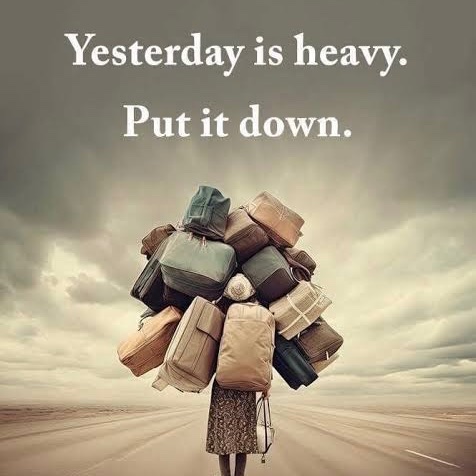
“If you carried a heavy bag of stones on your back for many years...
what would happen?”
The woman replied,
“My body would become exhausted and weak.”
The monk nodded.
“Your mind works the same way.
Every regret, betrayal, heartbreak, guilt, and painful memory you refuse to release becomes another stone you continue to carry.”
The woman asked,
“But how do I stop carrying it?”
The monk picked up a glass of water and held it before her.
“If I hold this glass for one minute, it feels light.
If I hold it for one hour, it begins to hurt.
If I hold it all day, my arm becomes numb and useless.
The weight never changed.
Only the length of time I chose to hold it.”
Then he looked at her and said:
“Your past is much the same.
The pain may be real...
but much of your suffering comes from holding onto it long after the moment has passed.”
The woman lowered her head quietly.
“But I don't know how to let go,” she whispered.
The monk replied:
“You let go by accepting that the past cannot be changed.
By forgiving yourself for who you were when you knew less than you know today.
By understanding that pain often teaches lessons that comfort never could.
And by realizing that you do not have to keep punishing yourself to prove that you have learned those lessons.”
Then he smiled and said:
“The past is a place of reference, not a place of residence.
Visit it only to learn...
never to live there forever.”
Sometimes healing is not about forgetting what happened.
It is about putting down the weight you were never meant to carry for the rest of your life.
✨🙌🏾💫
I've initiated a position in $IREN in the overnight markets.
A few hours ago, Google just told the world something important:
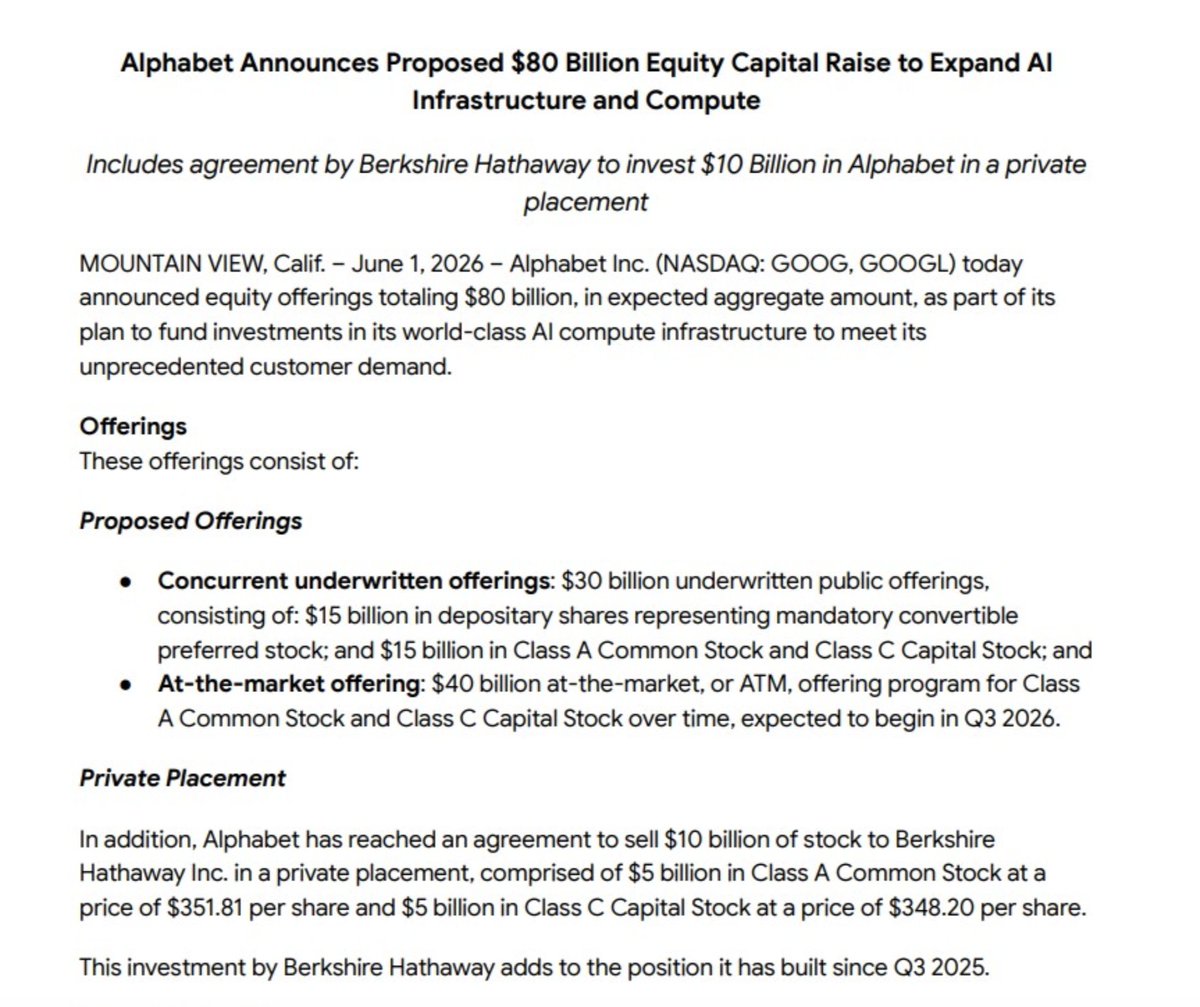
Demand for AI compute infrastructure has reached a scale where even $174 billion in annual operating cash flow isn't enough. They're raising $80 billion more in equity on top of $100 billion in existing debt just to keep pace.
Sundar Pichai said "compute capacity" is what keeps him up at night. "Be it power, land, supply chain constraints, how do you ramp up to meet this extraordinary demand for this moment?"
His answer? Raise $80 billion in equity. Dilute shareholders. Do whatever it takes.
They already raised over $85 billion in debt across six currencies in the last year. Total debt balance now over $100 billion. And now back for $80 billion more in equity on top of that. 2027 capex expected to significantly increase compared to 2026's $180 to $190 billion.
This is not a company managing a growth cycle. This is a company in a full sprint that cannot build fast enough.
And that money does not stay inside Google's walls.
It flows downstream into the neoclouds, the power holders, and the companies sitting in the critical path of every dollar they spend.
I initiated a position in $IREN today as the catch-up trade in this space.
Here's why:
- IREN just signed a five-year $3.4 billion AI cloud contract with Nvidia to provide managed GPU cloud services for Nvidia's internal AI and research workloads. On top of that, Nvidia was given a five-year right to purchase up to 30 million IREN shares at $70 per share -> a right to invest up to $2.1 billion. The broader strategic partnership targets deployment of up to 5 gigawatts of Nvidia DSX-aligned AI infrastructure across IREN's global pipeline.
- Nvidia chose $IREN as a strategic partner. That is not a small thing.
- The stock still trades at roughly $4 to $5 per watt while CoreWeave trades at $26 per watt and NBIS at $20 per watt. The big names already ran. $IREN is the catch-up.
Now the risk I want to be honest about:
IREN's buildout is heavily dependent on external capital. Between Nvidia's share purchase right and a $2 billion convertible note offering, dilution and debt servicing are real risks. The ATM program is still active. If the stock re-rates upward, dilution could act as a ceiling slowing the move. Eyes open on that.
But Google raising $80 billion to meet demand that is outpacing their supply is exactly the macro environment where $IREN's pipeline gets filled. That is the trade.
And the options market agrees. $50 million in premium just hit on $IREN calls at a $110 strike expiring January 2027. That is highly unusual flow. Smart money is positioning.
In summary:
- Google raising $80 billion to fund AI infrastructure is the ultimate bull-signal for neoclouds.
-I believe neoclouds are about to go on another heater.
On top of my $NBIS, $CRWV, $DGXX, $APLD, $KEEL, $CIFR, and $WULF positions... I think it's finally $IREN's time to play catch-up. The options flow seems to agree, with there being over $50 million in premium for the $110 calls expiring in January 2027.
Not financial advice. Do your own research. I have a position of 6,000 shares at a $63.70 average cost.
Anthropic engineer:
"You can build 5 assistants in one afternoon. Each one handles a task you've been doing manually every single day."
In 45 minutes he builds 5 focused agents from scratch on camera.
Most people are still doing code review, testing, and documentation by hand every single day
Watch the session, then save all templates below 👇
Your brain has a circuit that doesn't know you live in a city. Its only job is to monitor whether birds are still singing. When they stop, something dangerous is nearby. When they continue, the coast is clear. This wiring predates primates. These kids are being sedated by the oldest safety signal in the mammalian nervous system.
The Max Planck Institute tested this in 2022 with 295 participants. Six minutes of birdsong reduced anxiety and paranoia with medium effect sizes. Six minutes of traffic noise increased depression by the same margin. The effect worked on people who had never left dense urban environments. Their bodies responded to a signal their conscious minds had never learned.
King's College London ran a larger study. 1,292 participants, real-time mood tracking through a phone app, 26,856 assessments over three years. Hearing or seeing birds improved mental wellbeing for up to eight hours afterward. The effect held for people diagnosed with depression. Trees, plants, and waterways didn't explain it. The birds themselves were the variable.
Now here's where Italy connects to Finland. 95% of parents in the Finnish city of Oulu let their babies nap outside starting at two weeks old. A 2008 study confirmed the children took longer, deeper naps outdoors. Parents reported letting them sleep in temperatures as low as -15°C. 66% said their babies were more active afterward compared to indoor naps. The practice started as a public health initiative from Nordic maternity clinics in the early 1900s and became cultural infrastructure.
The Italian kindergarten in this video is running the same program the Nordic countries have been running for a century. Outdoor naps, natural soundscapes, no white noise machines, no blackout curtains. Meanwhile, American kindergartens have been eliminating nap time entirely to squeeze in more instruction. A UMass study showed that children who skipped naps forgot 12% of what they learned that morning. The nap itself was the learning.
The irony is that the countries spending the least on sleep technology for children are producing the best sleep outcomes. No sound machines. No apps. Just birds.
We are massively power constrained. This market, if functioning properly like every market before it, should be moving in the exact opposite direction.
20 years ago, Peter Costello delivered a budget that boasted no debt, a cash surplus, big tax cuts, and investment in a future fund.
There was no interest bill, and tax rates were falling fast because we were debt free.
This year, Jim Chalmers delivered a budget that boasted a gross debt of >$1 trillion, a $42.1b deficit, CGT, negative gearing and discretionary trust tax increases, plus deficits of $179.5b for the forward estimates.
Interest on debt is the fastest growing major payment in the budget.
From surpluses and tax cuts to trillion-dollar debt and entrenched deficits.
How fast we’ve fallen.
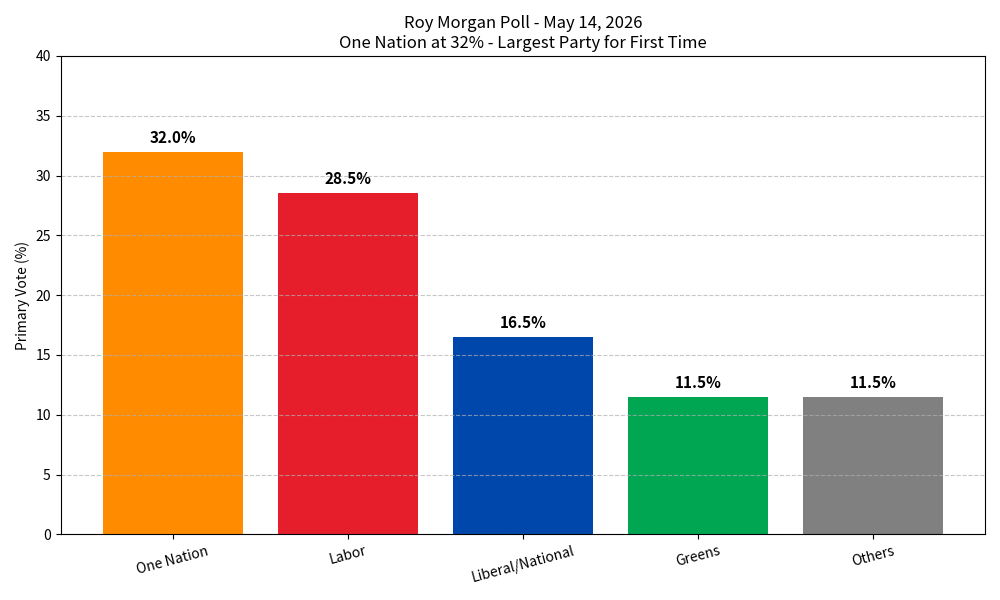
🇦🇺 One Nation just hit 32% in Australia's Roy Morgan poll, the first non-Labor/Liberal party to lead since World War II.
6 months ago they were at 6%. Insane.
🟠 One Nation - 32%
🔴 Labor Party - 28.5%
🔵 Liberal Party - 16.5%
🟢 The Greens - 11.5%
This is the Western anti-establishment wave hitting Australia. Immigration, cost of living, cultural anxiety. Voters are realigning.
The 2-party duopoly held for 80 years. It may not survive this decade, and it's a trend growing fast among many countries.
Source: Roy Morgan Research
15 psychologists who figured you out before you did :
1. Sigmund Freud — your unconscious is running the show, not you
2. Carl Jung — the parts of you that you hide end up controlling you
3. Abraham Maslow — you cannot find purpose before you find safety
4. Viktor Frankl — suffering becomes bearable the moment it has meaning
5. B.F. Skinner — your behavior is shaped by what follows it not what causes it
6. Albert Bandura — you become what you consistently watch and repeat
7. William James — your habits are literally rewiring your brain every single day
8. Ivan Pavlov — your triggers were trained into you long before you noticed them
9. Erik Erikson — every stage of your life has one question it needs you to answer
10. Alfred Adler — most of what drives you is the need to feel that you matter
11. Karen Horney — anxiety is not weakness, it is what unsafe childhoods produce
12. Leon Festinger — when your beliefs and actions clash, your mind will lie to fix it
13. Daniel Kahneman — you have two minds, the fast one makes most of your mistakes
14. Martin Seligman — happiness is not the absence of pain, it is the presence of meaning
15. Erich Fromm — the greatest human fear is not death, it is the freedom to choose your own life
Winston Churchill fought his depression with bricks. He'd lay them for hours at his country home in Kent. He joined the bricklayers' union. And in 1921 he wrote about why it worked. It took psychology another 75 years to catch up.
He called his depression the "Black Dog." It followed him for decades. His method for fighting it back was as basic as it sounds: laying brick after brick, hour after hour.
Churchill spelled out his theory in a long essay for The Strand Magazine. People who think for a living, he wrote, can't fix a tired brain just by resting it. They have to use a different part of themselves. The part that moves the eyes and the hands. Woodworking, chemistry, bookbinding, bricklaying, painting. Anything that drags the body into a problem the mind can't solve by itself.
Modern psychology now calls this behavioral activation. It's one of the most-studied depression treatments out there. Depression sets a behavior trap. You feel bad, so you stop doing things, and doing less means less to feel good about. Feeling worse makes you do even less. The loop tightens until you can't breathe inside it.
Behavioral activation breaks the loop from the action side. You schedule the activity first, even when every part of you doesn't want to. Doing it produces small rewards: a wall gets straighter, a painting fills in, a messy room gets clean. Those small rewards slowly rewire the brain. Action comes first, and the feeling follows.
Researchers at the University of Washington put this to the test in 2006. They studied 241 adults with major depression and compared three treatments: behavioral activation, regular talk therapy, and antidepressants. For the people who were most severely depressed, behavioral activation matched the drugs. It beat the talk therapy. A 2014 review of more than 1,500 patients across 26 trials backed up the result.
Physical work like bricklaying does something extra on top of this. It crowds out rumination, the looping bad thoughts that grind people down during the worst stretches of depression. Bricklaying needs both hands and gives feedback brick by brick: each one is straight or crooked. After an hour you can see exactly how much wall you built. No room left for the mental chewing.
The line George Mack used in his post, "depression hates a moving target," is good poetry. The science behind it is sharper. Depression hates a brain that has somewhere else to be.
Crazy how quickly red incandescents put people to sleep, especially children.
Last night my gf was babysitting a 4 year old at our house and within 5 minutes of me switching the lighting to red incandescents she went from being a ball of energy to tired and ready for sleep.
Take notes parents.