My conversation with Zcash’s 1000x engineers - Sean Bowe (@ebfull) and Jack Grigg aka Str4d.
0:00 - Project Tachyon
10:20 - Privacy can’t be an afterthought for a protocol
15:24 - Encrypted Bitcoin
22:11 - Soundness bug in original sprout pool
30:15 - Sapling
33:00 - A decade of progress
39:04 - Zcash’s anonymity set
51:29 - Using private money as a passthrough doesn’t work
56:04 - The importance of ledger indistinguishability
58:30 - The ultimate privacy stack
1:05:58 - Tachyon removes all cryptographic bottlenecks of encrypted money
1:08:16 - What’s next after Tachyon?
1:15:25 - Weightless blockchains?
1:18:24 - Ragu
1:19:44 - What the next 12 months look like for Jack and Sean
1:31:22 - “Everything worth doing is worth doing on ambitious timelines.” — Sean Bowe
1:32:16 - Sean’s advice for young engineers
1:34:18 - What got Sean and Jack into Zcash?
Why ZCASH? with @Cryptopathic
Featuring:
- The early days of ZCASH + why now
- Comparing and contrasting ZCASH and Monero
- Can ZCASH serve as a medium of exchange in addition to as a store of value?
- The future of ZCASH from a scaling and political perspective
imagine not allocating a small % of your portfolio to the coin that has bitcoin OGs scared shitless
$zec is what Satoshi imagined bitcoin would be
privacy is normal 🛡️
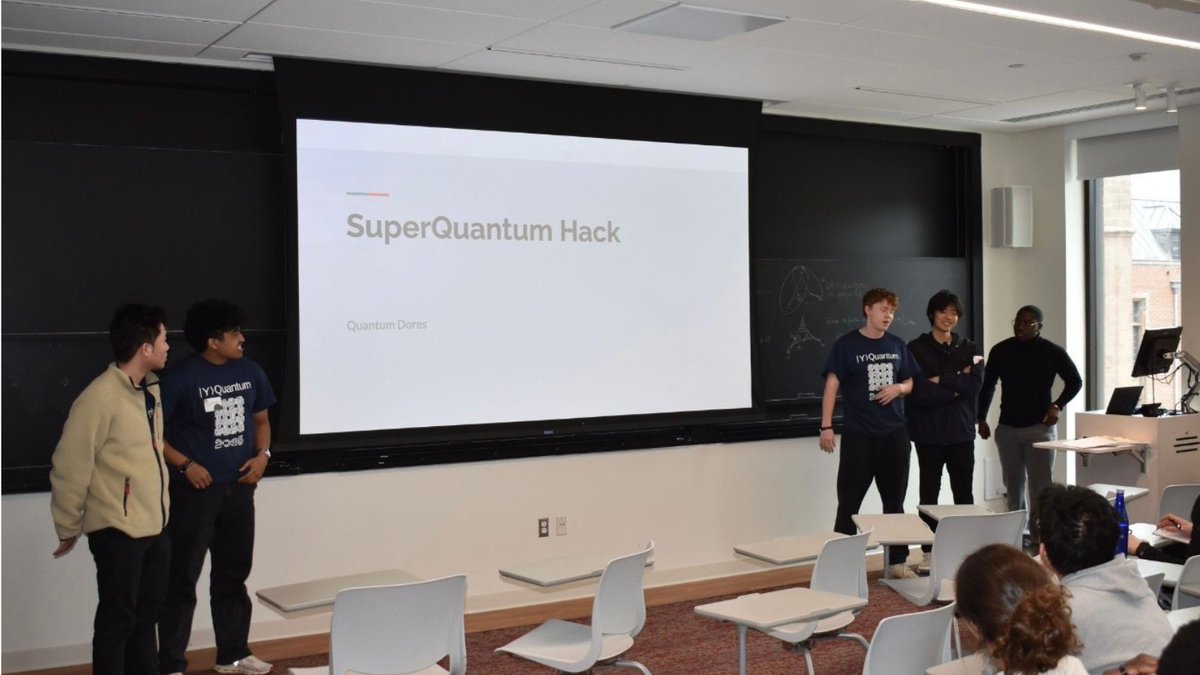
Throwback Friday: YQuantum 2025 at @Yale
At YQuantum 2025, Superquantum launched a hybrid challenge - both in-person at @Yale_QI and virtually for global participants - that asked students to rethink hashing through the lens of quantum computing.
Instead of traditional cryptographic puzzles, our challenge invited participants to design hash functions built on quantum principles.
The idea was simple but ambitious: explore how quantum circuits, especially those with parameterized gates and entanglement, can be used to generate deterministic, hard-to-invert outputs, just like classical hash functions.
Teams experimented with circuit layouts, used simulators, and even threw in some noise modeling to see how robustness might hold up in a real quantum environment.
Some leaned on established structures like quantum walks, while others ventured into more experimental territory, including entangled-state hashing and decoherence-driven randomness.
In the end, the creativity was off the charts.
We saw everything from highly structured hashes to chaotic, probabilistic schemes that still managed to stay verifiable.
The winning submissions balanced quantum complexity with classical verifiability, which is exactly the kind of thinking we hoped to achieve.
Big thanks again to all the students, mentors, and organizers who made this event possible - and congrats to our winning teams - QMers and Casekit!
The energy around quantum hashing was real - and we’re already thinking about what to challenge you with next.
It was good to connect and share expertise with our co-sponsors:
@QueraComputing@BCG@Alice__Bob@QuantumRingsInc@BlueQubitIO@CTquantum@rigetti@UConn@Yale@Yale_Ventures
@Zcash is the future encrypted version of Bitcoin.
You missed Bitcoin under $300… don’t miss this one.
The future of digital cash is privacy. 🔐
But let me guess — you won’t touch it now,
then you’ll cry when it keeps pumping. 🚀
$ZEC $BTC $ETH
It's an honor to have you as a customer @zooko. Thank you for all you have done for our industry and your pioneering work with @Zcash. This is still the world's most underrated crypto. One day the world will wakeup and figure out what the smartest OGs in the room already have.