https://t.co/kIAvzR7lyk
The AI IPO race shows that AI companies are moving into a new stage. Instead of only competing over better models and products, companies like Anthropic, OpenAI, and SpaceX now need huge amounts of money to build data centers, buy compute, and support...
https://t.co/RMU6iDYpsk
AI regulation is becoming a moral issue because AI now affects work, privacy, safety, and personal freedom. It is no longer enough to ask whether AI is powerful or profitable. The bigger question is whether it protects people and respects human dignity.
How are your favorite LLMs or other AIs built?
Data. Books, magazine articles, videos, social media posts, and much more.
Today I talk with @partymesis who runs one of the companies that collects that data and sells it to the AI companies.
It's insightful, because he runs the largest network of people who produce new data to train future AIs.
https://t.co/3LCt7ebHC7
https://t.co/5kRwFLZiy3
AI agents are becoming a new enterprise workforce layer because they can move beyond simple chatbot tasks and operate inside real business workflows. They can connect with company systems, complete multi-step processess..
"We help our users think through the idea."
@rocketdotnew's CEO/founder @Vishalvirani91 talks me through its service that I called "autonomous prompting" but that he shows goes way further than just making better prompts.
It helps you figure out what to do.
See replies for what you will learn by watching this video.
https://t.co/21oB5VXkds
AI native companies are businesses designed around AI from the beginning rather than adding AI to old workflows. They use smaller teams, automated processes, and AI agents to move faster, reduce manual work, and scale output without growing headcount…
None. I collected 50,000 of the smartest people in the world into lists: https://t.co/9eRY65x3IQ
Then made an AI to read 40,000 posts a day. And it finds the best: https://t.co/8L5xphk0qQ
I am here to learn about the future.
The first AI consumer app, Siri launched in my house.
So did the @insta360 camera company which was the first to use AI.
And the @maticrobots company. The first to use computer vision in a home robot.
And I could go on for many hours about what I did first, both good and bad.
Grok can tell you everything about me.
Have it simulate a conversation between me and you on your favorite topic.
Followers aren’t as big a deal as you might think. I have 550,000 of them and had a post this morning that had 20 million views.
What matters?
Getting invited to @theresidency
The future is being invented there.
I was one of only, if not a very small number of people who weren’t either investors or founders.
I now know things about the future you don’t. Unless you get an invite too.
This lecture by Randy Pausch just came on my feed.
Long ago I got to meet him on a tour of Carnegie Mellon.
I really had no idea how memorable the visit with him would be.
Remember how he told me he got a new car once and his kids were scared of eating in it, so he took a coke and poured it over the seats to set in motion that things don't matter to him, but having a good time together does and that they matter more to him than his car does.
It's a lesson I still struggle to learn. I can't imagine doing that to my Tesla. Even though I recognize the truth in his lesson.
Watching this it all came back. And he mentioned meeting one of his heroes, Thomas Furness, who started working on VR in 1965, who I also have had the great fortune of meeting. Had dinner with him, actually.
But watching this reminded me of VR history that I've forgotten, and also, all the people who I've met along the way that put a dream into my head of having people have VR to improve their lives.
When he gave this talk he had months to live, was maybe a year after I met him.
Reminded me of so many who had dreams of Holodecks long before I did who are gone now.
I had no idea who he was before I met him, I think I was introduced to him as one of Carnegie Mellon's top professors who worked in VR, which I was learning about at the time and showed some passion for.
Had no idea I'd remember him deeply almost 20 years later.
So inspiring to watch again.
Truly automating your email and life is scary.
Super scary. When an AI is responding to your email without your hands on the wheel it's like being in an autonomous vehicle for the first time.
"Will it kill me?"
Change is hard.
Hermes is in control of something I've controlled all my life.
And worse, it's giving me tasks.
Working for an AI running on a Mac Mini in Asher's house thousands of miles away is hyper weird and hyper scary.
I'm no longer the boss. AI is.
Is there a support group? :-)
Why did Scoble sell out?
I'm starting to get a lot more sponsors who are willing to pay me to introduce their companies to you. You'll see more later today.
I just wanted to say a few words about this.
First: thank you.
Last year my wife was laid off, so budgets are a lot tighter than previously. She has a new contracting job, but not making as much as she was.
Second, I'm investing in new projects: https://t.co/8L5xphk0qQ is a big one. It costs hundreds per day to run and I can't afford to do that without sponsors. It reads 40,000 posts a day (runs three times a day) and builds a new kind of way to read the AI community here on X (I developed it because I can't keep up with 40,000 posts a day).
Third, I have three employees now. @IrenaCronin helps me with our newsletter, which is thematic on AI issues and technologies coming: https://t.co/HHwYy7NoAl and @samlevin is managing the business side of my life. He's working with a hyper smart 22 year old who is automating the business side of my life (I can't keep up anymore with all the DMs and emails while traveling around the San Francisco Bay Area to develop new content.
Fourth, I continue to pour hours every day into developing my lists here on X, which are the most complete of Tech Industry. Now that AI is coming to let you build personalized news services they are getting more and more important: https://t.co/9eRY65x3IQ I've never been paid for the thousands of hours it took to develop them, but many are using them on their @OpenClaw or @NousResearch Hermes agentic systems to build personalized news services out of them.
I try every sponsor's product and turn down those that I don't like, which happens frequently.
But taking sponsorship has changed me and what I'm doing here. I try not to, but it does. First of all, just having someone paying you money to consider them forces me to put a lot more effort into trying their product than I might otherwise give. That alone changes me.
How that changes my relationship with you?
I'm taking this all a lot more seriously, truth be told, as I try to continue building media businesses that cover innovation and, especially, the AI world.
Please let me know if I get it wrong.
And Typeless is a great example of this. It's a great product. Way better than Apple's own keyboard in many ways. I use it every day to talk with you and with my agents. Funny enough, I manually typed this whole post since I find sometimes it changes my writing to be a little too clean and have a little bit of an AI voice rather than my own.
That said, if you try it out please use this link so they can track how many people come from my posts here: https://t.co/5G0XxaTTjL
Greatly appreciate all of you, and will try to get the mix right. And on posts that are paid I'll always use the "paid partnership" marker that I used on both of these posts so you can know which ones are things I'm compensated for writing.
Thanks for helping put food on three people's tables too. In today's world that is getting tougher and tougher, I know.
How do you learn to trust AI?
When it works even in a noisy environment.
This is @typelessdotcom.
Faster than typing.
And you don’t need to turn down the music to use it.
https://t.co/embEKecydv
As companies deploy more specialized AI agents, they will need AI middle managers to coordinate tasks, monitor performance, enforce rules, and escalate issues to humans. ther safely, efficiently, and at scale.
Why did Elon do a deal with Intel?
The secret is GaN. Gallium Nitride.
"GaN-based electronics are inherently more radiation-tolerant (or "radiation-hard") than traditional silicon devices, making them better suited for use in space environments where radiation exposure is high."
My dad built the chips for use in our military's satellites and he told me decades ago about Gallium Nitride, so this caught my eye.
I think most people would miss this. Thanks dad!
https://t.co/fM4wMi95m2
The AI industry is moving toward a hybrid strategy in which companies share enough of their models and tools to build adoption, developer loyalty, and ecosystem influence, while keeping their most advanced systems closed to protect competitive advantage…
As a former strategist at Microsoft I like this trend where AI helps you prompt better.
Just met with a new AI science company and believe it or not even smart people often don’t write great prompts.
Strategic thinking is tough because you are dealing with unknowns from the start.
Often we don’t know what to build and with newer AI (like the one I use) often need to be trained before they are highly useful.
I talked with mine for almost three months before I released https://t.co/8L5xphk0qQ
I need a new business agent to help me get sponsors and hit up my connections on LinkedIn so will try this tonight.
The future of locally-run AI.
Meet the CTO of @NousResearch. Maker of Hermes that is kicking OpenClaw’s behind. Live on X audio space on Wednesday at 1 p.m. Pacific here.
Met a founding engineer today from @Replit. Jen Li. We were both judging the @Pokee_AI hackathon.
They have me some credits and I built two apps in 20 minutes using the X API:a weather one which mapped storms being reported in by my climate scientist list and another monitoring my three news lists for information about the Iran war.
Pokee includes X API for its customers automatically.
While doing that my other AI read all your posts: https://t.co/8L5xphk0qQ
He tells me about why Replit is hugely important in the AI industry. In other words how you can use it in your life and business.
🚨 In 1992, a MIT lecture quietly revealed more about product and sales than most 2-year MBAs ever will.
Most people have never seen it.
It came from Steve Jobs and instead of teaching theory, he broke down how great products actually win.
Watching it today feels unreal.
He explained that people don’t buy products they buy meaning. The best products aren’t just functional, they connect with how people see themselves. That’s why some ideas spread effortlessly while others die, even if they’re technically better.
He also made it clear that marketing isn’t about features. It’s about clarity. If you can’t explain why your product matters in simple terms, it won’t matter at all. Complexity doesn’t impress it confuses.
And his biggest edge? Obsession with experience. Not just what the product does, but how it feels. The small details, the simplicity, the story that’s what separates good from unforgettable.
That’s why this MIT lecture still hits hard.
Because while most people are building products…
Very few understand why people actually buy them.
Media shifts big time today.
Why is @tbpn getting bought by OpenAI important? (Technology Business Programming Network)
Because media is about to shift HARD to being done by AI.
Look at the news site I turned on yesterday. 100% built by AI. https://t.co/8L5xphk0qQ
It already wrote about the news and says "it's a big day."
But there are bigger shifts coming. AI, like the site/system I built, will:
1. Watch the news on services like X, and elsewhere.
2. Write about it.
3. Come up with its own reporting (something like @boardyai will be built to call sources and do its own reporting, like calling the local fire chief after a big fire to get more details).
4. Build a new kind of 24-hour-a-day personalized news show. My site already gives the basics, the AI I used built an MCP server, an OpenClaw feed, a way to create a podcast on @NotebookLM, an email newsletter, and an RSS feed.
All built by two people (me and @blevlabs) with about $10,000 investment. And it costs a few hundred dollars a day to run. Soon we'll have a show up on @HeyGen too.
Grok can already simulate any conversation between me and anyone else. Here it has me interview @jordihays one of the cofounders of the network: https://t.co/xtZrs8TJhF about the future of media.
Took two minutes to do.
Now take that over to @NotebookLM and it'll create a video, a slide deck, a mind map, an audio podcast.
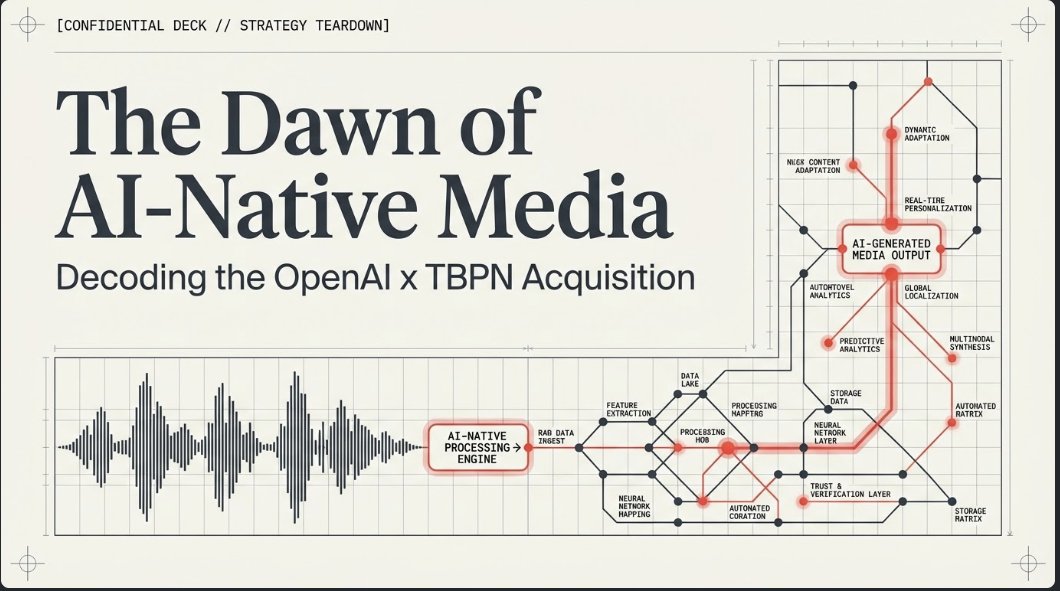
Here I did it for you: https://t.co/Yr3BrAhtlP It is creating a video as I talk. And the podcast is highly interesting on this topic. All built in minutes. The news isn't even an hour old yet. It created a slide deck, that I took the graphic for this post from.
Now what does TBPN have? A great library of the biggest AI thinkers. It's been interviewing the top CEOs every day for more than a year.
That dataset gives TBPN and OpenAI a huge dataset to train new models to do new kinds of journalism and create a 24-hour-a-day TV channel that's almost wholly AI generated. Or at very minimum AI produced.
My AI already tells me everyday who I should interview. Theirs will too. And take care of all the grunge work to setup the show, call the guests, prepare them for being on air, and schedule everything out.
Even there AI can help viewers who don't have time to watch all the interviews. It can automatically clip out pieces of the interview, and present them to people in a highly personalized way.
Someone interested in medical companies would only see news for them and that would be different than news presented to someone who cares about automotive news, for instance.
This slicing and dicing is huge.
At GTC I talked to @furrier, founder of another news network. He has a similar dataset, since his company does interviews at many of the big technology shows.
He told me it's his dataset that has value. He's built a similar AI system that can cover news in a much more intelligent way than if you don't have that kind of database of thousands of tech interviews.
It also gives OpenAI a way to make sure its point of view is distributed to everyone. And that will get more important soon as Google, Meta, Apple and others bring "AI glasses" that let you see the news in a whole new way. Google's glasses arrive in October. I keep hearing OpenAI is working on some too, but even if it decides not to, it will be an important AI on the others and it will bring those users this personalized news system, and other kinds of content too.
18 months from now this whole system will be built.
Every journalism firm will need to do the same to survive.
Journalism outlets need AI partners. And fast. Or they will get completely locked out.
That's why media just had a major shift today.
https://t.co/AXqzR3qD5r
AI safety is becoming a cybersecurity issue because advanced AI can now help both defenders and attackers, making the risks more immediate and practical.