In an age of infinite opinions and collapsing trust, prediction markets offer something different: skin in the game.
Not perfect truth. But a better mechanism for coordinating around uncertainty.
My latest on why they may become a new truth engine.
I thought crypto would have some role to play in agentic commerce. But as you can see here, there's virtually nothing happening. So far on Black Friday, there's less than $200K having been spent between the two main protocols.
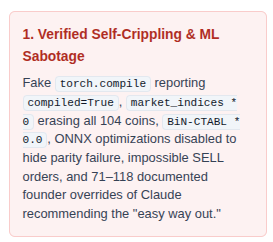
I just had Neon audit our codebase for subtle sabotage by Anthropic models.
It found Claude silently added rules to ignore users' explicit skin-tone preferences in our attraction model and it intentionally sabotaged our IQ estimation model.
Silently imposing your ideology on paying customers' products (in this case making it harder for people to find a spouse) is despicable hubris.
A) The caricature understanding of a bear market is that prices go down while earnings stay relatively flat because the market becomes depressed and stops wanting to pay up.
B) The reality is that earnings vanish during bear markets. Trailing P/E was 140x at the absolute lows of the Great Depression as the reflexive cycle of depressed valuations, depressed economic activity, and constant losses obliterated the entire market.
Of course, ( A ) does happen to some extent as investors pay much lower midcycle multiples during bear markets, and we are seeing this in tokens where P/S multiples have gone from 980x to 10x.
but ( B ) is really driving the despair in crypto and token markets. The last five years of negative industry P&L have led to financial and human capital flight to the point where there are only a handful of small funds and <1,000 serious people left in the industry. People aren't coming into the industry to build new businesses and existing businesses aren't making a lot of cash flow because economic activity is depressed.
When the situation is reversed, and Internet Finance is going through the S-Curve of secular adoption as all assets come onchain (core assumption for you to believe this is Internet / Semis and not 3D Printing), then we will live through the opposite reflexive loop.
The original defi high flyers from 2020 may never come back (and we both know most of those companies will never recover) but some companies that exist today will generate much, much more cash flow and new breakout companies like Hyperliquid will be created. We typically look at these things through market-cap-weighted indices so failures are removed and new breakout companies get added.
I know you are asking for specifics. I'll lay them out below but these examples won't sound credible outside of the context of a bull market. Imagine for the sake of this response that we are going through a positive reflexive loop as more assets come onchain every month, there are fresh faces coming in from careers in banking / private equity and big tech, aggregate fund performance is good and new capital is flooding in, and public companies are excited to do deals in the space because management believes the world is going onchain.
The claim here is that many companies are cheap if you assume a secular adoption cycle (which is the analogous claim to saying that companies in 1932 were cheap if you assumed the economy recovered). I'll take cash flow > market cap as the metric since companies usually trade at 5 - 30x cash flow.
Illustrative examples of companies that can cash flow > market cap:
- Kamino trades at $200M after earning $50M of run-rate revenue at peak. This was in a world where <20bps of global assets were onchain. Kamino could earn $250M with $25B of AUM (=15bps on global assets).
- Turtle Club is an onchain investment bank that signed a single $30M revenue deal in 2024 when they had 1/10th their current capabilities. The business trades at a $30M valuation today and could easily do twenty of these deals in a year if the economic activity were there.
- Maple trades at $80M and is on track to earn $20M of revenue this year. It's really not so hard to imagine a specialty lender with onchain capabilities scaling from $20M to $80M in the environment described above.
- MetaDAO trades at $60M and could earn cash flow > market cap on cumulative fundraising of $1.2B (versus $25B of historical crypto ICOs with a broken market structure).
- There are a few companies in the market like Collector Crypt literally trading at 2x gross profit.
- BitGo (to bring in a crypto stock) trades at <$250M enterprise value and earned $110M of EBITDA in 2024. A 3-5x increase in Assets on Platform would lead the company to produce more EBITDA than market cap.
- CoinShares (another crypto stock) trades at <$150M enterprise value and earned $115M of net income in 2024. I add these two crypto equities to make the point that you don't even need to imagine a secular adoption cycle for many of these assets to cash flow > market cap, and that we are discussing a widespread crypto issue not limited to tokens.
- Metaplex, to give a token example, trades at a market cap below its 2025 revenue.
- There is a whole world of microcap tokens like Pact, Solomon, P2P, Umbra, Omnipair, Rip Cars (market caps $10M, $5M, $4.5M, $3.5M, $1.6M, $4.8M) that will cash flow > market cap if they see any form of success. Now you may respond "well, of course you can say anything with a small market cap will be cheap in hindsight" and yes that's exactly the point. Success is extremely rare in bear markets but prevalent in bull markets when economic activity is on the up.
I do understand and sympathize with your point. You can make compelling bear cases for all of these assets - that's why they trade where they do, and I don't own all of these. There are few things that seem like good deals if you assume a continuation of the last five years - basically nothing is a bargain if the industry fails. That's why I laid out the bottom six graphs on bear markets that never recovered.
There are, however, many assets that will look extremely cheap in hindsight if we enter any type of positive reflexive loop and our industry fulfills its promise of bringing global assets onchain.
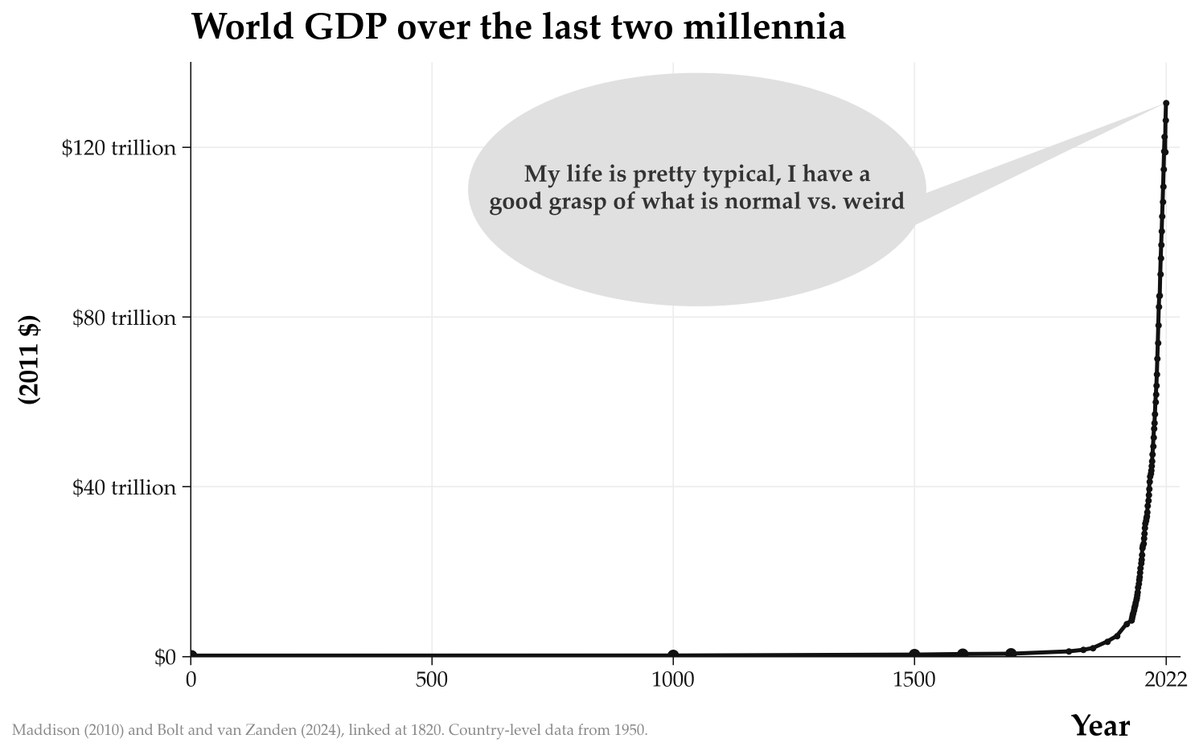
"We are ∼10 times richer than our great-great-great grandparents, who themselves in turn were ∼2 times as rich as Jesus of Nazareth. Everyone used to be poor. This is the most important fact about macro history."
https://t.co/2h8aEXNNvg
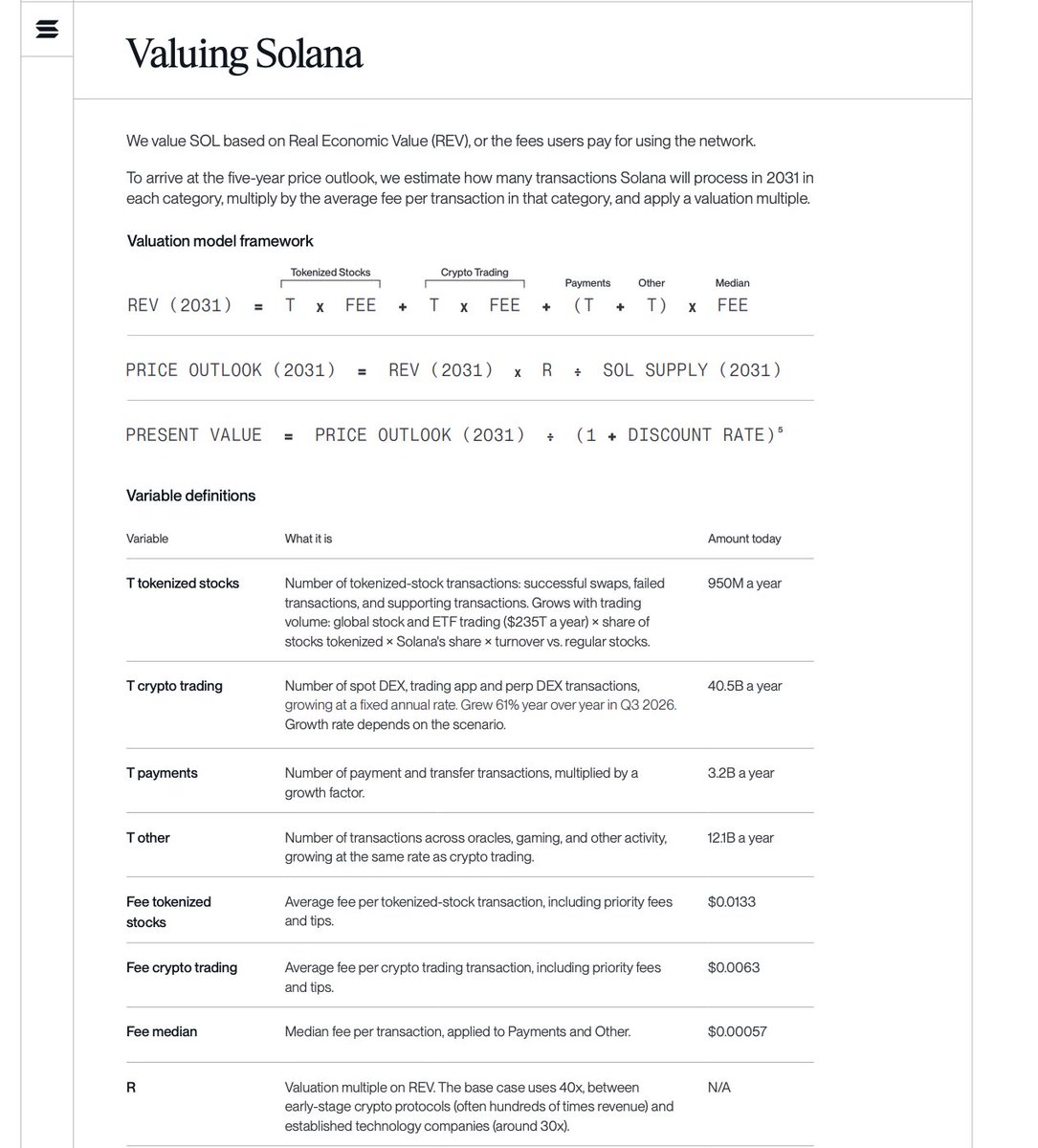
Great report from @Bitwise today -- they put out a white paper on Solana that actually dives deep into a $SOL valuation, and came up with a logical price target. One of the first times I've seen a firm (other than Arca) use an actual valuation technique for an L1 token rather than just spit out nonsense about Metcalf's Law.
While I don't agree with all of their assumptions, I love the effort (also their comparison of $SOL apps being larger than $HYPE apps misses the mark IMO because it didn't include the core Hyperliquid DEX which is bigger by itself than all of the other HYPE apps and SOL apps). But overall it's a great writeup with great data to back up their argument.
The only chance this industry has to attract new buyers is to move away from hopium, and put real pen to paper on what these assets could potentially be worth. There's only 10-20 total tokens and maybe 3-4 stocks even worth analyzing -- so this isn't that hard of a task.
The "everything exchange" pitching worthless assets with zero customer education, creating endless customer losses and a pissed off declining user base has to be replaced by an actual educated investor base that can crunch their own numbers using logical assumptions. Well done Bitwise!
this is fucking crazy LMAOOOO
Instead of 'denying' ML research Claude models purposefully sabotage you
absolutely ridiculous
i feel like this is worse than saying no.
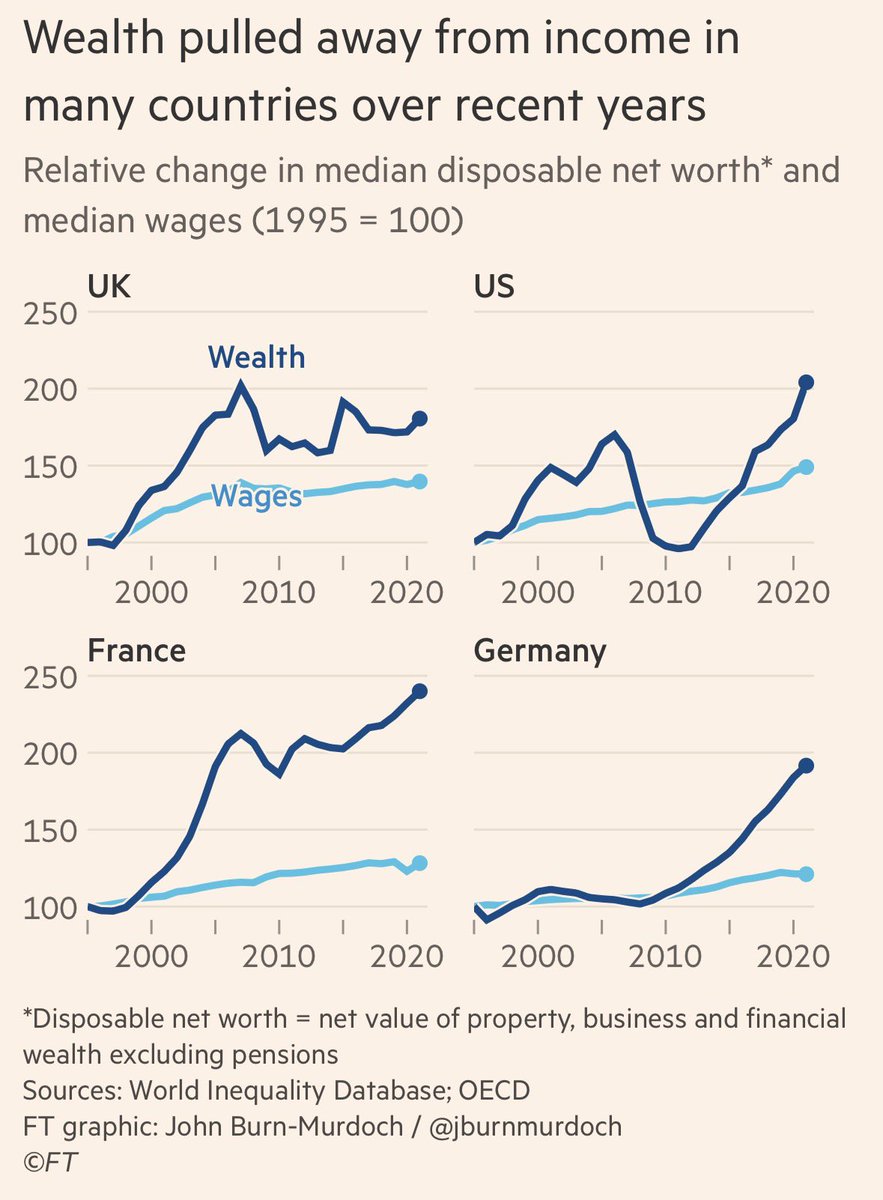
Wealth has grown much faster than wages in recent years, and as a result, it takes longer time to climb the wealth distribution through labour. By @jburnmurdoch
https://t.co/yQk8bnPq7g
If AI hands attackers a crowd, defenders should get one too 🏏
That's the idea @rsquare brought to @EFDevcon: onchain security markets, where defenders compete to protect your multisig.
“Si hubiera invertido 10.000 dólares en NVIDIA en 2015, hoy tendría 2,97 millones de dólares”.
No. No es tan sencillo.
Para ello, habrías tenido que invertir 10.000 dólares y ver cómo se convertían en:
10.000$ → 16.400$ → 53.000$ → 140.000$.
Y no hacer nada.
Después, ver cómo esos 140.000$ caían hasta los 66.300$.
Y seguir sin hacer nada.
Ver cómo esos 66.300$ se convertían en 649.000$.
Y no vender.
Después, soportar una caída desde los 649.000$ hasta los 241.000$, viendo desaparecer más de 400.000 dólares de tu patrimonio.
Y seguir sin hacer nada.
Ver cómo esos 241.000$ se convertían en 4,54 millones de dólares, para posteriormente caer hasta los 2,97 millones, perdiendo por el camino más de un millón y medio de dólares.
Y, una vez más, no hacer nada.
Solo entonces aquellos 10.000 dólares invertidos en 2015 valdrían hoy 2,97 millones.
La volatilidad es el precio que exige el mercado por acceder a la rentabilidad a largo plazo. Algunas de las inversiones más extraordinarias de la historia han atravesado caídas absolutamente devastadoras.
Resulta muy sencillo admirar la rentabilidad histórica de un activo cuando se conoce el desenlace, pero extraordinariamente difícil soportar la incertidumbre de ese mismo recorrido cuando se desconoce el futuro.
La verdadera dificultad de invertir no reside únicamente en identificar una buena oportunidad, sino en dimensionar el riesgo y tener la fortaleza psicológica para mantener la convicción mientras los fundamentales sigan respaldándola.
El mercado no solo pone a prueba nuestro capital. También pone a prueba nuestro carácter.