CS PhD | Skilled Software Engineering with a growing passion for applying machine learning in Computational Fluid Dynamics (CFD), LLM to complex problems
I'm proud to be a Kaggle Competition Expert, ranking in the top 0.5% of over 203,000 users! I achieved this with two Bronze Medals from competitions hosted by Google and major energy company Enefit.
My Kaggle profile: https://t.co/DzLjYsf0Zr
HydroGym: A Reinforcement Learning Platform for Fluid Dynamics
Now published in Nature!! https://t.co/o1zTn2DIHg
GitHub: https://t.co/9MLBzJAMiJ
Amazing collaboration with Christian Lagemann, S Mokbel, M Gondrum, M Rüttgers, Y Wang, P Suárez, L Paehler, D A Bezgin, A B Buhendwa, J L Callaham, S Ahnert, N Zolman, X Shao, J-Ch Loiseau, N A. Adams, M Meinke, W Schröder, K Lagemann, E Lagemann, R Vinuesa & S L Brunton
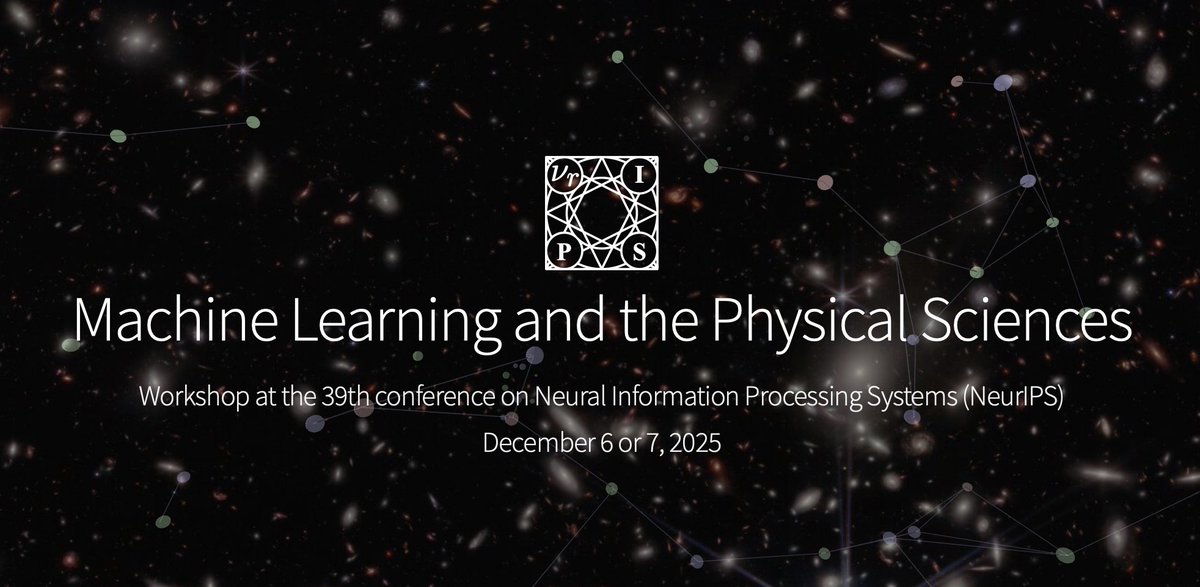
🎉 Great news: Our Machine Learning and Physical Sciences workshop at @NeurIPSConf will be back again this year! 🎉
Keep an eye out for updates on deadlines etc, we will be updating the website soon
https://t.co/fBA3vhEBKc
#ML4PS2025@ML4PhyS
Is anyone experiencing github sending webhooks with unexpected TLS version numbers?
Today our webhooks started intermittently failing to send to our nginx instance... it's all a bit odd.
#github#webhooks
Happy to announce that our book, 'Digital Technologies for Sustainable Futures: Promises and Pitfalls', co-edited with @chiaracertoma & Federico Martellozzo, is now available for pre-order from @routledgebooks.
More details and the table of contents at: https://t.co/xmdMNsLFM5
Looking forward to my @TEDTalks on building #AI with universal physical understanding. Excited to announce our recent works building the foundations for such a model.
Language models have shown impressive capabilities with universal text understanding capabilities, but they are not enough for science and engineering tasks since the ideas that they propose still need experimental validation, which is expensive and time consuming, and usually the biggest bottleneck. We can overcome this by training AI models that can simulate physical phenomena and generate novel designs in a physically-valid manner.
Partial differential equations (PDE) form the foundation for simulating many physical phenomena and we have shown AI models, Neural Operators, to be their universal approximators. Using Neural operators to solve PDEs has been shown to achieve 4-5 orders of magnitude speedups over numerical simulations while maintaining accuracy. This has previously been applied for weather forecasting, nuclear fusion, fluid dynamics and catheter design. Our recent @NatRevPhys article https://t.co/ewJSOIkyvL provides an overview. But so far, the AI models are mostly limited to a narrow domain and trained on data from that domain.
LLMs have proven that training one large model for a wide variety of tasks is not just successful at solving those tasks, but outperforms custom narrower models at those tasks. We now show a similar result for physics-AI models solving PDE tasks: a model pre-trained on a multitude of them doesn't just solve the different tasks but outperforms models trained on those individual tasks.
We propose two frameworks: (1) an auto-regressive Denoising Pre-training Operator Transformer (DPOT) and (2) Co-domain Attention Neural Operators (CoDA-NO) for multiphysics PDEs. Together, they allow us to handle diverse set of PDEs and coupling of multiple PDEs needed for multiphysics.
DPOT is the largest foundation PDE model (0.5B) to date, achieving state-of-art accuracy. We collect massive PDE data, including more than 100k trajectories from more than ten datasets consisting of diverse PDEs, such as Navier-Stokes equations, diffusion-reaction equations, and shallow-water equations, with vastly different properties. We design an auto-regressive denoising pre-training strategy by injecting Gaussian noise into training data. By predicting the next time step using noisy inputs, we show robustness and generalization in downstream tasks.
CoDA-NO builds a foundation model from a different perspective: ability to easily couple multiple PDEs to solve multiphysics problems. It tokenizes functions along the codomain or channel space, enabling self-supervised learning on multiple PDE systems. We extend positional encoding, self-attention, and normalization layers to the function space. CoDA-NO can learn representations of different PDE systems with a single model. On complex downstream tasks with limited data, such as fluid flow simulations and fluid-structure interactions, CoDA-NO outperforms existing methods on the few-shot learning task by over 36%.
There are several challenges here, and it is not as straightforward as image and text models mainly due to the complexity and diversity of different PDE tasks. First, different from images and text, PDE datasets require the ability to train and test at different resolutions. To solve this, neural operators were developed which learn mappings between function spaces and can be discretized to any grid or resolution.
Second, different PDEs exhibit significant variations in dimensions, number of temporal steps, resolutions, and geometric configurations. Further, different types and cases of PDEs have their own regularity and numerical ranges. This diversity necessitates the model and the pre-training strategy to be flexible to handle diverse inputs and scalable in its representational capacity to generalize to unseen data.
Papers: https://t.co/zvELjwLhCq https://t.co/UnC6vqqxpN
Code: https://t.co/U8oqnHRKLw
@julberner@Ashiq_Rahman_s@Robertljg @ZongyiLiCaltech @crwhite_ml@RaymondYeh@JeanKossaifi@Azizzadenesheli@caltech
CS159: LLMs for reasoning lecture slides from Caltech are really good. Link: https://t.co/cqQrAHa4Kg
Thank you for making them public @yisongyue and @acbuller
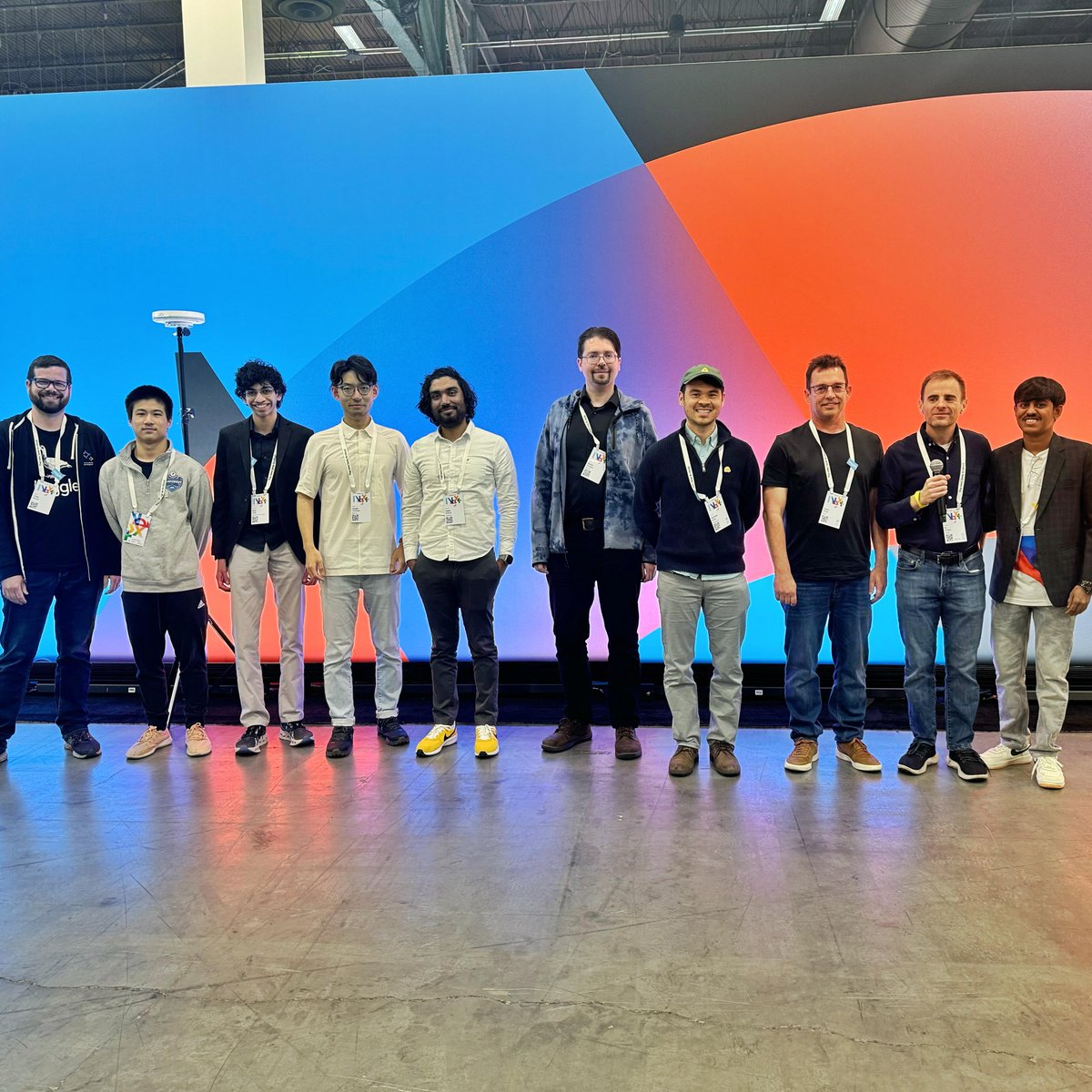
🎉Congratulations to the winners of the in-person NEXT 2024 Hackathon competition at #GoogleCloudNext! 👏
Learn more about the competition here: https://t.co/WTGH5TSOMd
Probably the most surprising thing I've seen this week -- and I'm a few years late on this -- is that `printf` is Turing complete https://t.co/0vRsLaS1WZ
I don't know if/when the world will truly wake up to the sustainability problems inherent in the open source software we depend on, but sensible, mainstream, articles like this are surely a necessary step towards wider understanding. https://t.co/R55yMsTCEN
AI with Fourier Neural Operators speeds up Plasma modeling in Nuclear fusion by a million times
Predicting plasma evolution within a Tokamak reactor is crucial to realizing the goal of sustainable fusion. A big challenge are disruptions that occur when the plasma gets unstable and can damage the reactor. Coming up with real-time prediction methods to accurately predict disruptions is crucial.
FNO has a speedup of more than a million times over traditional solvers in predicting the plasma dynamics simulated from magnetohydrodynamic models, while maintaining a high accuracy.
FNOs can also predict plasma evolution on real-world experimental data observed by the cameras positioned within the MAST Tokamak, i.e., cameras looking across the central solenoid and the divertor in the Tokamak. We show that FNOs are able to accurately forecast the evolution of plasma for real-time monitoring. @mistervickster@LorenzoZanisi @ZongyiLiCaltech @niteshbhatia@UKAEAofficial
https://t.co/fqamL0YxtH via @ioppublishing
@EdwardSun0909 Relying on human data for AI model alignment presents a significant challenge, because of insufficient human data and inaccuracies due to human error. Awesome article addresses this issue!