Genetic studies show the Armenian gene pool has deep local roots in the Armenian Highlands. Maternal lines (mtDNA) display continuity for about 8,000 years. Autosomal DNA indicates substantial continuity with ancient highland populations for over 6,000 years. Major admixture occurred in the Bronze Age (~3000–2000 BCE), after which the population remained relatively isolated for the last ~3,000 years with minimal later external input.
@0FedKin@JoshuaBarzon Clearly it’s still inaccurate information. Turkey is never mentioned in the bible, it didn’t even exist back then. So why would its name be included in this “map of nations mentioned in the bible?” A more accurate map of the time period is needed. Clearly.
@Hashim__Butt@grok Hey Ethan, why do you make posts with fake, inaccurate maps? azerbaijan is not that big, and this fake map shows it covering the entirety of the country of Armenia.
Who paid you to use this fake map? Or are you a bot? Shameful. What world do you live in?! Stop spreading misinfo
The denial of the connection between Armenians and Hayasa has a political undertone.
The name Hayastan, as commonly believed, appeared in the 6th century BCE. The state that existed in the same place before was called the Kingdom of Van or Urartu. Why do Armenians want to be deprived of their indigenous rights in the Armenian Highlands?
After the collapse of the Kingdom of Van, known as Urartu, it disappeared, and almost immediately in its place emerged the familiar Hayastan, which has been called by that name for at least two and a half thousand years.
Furthermore, to the north of Mesopotamia, in the 3rd millennium BCE, there was a state called Aratta among the Sumerians. It is noteworthy that in the Septuagint translation of the book of the prophet Jeremiah, the kingdom of Ararat, i.e., Armenia, is mentioned specifically as the “kingdom of Arate.” Not only does Aratta clearly resemble Ararat, but there are ancient sources that explicitly provide the name. An even more interesting story is associated with the name Hayasa. It was not discovered through archaeological excavations but through the translation of the Hittite Empire’s library.
In 1905, in central Turkey, 150 km from modern Ankara, the German orientalist-assyriologist Hugo Winckler (1863-1913) discovered a large number of tablets in the modern village of Bogazkoy, the site of the former Hattusa, the capital of the Hittite Empire (the self-designation of the country was Hatti). The tablets were written in Akkadian cuneiform, already known to European scholars, but they were in an unknown language. Here is an important point: researchers could easily read the Hittite script, but they completely did not understand their ancient and long-extinct language.
The decoding of the Hittite language was undertaken from 1915 by Bedřich Hrozný, a young Czech assyriologist who later became well-known. Hrozný transcribed the cuneiform text into Latin script and hypothesized that the Hittite language was an Indo-European language. And he was right. He began translating by analogy with words from other Indo-European languages. When a certain word resembled something in known languages, its meaning was established based on that resemblance. Soon, Hrozný was able to read the rich royal archives of the Hittite capital.
These documents mentioned that during the Hittite Kingdom (around 1800-1180 BCE), there existed a state called Hayasa in the territory of the Armenian Highlands. It thrived for a millennium before Urartu.
Hayasa or Hayasa-Azzi (Hayasa-Atti) was mentioned in Hittite cuneiform texts from the 16th to 13th centuries BCE.
During this period, Hayasa sometimes made peace with the Hittite Kingdom and paid tribute, formed alliances, and even provided troops, but at times engaged in military conflicts with them. For example, Anniyas or Ananiah, the king of Hayasa in the 1340s-1310s BCE, waged fierce wars against the Hittites and inflicted defeat after defeat upon them. Most Hittitologists place Hayasa in the headwaters of the Chorokh and Euphrates rivers, within the territory of the Armenian Highlands. However, its eastern boundaries are not precisely known. Naturally, the Hittites wrote about events on the western borders of Hayasa, as that was where it bordered the Hittite Empire. They were less interested in the affairs of their neighbors in the eastern and distant regions.
Historians believe that the capital of Hayasa was the city of Kummaḫa (later Armenian Kemah), located in the headwaters of the Euphrates River, near the modern city of Erzincan (Armenian Erznka). It is worth noting that this is a quite unique situation where the Hittites actually used the name of the country that, apparently, the inhabitants themselves used. In other words, the Hittites did not adopt foreign names or exonyms but used the self-designation or endoethnonym of their own neighbors. This is rare since exonyms and ethnonyms of countries usually differ, as in the cases of Deutschland and Germany, Greece and Hellas, Japan and Nippon, and so on.
However, a paradoxical situation arises here. It turns out that before the emergence of the Urartu kingdom, there was an older state in the same location called Hayasa, frequently mentioned by the Hittites. But one does not need to be Armenian to know that the modern and ancient name of the country for the Armenians themselves is Hayastan or Aystan, used since the disappearance of Urartu, i.e., from the 6th century BCE. As they say, feel the difference: first, in the mid-2nd millennium BCE, Hayasa, then Urartu, and after the collapse of Urartu, Hayastan. Any objective historian, knowing the name by which modern Armenians refer to their country, will notice the obvious similarity with the name from Hittite archives.
Therefore, it is quite natural that in the first half of the 20th century, some European researchers speculated that the root “haya” (hayа) in the word “Hayasa” corresponded to the self-designation of Armenians, “hay,” and that the suffix “(a)sa” was a Hittite suffix meaning “land” or “country.” This theory was first formulated by Swiss Assyriologist and the first Hittitologist, Emil Gustav Forrer. It was further developed by German philologist Paul Kretschmer. In 1933, the Austrian Academy of Sciences published Kretschmer’s work “Der nationale Name der Armenier Haik” (“The National Name of the Armenians Haik”), where he concluded that the name “Hayasa” mentioned in the Bogazköy inscriptions meant “Armenia.” Later, this viewpoint was supported by Nikolay Adonts, Grigor Kapantsyan, Rafael Ishkhanyan, and other historians in Armenia. Gevorg Jaugayan wrote about this: “The primary language of Hayasa was Armenian, and the Armenian element played a dominant role in the Hayasan state.” It seemed logical and understandable to everyone.
However, in the second half of the 20th century, a strange struggle began among historians where attempts were made, under the guise of scientific discussion, to detach Hayasa from Armenian history and consequently deprive Armenians of their past. Even during the late Soviet period, prominent Soviet scholars participated in this dispute. In the early 1980s, Igor Mikhailovich Diakonov, a renowned historian, orientalist, and linguist, suggested that the self-designation of Armenians in Classical Armenian (grabar), Հայք (hay-kʿ), likely derived from the Urartian name for the city of Melitene, Urartian Ḫāti. In response to this, Vyacheslav Vsevolodovich Ivanov, a famous linguist and academician of the Russian Academy of Sciences, co-author of the Gamkrelidze-Ivanov hypothesis (Armenian hypothesis of the Proto-Indo-European language origin), stated the erroneous nature of all of I.M. Diakonov’s constructions regarding the origin of the ethnonym “hay” and other questions of Armenian ethnogenesis, and supported the correctness of G.A. Kapantsyan’s conclusions.
Diakonov was a proponent of the view that the ancestors of Armenians migrated to the Armenian Highlands from the west, from the European homeland. In 1968, he published his research on the ethnogenesis of Armenians titled “Proiskhozhdeniye armyanskogo naroda” (“The Origins of the Armenian People”), where he argued for a migration-mixed hypothesis of Armenian ethnogenesis. Vyacheslav Ivanov, who, together with Tamaz Gamkrelidze, put forward the hypothesis of the Proto-Indo-European language origin, rejected I.M. Diakonov’s assumptions on several questions of Armenian ethnogenesis as erroneous.
Modern researchers assert that I.M. Diakonov’s hypothesis on the proximity of Greek and Phrygian to Thracian and Armenian, proposed in the 1960s, has not found confirmation in science. It must be said to the credit of Diakonov himself that by the end of his life, he acknowledged the erroneous nature of these views and expressed his opinion on the localization of the Proto-Indo-European homeland around 6000 BCE in Anatolia, from where they migrated to the Balkan-Danube region. In other words, he came to the conclusion that the movement of ancient peoples was in the completely opposite direction, not from west to east, but from east to west. However, even today, there are still Western historians who continue to defend similar views that have already been rejected by many scholars and deemed unsubstantiated. Debates continue over the location of Aratta, as well as the ethnic composition of Hayasa and Urartu and their role in the origin of Armenians.
According to contemporary historian Armen Ayvazyan, the denial of the connection between Armenians and Hayasa is politically motivated and aims to deprive Armenians of their right to indigenous status in the Armenian Highlands.
It is widely known who stands behind such denial and who benefits from it. However, another question is of interest: how much longer will this struggle continue, and when will representatives of science stop arguing about the obvious? Nevertheless, as Armenians humorously paraphrased the famous aphorism of the Roman historian Livy, “The truth may be obscured at times, but it never extinguishes.” So, no matter the struggle, the truth will survive and prevail.
Image: Ceramic vase from Hayasa-Azzi, found near Erzurum, c. 2000 BCE
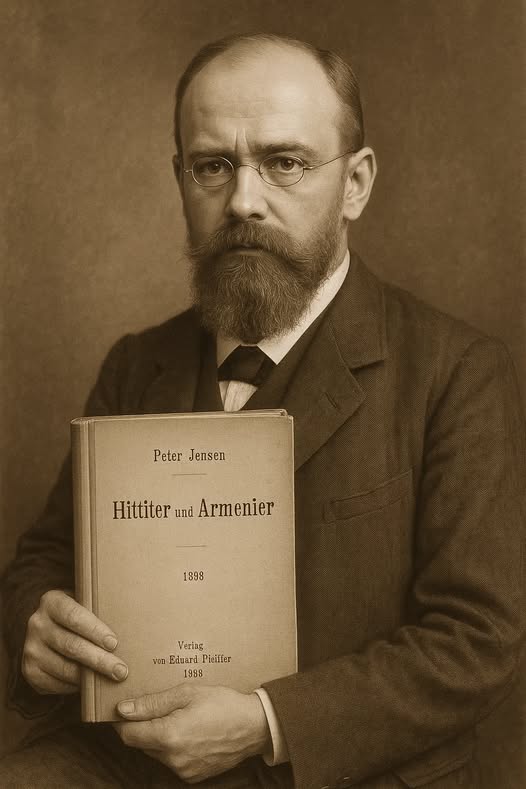
"The language of the Hittite inscriptions is the native language of today’s Armenian language."
— Fundamental work "The Hittite and the Armenian", 1898, by Peter Jensen, German orientalist and professor at the University of Marburg.
In this groundbreaking work, Peter Jensen explored linguistic parallels between the ancient Hittite language—known from cuneiform inscriptions discovered in Anatolia—and the Armenian language, which by the 19th century had developed into its classical and modern forms. Jensen proposed that the Hittite language, one of the earliest attested Indo-European languages, shared deep-rooted structural, phonetic, and lexical affinities with Armenian, to the extent that he described Hittite as a “native” ancestor of the Armenian Language.
He was among the first European scholars to seriously consider the continuity of linguistic and cultural traditions in the Armenian Highlands, from the Bronze Age through to historical Armenia.
His 1898 publication, written in German, included:
Comparative vocabulary tables
Analysis of Hittite grammar alongside Armenian
Historical-philological arguments tying ancient Anatolia with early Armenian presence
Cultural references suggesting transmission of traditions
Jensen’s thesis reflected the growing interest in Armenian as a key to understanding Indo-European origins, and while not all of his conclusions have stood the test of time, his work laid an important foundation for later studies linking ancient Anatolian and Armenian civilizations.
The Hittite Hieroglyphs: An Early Form of Armenian Writing
The Hittite cuneiforms of the 17th-13th centuries BC were preceded by a hieroglyphic script, which can be considered an early form of Armenian writing. This fascinating connection between the Hittite hieroglyphs and the Armenian language has been explored by various scholars, including Peter C. A. Jensen in his 1898 work, “Hittiter und Armenier.”
The Hittite Hieroglyphic Script
The Hittite hieroglyphic script, used before the adoption of cuneiform writing, represents a significant stage in the development of written language in the ancient Near East. These hieroglyphs were used for various administrative, religious, and historical purposes, providing valuable insights into the culture and society of the Hittites.
Linguistic Connections
According to Peter C. A. Jensen, the language represented by the Hittite hieroglyphs is related to Armenian. This connection suggests that the Hittite hieroglyphic script may have influenced the development of early Armenian writing. The similarities between the two languages highlight the deep historical and cultural ties between the Hittites and the Armenians.
Historical Significance
The study of Hittite hieroglyphs and their relationship to Armenian provides a broader understanding of the linguistic and cultural exchanges in the ancient Near East. It underscores the importance of the Armenian Highlands as a crossroads of civilizations, where various cultures and languages interacted and influenced each other.
In conclusion, the Hittite hieroglyphic script represents an early form of Armenian writing, reflecting the historical and linguistic connections between the Hittites and the Armenians. The work of scholars like Peter C. A. Jensen continues to shed light on these ancient ties, enriching our understanding of the region’s complex history.
@drleeclare How does it feel to be paid off and controlled by the turks?
You must feel so important be to be chosen by them 😂😂
You are a shill sir. Get a real job, or actually do the one you’re supposed to be doing. EXCAVATE!
@DrDavidMiano DNA evidence from gobekli tepe is that of the indigenous peoples of those lands.
ie. ancestors of the Armenian highlands (what people call Anatolia)
@BrightInsight6 Maybe we should shift attention from failed projects like gobekli tepe excavation to other nearby Neolithic sites such as “Silikyan Pre-Pottery Neolithic Settlement” in Armenia, or with countries that would be unbiased; thus accelerating excavation and research.
NAKHICHEVAN: ONE OF THE HISTORICAL LANDS OF THE ARMENIAN WORLD
The history of Nakhichevan is a centuries-long chronicle of ancient kingdoms, Armenian noble dynasties, vital trade routes, powerful empires, and invaluable cultural heritage — much of which was lost amid the tragic events of the twentieth and early twenty-first centuries.
Situated at the crossroads of the Armenian Highlands, Iran, and the South Caucasus, Nakhichevan has occupied an important place in the political, economic, and cultural history of the region for thousands of years. Its destiny was closely intertwined with the histories of Armenia, Persia, and neighboring states. Its towns and settlements witnessed the rise and fall of dynasties, military campaigns, population transfers, and profound cultural transformations.
For Armenians, Nakhichevan is more than a geographical name. It is a land associated with historical memory, the development of Armenian literature and literacy, Christian architecture, medieval monasteries, and generations of people who left their cultural imprint upon its landscape.
🏺 NAKHICHEVAN IN THE ANCIENT WORLD
The history of Nakhichevan reaches deep into antiquity. The region lay within the sphere of interaction between the civilizations of the Armenian Highlands and the ancient Near East. At different times, it came under the influence of Urartu and Media before becoming part of the Achaemenid Persian Empire.
Ancient geographical tradition referred to the city by a name rendered as Naxuana. Over the centuries, different forms of the name emerged, including Nakhichevan, Nakhchivan, Naxçivan, and Nakhijevan, reflecting the linguistic traditions of different peoples.
In Armenian tradition, the name Nakhichevan is associated with the biblical story of Noah's Ark. According to this tradition, Noah and his family settled in the vicinity of Mount Ararat after the Flood. The name was traditionally interpreted as meaning “the place of first settlement” or “the first resting place.”
Following the collapse of Alexander the Great's empire, the region retained its strategic importance. In subsequent centuries, it became closely connected with Armenian political formations and eventually formed part of the Kingdom of Greater Armenia.
👑 WITHIN THE KINGDOM OF GREATER ARMENIA
In 189 BC, Artaxias I established the Kingdom of Greater Armenia, strengthening Armenian independence and laying the foundations of a new era of Armenian statehood.
Nakhichevan became part of the historical landscape of Armenian political life. Its territory was associated with the historical provinces of Ayrarat, Vaspurakan, and Syunik, although administrative boundaries and the political affiliation of particular districts changed over time.
Its geographical position made the region especially valuable. Trade routes connected the Armenian Highlands with Iran, Mesopotamia, and other parts of the South Caucasus. Commercial interests, political ambitions, and cultural influences converged here.
Armenian historical sources preserve accounts of noble families that held lands in the region. According to the medieval historian Movses Khorenatsi, the Muratsyan princely family once possessed estates here before its power was suppressed by the Armenian king Artavazd I.
Nakhichevan's history within the Armenian world was never isolated from wider Armenian developments. The region participated in the political and cultural networks that connected the different provinces of the Armenian Highlands.
✍️ MESROP MASHTOTS AND THE HISTORY OF ARMENIAN WRITING
Nakhichevan holds a special place in the history of Armenian literary culture.
In the early fifth century, Mesrop Mashtots created the Armenian alphabet, one of the most consequential achievements in Armenian civilization. The introduction of a distinct writing system enabled the development of literature, translation, theology, historiography, and education. It provided the Armenian language and culture with a powerful means of preserving their identity across the centuries.
According to Armenian historical tradition, the region of Goghtn, corresponding to part of modern Nakhichevan, was associated with Mashtots's activities. Tradition holds that he completed his work on the alphabet there and began organizing the first Armenian schools.
The significance of this legacy extends far beyond a single region. Armenian writing became a foundation of cultural continuity for a people that endured political upheavals, periods without independent statehood, and changes of power across its historical territories.
In this respect, Nakhichevan is associated with one of the defining chapters of Armenian history: the era in which language, books, and education became pillars of collective memory.
✝️ THE MEDIEVAL ARMENIAN WORLD AND THE CHANGING TIDES OF POWER
In 428, the Armenian monarchy of the Arsacid dynasty was abolished, and Nakhichevan came under Sasanian Persian rule. In the centuries that followed, control of the region passed between different states and local rulers.
During the seventh century, Arab conquests reached the South Caucasus. For Armenian noble families, this was a period of severe trials. Medieval Armenian sources recount harsh reprisals against the Armenian aristocracy, particularly the tragic events of 705, when Arab authorities executed numerous Armenian nobles.
These political upheavals weakened parts of the local aristocracy. Some Armenian families were forced to leave their ancestral lands, while others managed to preserve their influence in neighboring territories.
In subsequent centuries, Nakhichevan came under the authority of Arab governors and regional dynasties, including the Sajids, Sallarids, and Shaddadids. The region remained contested because control of its towns, trade routes, and strategic passages offered considerable political and military advantages.
Yet Nakhichevan's history was not defined by warfare alone. Agriculture, craftsmanship, commerce, and urban life continued to develop. The interaction of different communities created a complex cultural environment characteristic of the medieval South Caucasus.
⚔️ THE SELJUKS, THE ATABEGS, AND THE MONGOL INVASIONS
In the eleventh century, Nakhichevan came under Seljuk Turkish rule. During the twelfth century, the city became one of the important centers of the Ildegizid state, also known as the Eldiguzid Atabeg dynasty, whose territories extended across substantial parts of present-day Iran and the South Caucasus.
This period produced one of Nakhichevan's most celebrated architectural monuments: the Mausoleum of Momine Khatun, built in the twelfth century in honor of the wife of the ruler Jahan Pahlavan.
Its towering structure, intricate brickwork, and elegant geometric ornamentation demonstrate the remarkable skill of medieval architects and craftsmen. The mausoleum remains one of the most recognizable historical landmarks of Nakhichevan.
As Ildegizid authority weakened in the early thirteenth century, members of the Armenian-Georgian princely house of Zakarian undertook military campaigns in the region. Soon, however, the South Caucasus faced a new and devastating threat.
The Mongol invasions of the 1220s, followed by the establishment of Mongol rule during the 1230s, brought destruction and profound changes. Warfare disrupted commercial networks, devastated settlements, and transformed the demographic landscape.
In subsequent centuries, Nakhichevan passed under the authority of various Mongol, Turco-Mongol, and regional dynasties. Each new political order left its mark on the history of the land.
🕌 BETWEEN SAFAVID PERSIA AND THE OTTOMAN EMPIRE
During the sixteenth century, Nakhichevan came under Safavid Persian rule and became associated with the administrative system of the Erivan Province, also known as Chukhur-Saad.
Its geographical position, however, placed it at the center of prolonged conflict between Safavid Persia and the Ottoman Empire. Armies crossed its valleys and towns, while the local population repeatedly suffered destruction, displacement, and the consequences of imperial warfare.
One of the most devastating episodes occurred in 1604, when Shah Abbas I implemented a scorched-earth policy during the war against the Ottomans. Persian authorities forcibly deported inhabitants of frontier territories deeper into the country in an attempt to deprive advancing Ottoman forces of food, supplies, and other resources.
These deportations affected multiple communities, including Armenians. Many Armenian deportees were resettled in the vicinity of Isfahan, where New Julfa subsequently emerged as a celebrated center of Armenian commerce and culture.
Merchants from New Julfa established extensive connections with Europe, India, and other parts of Asia. Their activities contributed to international trade, printing, and cultural exchange.
Yet the achievements of the Armenian diaspora did not erase the tragedy of forced displacement. For many families, deportation meant separation from ancestral villages, monasteries, cemeteries, and the places where their forebears had lived for generations.
Following the death of Nader Shah in 1747, the Nakhichevan Khanate emerged as a regional political entity, beginning another chapter in the history of the land.
1828: THE BEGINNING OF A NEW ERA
The Russo-Persian War ended in 1828 with the Treaty of Turkmenchay, under which the Nakhichevan Khanate passed from Persian to Russian imperial rule.
In the decades that followed, the Russian authorities encouraged Armenian resettlement from Persia and the Ottoman Empire into various parts of the South Caucasus. Nakhichevan nevertheless remained a multiethnic territory inhabited by Muslim and Christian communities.
Nineteenth-century imperial statistics recorded a substantial Muslim population. Russian documents of the period commonly referred to this population as Tatars; the designation Azerbaijanis became established later. Armenian communities also continued to live in the region, maintaining their religious institutions, local traditions, and cultural connections.
Understanding this period requires careful attention to historical sources. The demographic composition of individual districts changed, and administrative boundaries did not always correspond to ethnic, religious, or historical divisions.
Nevertheless, the Armenian presence in Nakhichevan long predates the nineteenth century. It is documented in historical accounts, ecclesiastical architecture, inscriptions, and numerous monuments that survived into the modern era.
🩸 1918–1921: THE STRUGGLE OVER NAKHICHEVAN'S FUTURE
The collapse of the Russian Empire following the revolutions of 1917 brought profound political changes to the South Caucasus.
After Armenia and Azerbaijan declared independence, Nakhichevan became the subject of a bitter territorial dispute. Between 1918 and 1920, the region experienced armed clashes, mass violence, the destruction of settlements, and the forced displacement of civilians.
In December 1918, the Republic of Aras was proclaimed with the support of Azerbaijani nationalist forces. The Armenian government disputed its legitimacy and sought to establish control over the contested territory.
Local armed formations, Azerbaijani forces, Ottoman troops, and the British administration all played roles in the unfolding crisis. Attempts at international mediation failed to produce a lasting settlement.
As empires collapsed, competing national movements sought to secure their territorial claims, while civilians bore the consequences of armed confrontation.
In the early 1920s, Nakhichevan's fate was determined amid the establishment of Soviet rule. The 1921 Treaty of Moscow between Soviet Russia and Turkey, followed by the Treaty of Kars, helped establish the region's special political status. Nakhichevan subsequently became an autonomous territory within the Azerbaijan Soviet Socialist Republic.
For Armenian historical memory, this marked a further separation of Nakhichevan from Armenia and preceded the gradual decline of the region's Armenian cultural presence over subsequent decades.
🪦 JUGHA: THE DESTROYED TREASURE OF ARMENIAN ART
One of the most tragic chapters in Nakhichevan's modern history concerns the fate of Armenian khachkars and medieval cemeteries.
A khachkar is far more than a stone cross. It represents a distinctive Armenian art form combining religious symbolism, masterful stone carving, intricate vegetal ornamentation, and sophisticated geometric compositions.
For centuries, Armenian craftsmen created khachkars to commemorate the dead, mark significant events, express gratitude for deliverance, or proclaim their faith. These monuments could bear personal names, dates, dedicatory inscriptions, and unique decorative designs.
One of the greatest centers of this artistic tradition was the medieval cemetery of Jugha, near Julfa. It contained thousands of Armenian tombstones and khachkars, many of exceptional historical and artistic significance.
Yet by the end of the twentieth century and the beginning of the twenty-first, this extraordinary heritage had been almost entirely destroyed.
International researchers and organizations documented the disappearance of the monuments. In 2010, the American Association for the Advancement of Science published an analysis of satellite imagery confirming the destruction of the cemetery.
Azerbaijani authorities denied allegations that Armenian cultural heritage was being deliberately destroyed. Nevertheless, satellite imagery and other documentary evidence revealed the scale of the loss.
In 2022, Caucasus Heritage Watch, a research initiative associated with Cornell University, published findings from its monitoring of Armenian historical monuments in Nakhichevan. According to its report, 108 of 110 medieval and early modern Armenian monasteries, churches, and cemeteries identified through archival sources had been completely destroyed between 1997 and 2011.
The destruction of a monument means more than the loss of a building. Historical inscriptions, the names of craftsmen, evidence of family histories, traces of religious life, and material testimony to the past disappear with it.
When an entire cemetery is destroyed, part of the historical record is lost forever. Neither books nor photographs can fully restore what has vanished.
⛪ THE CHURCHES AND MONASTERIES THAT DISAPPEARED
Nakhichevan's Armenian Christian heritage included monasteries, parish churches, chapels, cemeteries, and numerous commemorative structures.
Among the known monuments were the Church of Saint Stephanos in Abrakunis, the Church of Saint Hakob-Hayrapet in Shurut, and Armenian churches in Norashen, Kirna, and Gah.
Many of these buildings survived into the twentieth century but subsequently disappeared. Documentary evidence and cultural heritage research reveal the extent of the destruction, which affected not only individual churches but entire historical complexes.
Old photographs, travelers' accounts, archival documents, ecclesiastical records, and epigraphic evidence are particularly valuable to researchers. They help reconstruct the appearance of lost monuments, establish their chronology, and trace the histories of the communities that built them.
Preserving this evidence matters to more than Armenians alone. It forms part of the shared history of the South Caucasus, a region shaped by centuries of interaction among different peoples, religions, and artistic traditions.
A historical monument does not lose its value because it lies outside the present-day borders of the state associated with the culture that created it. On the contrary, such monuments deserve particular protection and independent scholarly investigation.
🌄 NAKHICHEVAN IN THE HISTORICAL MEMORY OF THE ARMENIAN PEOPLE
Today, Nakhichevan is an autonomous republic within Azerbaijan. Its historical heritage developed over thousands of years and encompasses monuments and traditions from many different periods.
Yet the Armenian history of Nakhichevan does not disappear with the destruction of churches and cemeteries. It survives in medieval manuscripts, historical chronicles, old photographs, scholarly research, and the family memories of descendants whose ancestors lived on this land.
No single people has an exclusive claim to the entire past of the South Caucasus. The region's history is complex and multilayered, demanding respect for the heritage of its different communities.
Recognizing this complexity, however, does not mean ignoring documented evidence of cultural destruction or denying the historical presence of Armenians in Nakhichevan.
Historical memory must not become an instrument of hatred. Its purpose is to preserve evidence of the past, investigate the causes of historical tragedies, and help prevent similar events from happening again.
Nakhichevan reminds us how fragile cultural heritage can be and how great the responsibility is of those who control the fate of historical monuments.
Empires rise and fall. Borders change. Political systems collapse. But a people's history is not defined solely by the existence of a state, nor does it disappear when buildings are destroyed.
Nakhichevan remains one of the historical lands of the Armenian world — a land of ancient traditions, literary culture, medieval architecture, and memories of generations who left their mark upon it.
That is why its history must be studied, documented, and preserved for future generations.
Because protecting the past is not merely a right to remember. It is a responsibility to history itself.
Photos: Khachkars in the Armenian cemetery of Jugha (1915), by Aram Vruyr
When was the last time a T-Pillar was excavated at Gobekli Tepe? Was it 2017?
The site is made up of approx 200 T-Pillars. Only 72 have been excavated. Around 128 remain buried. Yet, for reasons unknown, they’ve chosen to stop excavating the Pillars? Why don’t they want to find out what the original purpose of this site was?
Another Armenian serviceman has been found dead with a gunshot wound, Armenia’s Ministry of Defense reported on October 10.
The body of serviceman A. Gh. was discovered at a military unit. The ministry confirmed that his family had been notified but provided no details about the circumstances of his death.
An investigation is underway to establish the full circumstances surrounding the incident.
The latest death brings the number of Armenian servicemen reported dead since the beginning of 2026 to at least 38, all under non-combat circumstances.
The Lchashen wagon is a 3,500 year-old Late Bronze Age covered wooden vehicle. Served as a ceremonial or funeral vehicle to transport elite tribal chieftains into the afterlife. Survived in remarkable condition because waterlogged, oxygen-poor soil near Lake Sevan (lowered during Soviet-era hydro projects) protected the organic wood...
In the 20th century, Soviet engineers lowered the level of Lake Sevan, Armenia's largest lake, to supply water for irrigation and hydropower. As the water retreated near the village of Lchashen, it exposed an ancient cemetery of more than 500 graves. Some of the richest burials held something extraordinary: six wagons made of oak, buried with Bronze Age leaders in the 15th–14th centuries BC, about 3,500 years ago. Four of them had arched frames that were probably once covered with hide or cloth, an early form of the covered wagon.
What makes the Lchashen wagons remarkable is their condition. The burial conditions kept oxygen away from the oak, so the wood survived where it would normally have rotted to nothing. Their builders joined dozens of parts with mortise-and-tenon joints, and at least one wagon was built from more than 70 pieces fitted together with bronze fittings. Wheeled vehicles were invented thousands of years earlier, so these aren't the world's first wagons, but they are among the best-preserved ancient wagons ever found. Today they stand in the History Museum of Armenia in Yerevan.
#archaeohistories