Tracking breaks quietly.
A theme update or new app drops the purchase event. You find out weeks later, after Meta and Google have been bidding on bad data.
AuditTag checks your tracking and tells you what it can and can't prove. The audit is free at https://t.co/ZyI4mLPO0e
The rule I'm most stubborn about with AuditTag is that the report says what it couldn't see, not only what it found.
A tag missing from the page source isn't the same as a tag missing. I'd rather write "can't tell" than guess and be confidently wrong.
@arnavsawantt View-through credit can do that. Meta can count a purchase against an ad that was only shown, depending on the attribution setting. Is your checkout answer a post-purchase “how did you hear about us” question?
Shopify store owners and agency people, which number in your analytics have you stopped trusting?
Purchases against orders, ad platform revenue against Shopify, something else. Genuinely curious.
@juansbiz Ads Manager never will, it counts purchases it credits to ads, not orders. Events Manager is the one that should sit close to your Online Store orders, and if that’s near double, something is sending purchases twice. Which one are you comparing?
@oderajoseph So far it has, every answer is some version of ad platform against Shopify. You must see this from the app side. Do merchants blame the app when the numbers don’t match?
Something I didn't expect from scanning stores twice.
I re-scanned 20 stores a few hours later and 8 of the 100 results I tracked changed, mostly because sitemap order moves and so do the pages I read. So the numbers are a dated snapshot, not facts about each store.
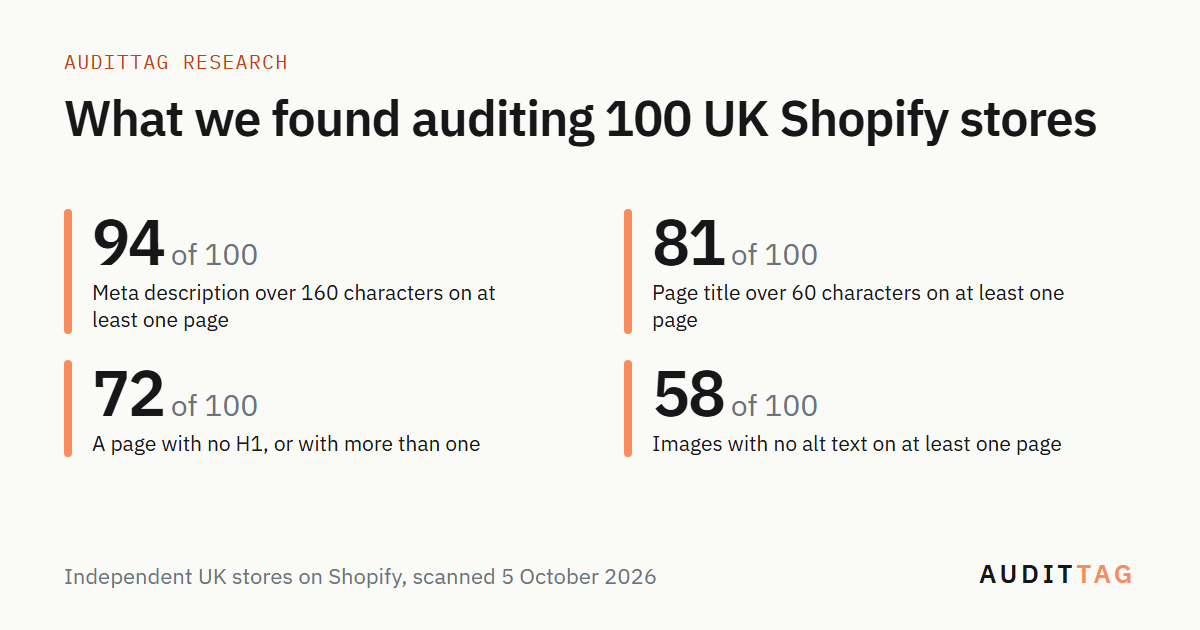
I read the public pages of 100 independent UK Shopify stores and counted what I found.
Every one had at least one of four basic on page issues. I also wrote down what the numbers can't prove, because there's a lot of that.
We read the public pages of 100 independent UK Shopify stores on 5 October.
Every one had at least one of four basic on page issues. We wrote up the four, how we picked the stores, and what the numbers can't prove.
@abdullahcro_x Good one to add, I haven’t caught it myself, because my scans only read public pages and can’t see what an event sent. A test order covers it, with the value in GA4 DebugView set against the Shopify order total. Is tax or shipping the usual gap you see?
A Meta Pixel can fire on every page of a Shopify store and still not be there when someone buys.
Pixel Helper lights up on a product page and people stop checking. Here's the catch, using a made up store so I can show all of it.
@AccessoraX Agreed, the detector skips empty alt on purpose and only counts images with no alt attribute at all. A blank lazy load placeholder was the one thing it got wrong, and that’s what the second parser caught.
Before publishing anything from my scan of 100 UK Shopify stores, I tested my own detector against a second parser I wrote separately.
20 stores, 180 comparisons. It was wrong once, counting blank lazy load placeholders as missing alt text. Fixed it and ran it again.
Odd thing about buying a domain. https://t.co/ZyI4mLPgaG had an owner before me, and SaaSHub still listed it as a hashtag tool from 2020, filed under photos and social networks.
So I claimed the listing and rewrote it. Nobody should land on it and think AuditTag is a photo app.
Your Shopify store can look healthy while your ad tracking is broken.
Tags pasted into the theme (Meta pixel, GA4, Google Ads) don’t run on checkout or the thank you page. Orders still come in, but your ad platforms never see the sale.
AuditTag checks how your tracking is installed on Shopify and flags theme-only tags that won’t reach checkout. Free, no install, run it yourself at https://t.co/GadvFjz7t4
@andr3barroso Iterate over time and keep a standing set of prompt rules the AI follows on every build, then use your own app like a customer and read every line, anything that feels generic gets rewritten.
@abdullahcro_x Every time, yes. Theme change, new app, checkout edit, then a test order and a look at Purchase in Events Manager, page-level checks only prove the storefront.
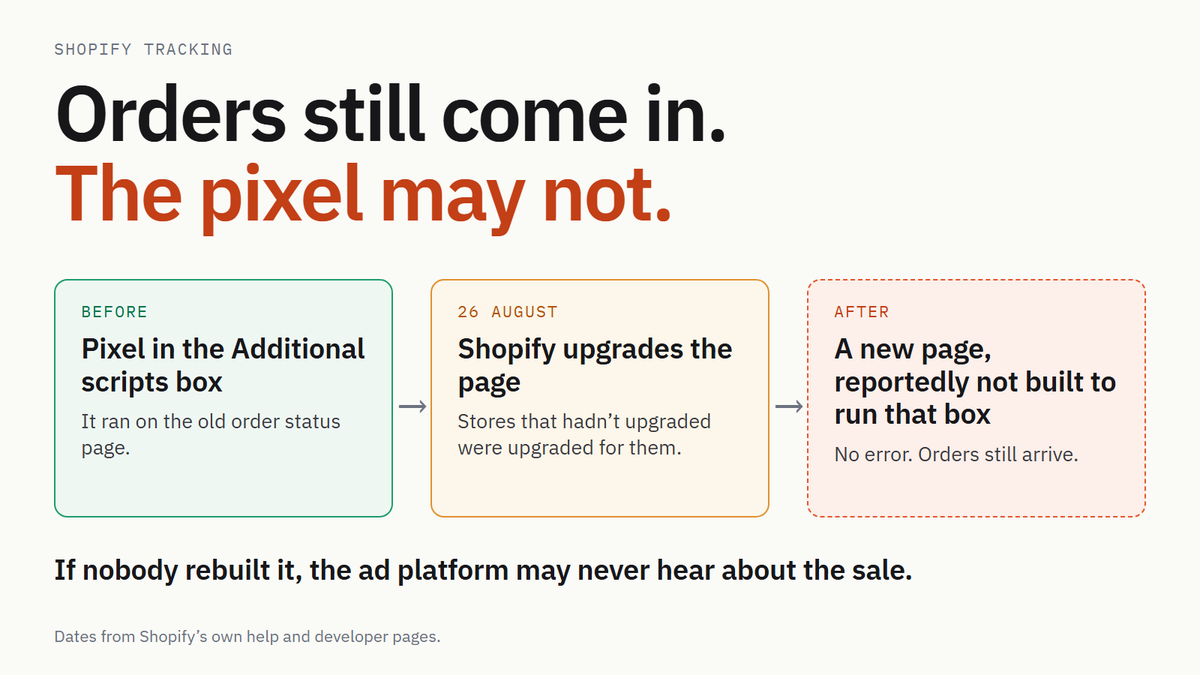
Shopify upgraded the Thank you page on every store that hadn't done it by 26 August. If a purchase pixel lived in the old Additional scripts box and nobody rebuilt it, it has probably stopped, and orders still come in so nothing looks wrong.