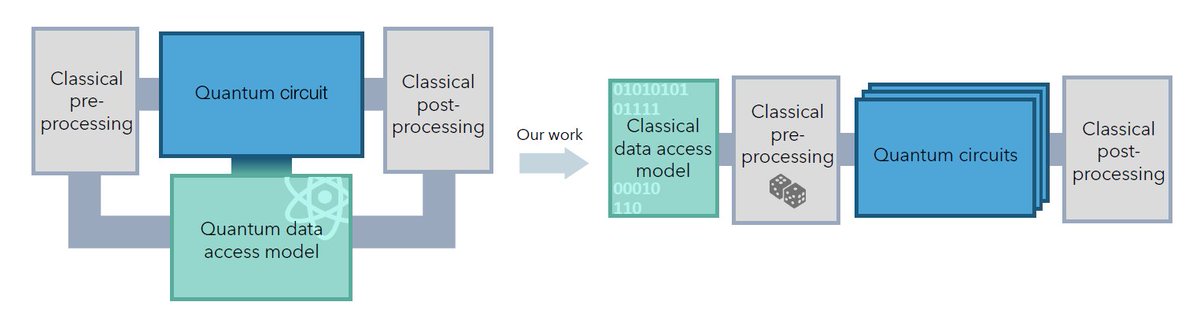
We look at two matrix function problems with classical input and output; toggle problem parameters (function, input model, matrix norm, sparsity, error); and catalog how the complexity changes
Joint work with Santi Cifuentes, Thais L. Silva, Mario Berta & @AolitaLeandro
Where exactly could we find concrete quantum advantage in processing large matrices? Happy to share new work (https://t.co/qNnCjduuem) trying to circle in on more precise answers to this question
I'm looking for a PhD student to join my new group at @UniHannover to work on quantum information and quantum learning.
More information here:
https://t.co/y2Pc6gMXKs
Please share and forward to anyone who might be interested.
The great @FrederikvomEnde has started a really nice "Counterexamples in quantum information" document -- assembling counter-intuitive results from across the literature
It would be great to spread and contribute!
https://t.co/K4qHeQwgzJ
🚨 Deadline approaching! Less than a month left to submit your papers to QCTIP24 🚀. February 5th is the last day! We're excited to see submissions across a wide range of quantum computing topics.Submit here: https://t.co/MKKkMrFrYf #QuantumComputing#QCTIP24
⭐️Looking for two post docs to come join us at EPFL ⭐️
One focused broadly on quantum learning theory.
The other, joint with Christa Zoufal and Stefan Woerner at IBM Quantum, working broadly on quantum simulation.
Apply 👉 https://t.co/YQ7rXjgPDr
@CraigGidney@letonyo@siddhantphy On reflection, we should have also highlighted our assumptions in the numerics clearly earlier in the manuscript. We will attempt to address these points with an improved v2
@CraigGidney@letonyo@siddhantphy Hi Craig, Anthony - thanks for your comments, you make fair points. We agree that our numerical analysis does not answer if this scheme is practically feasible in the near future as we concentrate only on additional errors that are specific to this framework
New work out on qubit-efficient randomized quantum algorithms! https://t.co/XzQyPEt1mq
We investigate a class of algorithms to sample properties of matrix functions, where we ask for no quantum/coherent oracle access to the matrix in question.
This builds on some great previous work using similar techniques for phase estimation (https://t.co/mf4vi9OL5y) and for randomizing multi-product formulas (https://t.co/xGY27bwEZk).
Applications are now open for the 2023 Los Alamos Quantum Computing Summer School! Our school focuses on theory, applications, and programming of quantum computers. Apply here: https://t.co/Jg0O29Bf2S
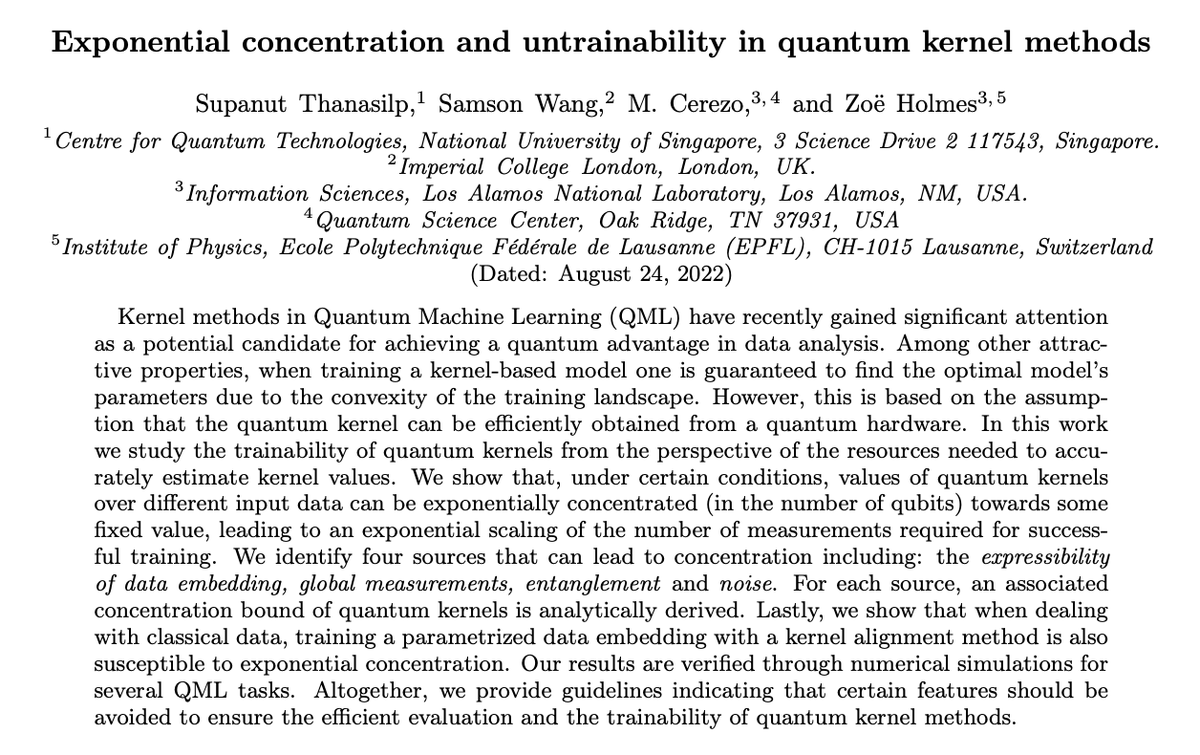
Kernel methods are famous for their trainability guarantees. But, is this always true for quantum kernel-based models where kernel values are statistically estimated from quantum hardware ?
Check out: https://t.co/8rNhXeawyG
with @samson_wang, @MvsCerezo and @qZoeHolmes
In the world of hypotheticals "the battle of clean and dirty qubits in the era of partial error correction" has been raging. Its outcome is here: https://t.co/zCQFR4Xzj3.
Huge thanks to
@samson_wang@MaxHunterGordon@czarnik_piotr@MvsCerezo @ColesQuantum @LCincio and @EuMoqs!
New preprint out, studying gradient scaling in QML models that employ quantum neural networks
with @s_thanasilp, Nhat Anh Nghiem, @ColesQuantum and @MvsCerezo.
Congrats Supanut and Anh on a great summer school project!
Do Quantum Machine Learning (QML) models suffer from trainability issues like barren plateaus?
Check out our new work: https://t.co/u3MaKtis5y
with @samson_wang , Nhat A. Nghiem, @ColesQuantum , @MvsCerezo from the LANL quantum computer summer school.