Why tZERO Could Become the AWS of Tokenization
When cloud computing began to take hold, most companies weren’t interested in running data centers. They wanted reliability, scale, security, & flexibility—without having to build everything themselves.
That gap is what AWS filled.
Today, capital markets are facing a similar moment. Tokenization is discussed as a way to modernize issuance, settlement, & ownership of assets.
This is where tZERO becomes structurally interesting.
Tokenization Is an Infrastructure Problem
The core questions institutions face are not whether assets can be tokenized, but:
•How ownership is recorded
•How settlement occurs
•How transfers comply with regulations
•How systems integrate with brokers, custodians, & exchanges
These are the same types of problems enterprises faced before cloud adoption became mainstream.
The AWS Parallel
AWS succeeded by abstracting complexity into layers that others could build on:
•Infrastructure as a Service (IaaS)
•Platform as a Service (PaaS)
•Software as a Service (SaaS)
This allowed companies to adopt cloud incrementally, without re-architecting their entire business.
tZERO’s opportunity in tokenization follows a similar pattern—applied not to compute, but to capital markets infrastructure.
tZERO as Infrastructure as a Service (IaaS)
At the base layer, AWS provides raw infrastructure: compute, storage, & networking.
tZERO’s equivalent IaaS layer is on-chain market infrastructure, including:
•A distributed ledger for securities ownership
•Settlement rails that support near-real-time finality
•Secure, permissioned connectivity between regulated participants
This layer targets post-trade functions that today rely on batch processing, reconciliation, & multiple ledgers of record. Like AWS infra, it is not consumer-facing- but reliable & standardized.
tZERO as Platform as a Service (PaaS)
AWS became more valuable when it added managed services that removed the need for customers to build foundational components themselves.
tZERO’s platform layer can include:
•Tokenized securities issuance frameworks
•Embedded transfer & eligibility rules
•Identity and compliance logic
•APIs for brokers, custodians, & exchanges
•Automated corporate actions such as dividends
This is where tokenization becomes operationally usable for institutions, not just technically possible.
tZERO as Software as a Service (SaaS)
On top of the platform sit applications.
For tZERO, these may include:
•Alternative trading systems
•Tokenized asset marketplaces
•Cap-table & transfer-agent style services
As with AWS, these applications matter—but they are not the core thesis. They demonstrate what the underlying infrastructure can support and provide adoption pathways.
Why This Model Fits Institutions
Financial institutions generally do not seek to rebuild infrastructure. They prefer:
•Incremental adoption
•Reduced operational complexity
•Regulatory alignment
A layered model allows tokenization to be adopted the same way Cloud was: gradually, without forcing institutions to abandon familiar structures
A Practical Way to Think About It
AWS did not replace the internet.
It made the internet usable at enterprise scale.
Similarly, tZERO does not need to replace exchanges, brokers, or custodians to succeed. If it becomes a foundational layer for regulated tokenized assets—supporting issuance, settlement & ownership—it can sit beneath the market, largely invisible to end users.
That is how infrastructure platforms tend to win
To Conclude
The future of tokenization is unlikely to be driven by standalone applications or isolated blockchains. It will be shaped by platforms that abstract complexity & allow others to build on top.
That is the role AWS played in cloud computing.
If tokenization follows a similar trajectory, tZERO’s opportunity is not to be the most visible player-but to become one of the most foundational.
Gemini AI : Here is exactly where ASTS stands with its remaining launch providers, its financials, and its position against Starlink.
Launch Capacity: SpaceX & ISRO (2026)
ASTS continues to target having approximately 45 Block 2 satellites in orbit by the end of 2026 to achieve continuous U.S. coverage. However, without New Glenn's heavy-lift capability, they face a severe bottleneck:
SpaceX (Falcon 9): SpaceX successfully launched the Block 1 BlueBirds in late 2024. However, finding near-term manifest space is highly constrained. Falcon 9 is essentially fully booked for 2026 and 2027 with internal Starlink missions and existing commercial contracts. While ASTS has a multi-launch agreement, booking additional near-term flights to compensate for New Glenn will be difficult.
ISRO (LVM3): ISRO successfully launched the massive 6,100 kg BlueBird 6 in December 2025. But for 2026, ISRO is heavily focused on the Gaganyaan program (India's first crewed spaceflight). Dedicating additional heavy-lift rockets to ASTS this year is highly unlikely.
Financial Snapshot & Cash Burn
ASTS remains a deeply loss-making, capital-intensive business as it scales its constellation.
Key insight: A fundamentally driven price target sits between $42 and $52 per share assuming they reach $1.5B in free cash flow by 2030 (using a 13% WACC). However, every quarter of delayed launches burns cash and pushes that cash flow further into the future, heavily compressing the present value.
Market Share, TAM, and the Starlink Threat
The Total Addressable Market (TAM) is staggering. In SpaceX's May 2026 IPO filing, they sized the TAM for "Starlink Mobile" at $740 billion worldwide.
ASTS does not need to dominate this market to justify its valuation; capturing just 2% of a $740B TAM yields ~$15B in recurring revenue. However, the competitive dynamics between ASTS and Starlink are structurally different:
The Technology Edge: ASTS currently holds the technological advantage for connecting directly to unmodified smartphones. Their massive 2,400-square-foot Block 2 arrays act like true cell towers in space.
The Business Model: ASTS operates a B2B2C revenue-share model. They partner with existing carriers (AT&T, Verizon, Vodafone). In contrast, Starlink's recent SEC filings state they intend to compete directly with carriers to be the "preferred connectivity experience... in rural, suburban, or urban areas."
The Carrier Defense: Because Starlink is attempting to bypass terrestrial carriers, U.S. mobile operators recently formed a joint venture to fund and prioritize neutral third parties like ASTS and Amazon Kuiper. Carriers have zero incentive to cede the Direct-to-Device market to a dominant Starlink.
The real threat to ASTS isn't consumer demand—it is the supply chain of getting to space. If SpaceX throttles ASTS's launch access while aggressively launching its own next-generation Starlink Mobile satellites, Starlink could capture the market before ASTS can deploy its full constellation.
Under the Securities and Exchange Commission's proposal, platforms offering tokens would need to guarantee investors receive the same rights as regular shareholders https://t.co/Y9PniGEU5j
If people want to understand what synthetics mean to me in this context, see the staff statement on tokenization, which distinguishes tokenized versions of issuer-sponsored stocks and of stocks that SEC-registered firms hold for their customers from synthetic instruments that provide exposure to stocks. https://t.co/XvVmjndGR5
BREAKING: The SEC is set to release its so-called "innovation exemption" for tokenized stocks which will pave the path for trading digital versions of securities, per Bloomberg.
Details include:
1. In a "surprise move," the SEC is leaning toward allowing the trading of tokenized assets
2. These tokenized assets would be tradeable on decentralized crypto platforms
3. The move could "reshape the landscape of the American stock market"
4. This would also be one of the US' biggest shifts into crypto infrastructure yet
Tokenized assets are rapidly expanding.
@tZERO x @Aptos
We've announced a collaboration to bring tZERO's institutional tokenization platform to the Aptos L1 – giving issuers high-performance blockchain deployment with compliance infrastructure built in.
"This integration reflects our continued focus on supporting issuers building tokenized assets with institutional-grade infrastructure. Leading protocols like Aptos are critical partners and consumers for our infrastructure as we offer compliant gateways for issuers and developers building on Aptos technology." – @Alan_Konevsky, CEO, tZERO.
🔗 https://t.co/q7qPkuPPVp
Following earnings and the Beacon Point announcement, Wall Street just materially repriced $HUT.
Recent analyst target increases:
• Citizens JMP: $100 → $140
• Canaccord: $70 → $130
• Needham: $88 → $128
• Piper Sandler: $93 → $127
• Rosenblatt: $65 → $124
• BTIG: $90 → $115
Analysts are finally starting to understand the scale of what they are building.
Hut 8 has signed a 15-year, 352 MW AI data center lease at its Beacon Point campus with base-term contract value of $9.8 billion and up to $25.1 billion if all renewal options are exercised.
Envisioned as a multi-phase, multi-tenant campus, Beacon Point is the second AI data center campus commercialized under Hut 8’s power-first, greenfield development model. We have executed an interconnection agreement for 1,000 MW of utility capacity, providing significant runway for potential campus expansion and revenue growth.
The transaction brings our total contracted AI data center capacity to 597 MW with aggregate base-term contract value of approximately $16.8 billion and aggregate average annual NOI of approximately $1.1 billion.
Today, we announced our results for Q1 2026. Two years of foundation-building have translated into $16.8 billion in triple-net, take-or-pay contracted lease revenue across two hyperscale AI campuses, underpinned by blue-chip, investment-grade counterparties.
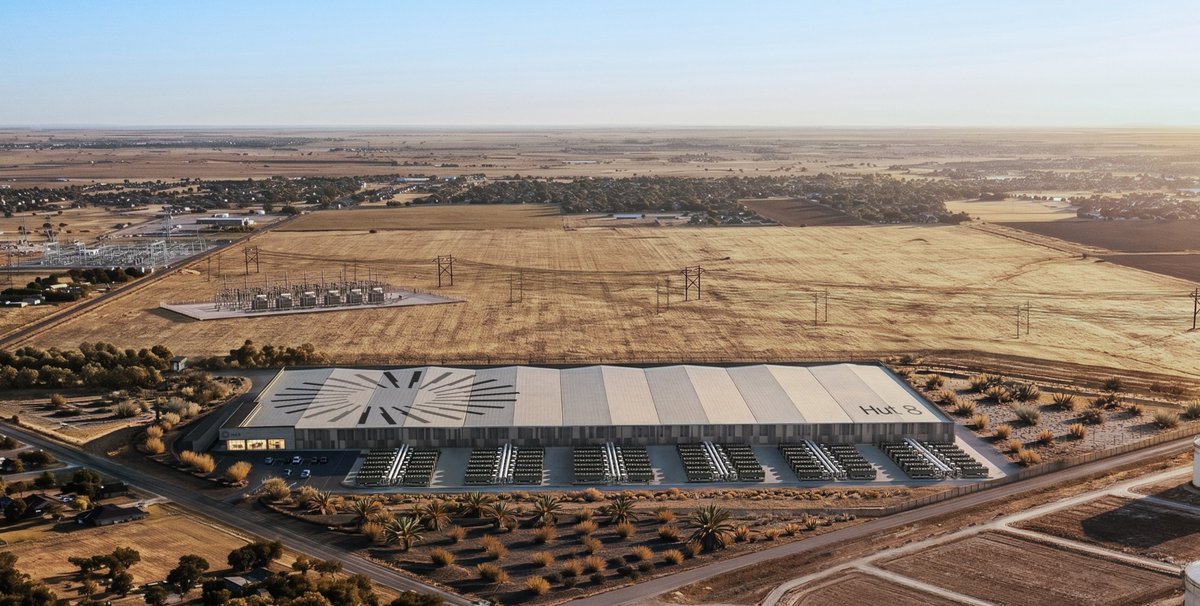
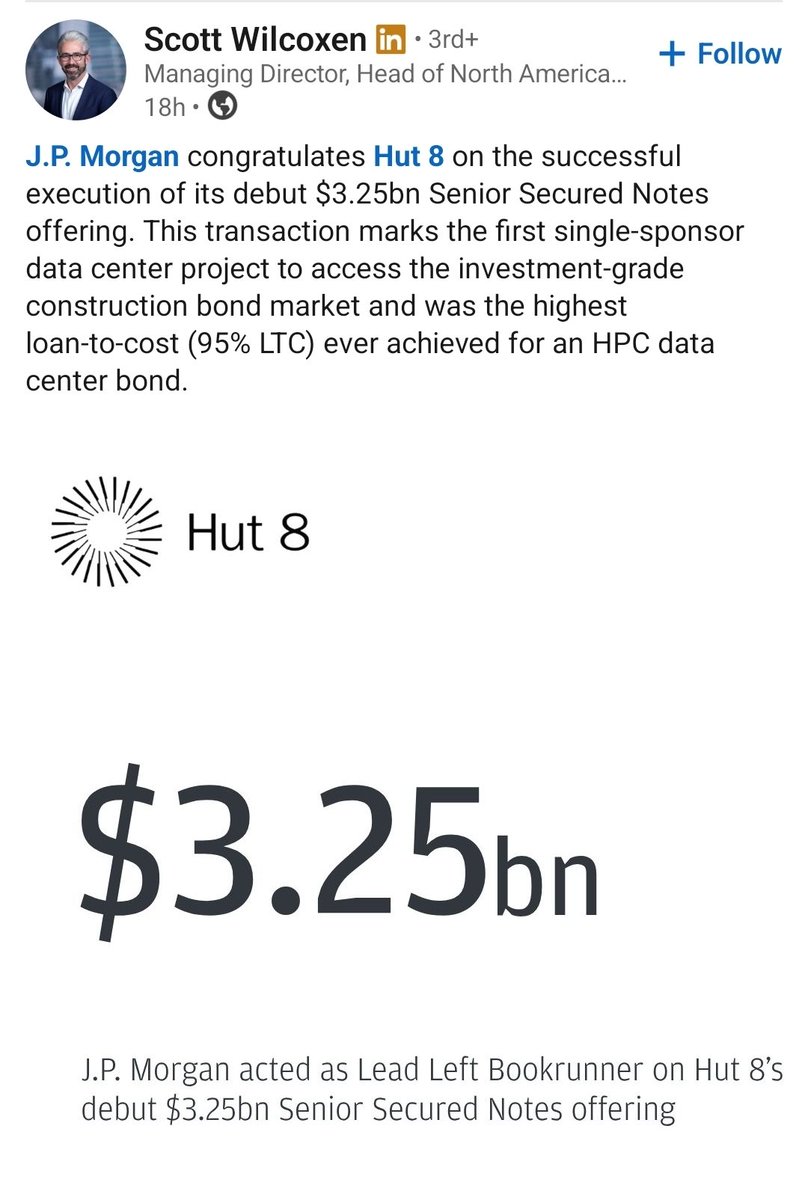
During the quarter, we demonstrated the repeatability of our power-first model. At Beacon Point, we signed a 15-year, 352 MW IT AI data center lease representing $9.8 billion in base-term contract value. Subsequent to quarter-end, we closed an offering of $3.25 billion of fully amortizing 16.5-year investment-grade senior secured notes to finance the construction of River Bend — the first single-sponsor data center project to access the investment-grade construction bond market. We streamlined our asset base through the divestiture of our 310 MW portfolio of natural gas power plants. And with an 8,375 MW development pipeline, we believe we are positioned to continue scaling with uncompromising discipline as we build what we believe will become an enduring, generational business at the intersection of energy and technology.
Today is one of those days where I’m genuinely proud of what this team at $HUT has built.
Years ago, this image was posted by our shareholders as an ambition. $100 felt like a stretch goal. A milestone out in the distance.
Today, we’ve surpassed it.
Along the way, our shareholder base has evolved. Institutional ownership now exceeds 70%, and we’re backed by some of the most respected names in the world. But what matters just as much is this:
We haven’t forgotten where we started.
The community that’s been with us from day one the ones posting on Reddit, sharing their journeys, growing alongside us you’ve been part of this story in a real way. It’s been incredible to witness, and even more meaningful to be a part of it together.
This is a thank you to all of you.
And a reminder: we’re just getting started.
Now let’s go set the next goal.
Tokenization works best when it fixes something broken.
CarbonEnfo is targeting a ~$1.4B fragmented solar credit market by aggregating Solar Renewable Energy Certificates (SRECs) into tradable, verifiable assets.
In this Q&A, CEO Mark Bell breaks down how Brytr + @tZERO bring real revenue streams on-chain.
Read more: https://t.co/yeFIggToB5
Today $HUT closed $3.25B of investment grade senior secured notes for our River Bend data center.
This is one of the first investment grade financings in our sector.
Here’s why it matters 👇
Since the leadership change at the end of 2025, @tZERO has been undertaking a strategic review of its IP portfolio – and is highlighting several foundational patents supporting the architecture of regulated, tokenized securities markets.
The initial spotlight includes 5 patent families / 103 issued patents worldwide, covering:
• compliance-aware transfer logic
• upgradeable smart contract frameworks
• corporate action processing on-chain
• broker-dealer identity interoperability
• legacy-to-blockchain trading system integration
These technologies reflect early infrastructure work that continues to support issuance, trading, custody, and lifecycle workflows for digital asset securities today.
More to come as the review continues and as we look to build product using our patents as well as identify other ways in which our intellectual property should be monetized or enforced.
🔗https://t.co/2PIxD2x3l2
📢 𝐉𝐔𝐒𝐓 𝐈𝐍: Hut 8 Project Targets $𝟑𝐁 Bond Sale for Google-Linked Data Center - $HUT $GOOGL
👉 𝐊𝐞𝐲 𝐇𝐢𝐠𝐡𝐥𝐢𝐠𝐡𝐭𝐬:
➤ Hut 8 project plans $𝟑𝐁 𝐛𝐨𝐧𝐝 issuance for Louisiana data center.
➤ Bonds due 𝟐𝟎𝟒𝟐 with yield ~𝟐.𝟏𝟑% above benchmark.
➤ Facility sized at 𝟐𝟒𝟓 𝐌𝐖, spanning 𝟔𝟎𝟎,𝟎𝟎𝟎 sq. ft.
➤ Backed by 𝟏𝟓-𝐲𝐞𝐚𝐫 lease with Fluidstack valued ~$𝟕𝐁.
➤ 𝐆𝐨𝐨𝐠𝐥𝐞 provides financial backstop for lease obligations.
➤ Power supplied by 𝐄𝐧𝐭𝐞𝐫𝐠𝐲 under service agreement.
➤ Deal led by Goldman Sachs, JPMorgan, and Morgan Stanley.