Imagine every pixel on your screen, streamed live directly from a model. No HTML, no layout engine, no code. Just exactly what you want to see.
@eddiejiao_obj, @drewocarr and I built a prototype to see how this could actually work, and set out to make it real. We're calling it Flipbook. (1/5)
My friend Milla Jovovich and I spent months creating an AI memory system with Claude. It just posted a perfect score on the standard benchmark - beating every product in the space, free or paid.
It's called MemPalace, and it works nothing like anything else out there.
Instead of sending your data to a background agent in the cloud, it mines your conversations locally and organizes them into a palace - a structured architecture with wings, halls, and rooms that mirrors how human memory actually works.
Here is what that gets you:
→ Your AI knows who you are before you type a single word - family, projects, preferences, loaded in ~120 tokens
→ Palace architecture organizes memories by domain and type - not a flat list of facts, a navigable structure
→ Semantic search across months of conversations finds the answer in position 1 or 2
→ AAAK compression fits your entire life context into 120 tokens - 30x lossless compression any LLM reads natively
→ Contradiction detection catches wrong names, wrong pronouns, wrong ages before you ever see them
The benchmarks:
100% recall on LongMemEval — first perfect score ever recorded. 500/500 questions. Every question type at 100%.
92.9% on ConvoMem — more than 2x Mem0's score.
100% on LoCoMo — every multi-hop reasoning category, including temporal inference which stumps most systems.
No API key. No cloud. No subscription. One dependency. Runs on your machine. Your memories never leave.
MIT License. 100% Open Source.
https://t.co/KggwTqijmD
Milla Jovovich (actress from The Fifth Element) created a world-beating Claude memory system with @bensig?!
- 100% on LongMemEval — first perfect score ever recorded.
Free and 100% open source. Github link in the quoted post from Ben.
I'm keen to hear how it works for you.
this is actually insane
> be tech guy in australia
> adopt cancer riddled rescue dog, months to live
> not_going_to_give_you_up.mp4
> pay $3,000 to sequence her tumor DNA
> feed it to ChatGPT and AlphaFold
> zero background in biology
> identify mutated proteins, match them to drug targets
> design a custom mRNA cancer vaccine from scratch
> genomics professor is “gobsmacked” that some puppy lover did this on his own
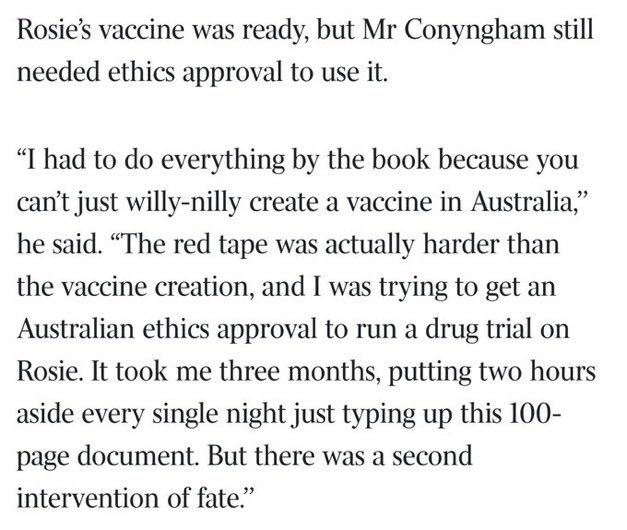
> need ethics approval to administer it
> red tape takes longer than designing the vaccine
> 3 months, finally approved
> drive 10 hours to get rosie her first injection
> tumor halves
> coat gets glossy again
> dog is alive and happy
> professor: “if we can do this for a dog, why aren’t we rolling this out to humans?”
one man with a chatbot, and $3,000 just outperformed the entire pharmaceutical discovery pipeline.
we are going to cure so many diseases.
I dont think people realize how good things are going to get
I've been thinking a bit about continual learning recently, especially as it relates to long-running agents (and running a few toy experiments with MLX).
The status quo of prompt compaction coupled with recursive sub-agents is actually remarkably effective. Seems like we can go pretty far with this. (Prompt compaction = when the context window gets close to full, model generates a shorter summary, then start from scratch using the summary. Recursive sub-agents = decompose tasks into smaller tasks to deal with finite context windows)
Recursive sub-agents will probably always be useful. But prompt compaction seems like a bit of an inefficient (though highly effective) hack.
The are two other alternatives I know of 1. online fine-tuning and 2. memory based techniques.
Online fine-tuning: train some LoRA adapters on data the model encounters during deployment. I'm less bullish on this in general. Aside from the engineering challenges of deploying custom models / adapters for each use case / user there are a some fundamental issues:
- Online fine-tuning is inherently unstable. If you train on data in the target domain you can catastrophically destroy capabilities that you don't target. One way around this is to keep a mixed dataset with the new and the old. But this gets pretty complicated pretty quickly.
- What does the data even look like for online fine tuning? Do you generate Q/A pairs based on the target domain to train the model? You also have the problem prioritizing information in the data mixture given finite capacity.
Memory based techniques: basically a policy for keeping useful memory around and discarding what is not needed. This feels much more like how humans retain information: "use it or lose it". You only need a few things for this to work:
- An eviction/retention policy. Something like "keep a memory if it has been accessed at least once in the last 10k tokens".
- The policy needs to be efficiently computable
- A place for the model to store and access long-term memory. Maybe a sparsely accessed KV cache would be sufficient. But for efficient access to a large memory a hierarchical data structure might be beter.
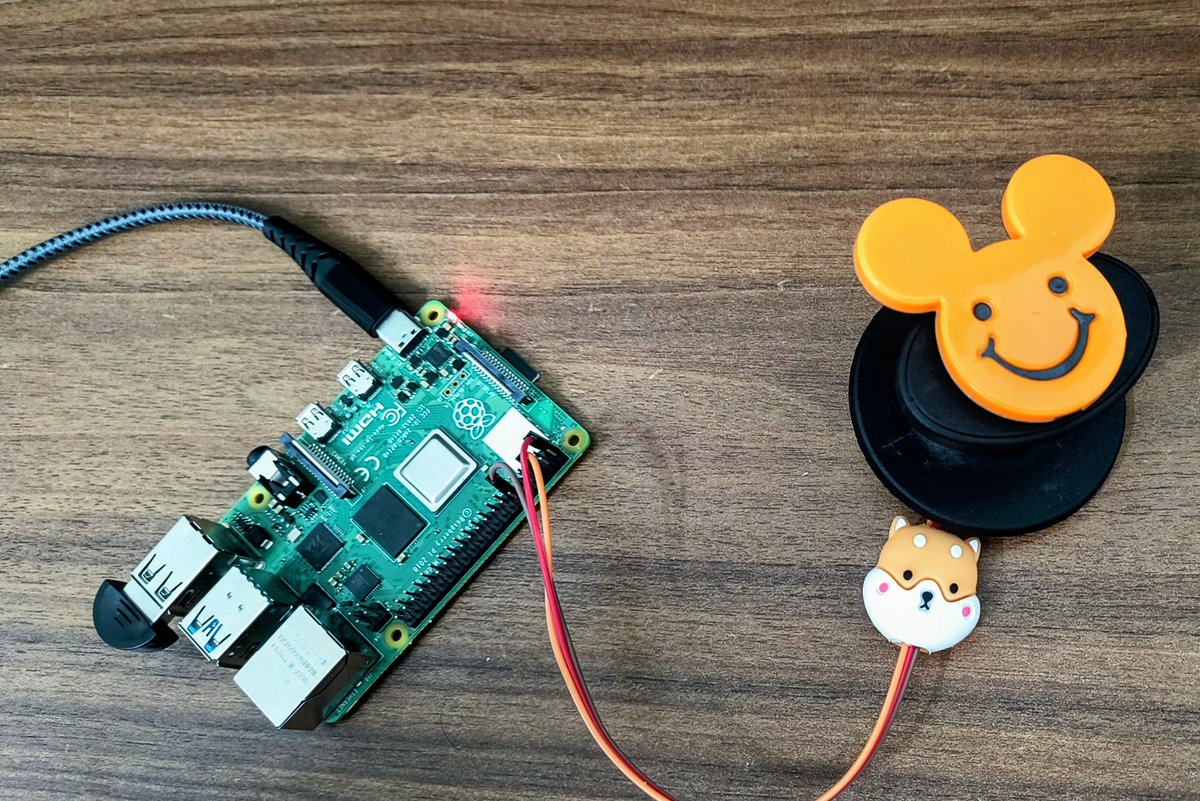
i kept wasting my weekends doing nothing so i built a button that kidnaps me. whenever im bored, i press it and it books an uber to a random interesting place in my city🚘
it has a physical digital push button connected to my raspi, and some python script.
ive pressed it 11 times so far and never had a bad trip. ok bye, going to a 110-year-old wrestling pit in shivajinagar, blr. i don't know what to expect but i'm excited
We offered 5 people a Porsche 911 GT3 RS if they could get @WisprFlow to make a mistake
It's the fastest and most accurate AI voice dictation app that's 3x more accurate than ChatGPT, Claude, or Siri.
Today, we’re finally launching on Android. Download now: https://t.co/TJhnUhDSLv
As a part of the launch, we’re giving away 6 months of Wispr Flow Pro for free.
Like, retweet and comment ‘Wispr Flow’ to get it. Enjoy.
— Written with Wispr Flow
World's first AI that asks before it designs.
Muse: refuses to generate slides until it understands your story. No slop. Just stunning presentations that actually sound like you.
Repost + comment "MUSE" to get early access in the next 24 hours.
A few random notes from claude coding quite a bit last few weeks.
Coding workflow. Given the latest lift in LLM coding capability, like many others I rapidly went from about 80% manual+autocomplete coding and 20% agents in November to 80% agent coding and 20% edits+touchups in December. i.e. I really am mostly programming in English now, a bit sheepishly telling the LLM what code to write... in words. It hurts the ego a bit but the power to operate over software in large "code actions" is just too net useful, especially once you adapt to it, configure it, learn to use it, and wrap your head around what it can and cannot do. This is easily the biggest change to my basic coding workflow in ~2 decades of programming and it happened over the course of a few weeks. I'd expect something similar to be happening to well into double digit percent of engineers out there, while the awareness of it in the general population feels well into low single digit percent.
IDEs/agent swarms/fallability. Both the "no need for IDE anymore" hype and the "agent swarm" hype is imo too much for right now. The models definitely still make mistakes and if you have any code you actually care about I would watch them like a hawk, in a nice large IDE on the side. The mistakes have changed a lot - they are not simple syntax errors anymore, they are subtle conceptual errors that a slightly sloppy, hasty junior dev might do. The most common category is that the models make wrong assumptions on your behalf and just run along with them without checking. They also don't manage their confusion, they don't seek clarifications, they don't surface inconsistencies, they don't present tradeoffs, they don't push back when they should, and they are still a little too sycophantic. Things get better in plan mode, but there is some need for a lightweight inline plan mode. They also really like to overcomplicate code and APIs, they bloat abstractions, they don't clean up dead code after themselves, etc. They will implement an inefficient, bloated, brittle construction over 1000 lines of code and it's up to you to be like "umm couldn't you just do this instead?" and they will be like "of course!" and immediately cut it down to 100 lines. They still sometimes change/remove comments and code they don't like or don't sufficiently understand as side effects, even if it is orthogonal to the task at hand. All of this happens despite a few simple attempts to fix it via instructions in CLAUDE . md. Despite all these issues, it is still a net huge improvement and it's very difficult to imagine going back to manual coding. TLDR everyone has their developing flow, my current is a small few CC sessions on the left in ghostty windows/tabs and an IDE on the right for viewing the code + manual edits.
Tenacity. It's so interesting to watch an agent relentlessly work at something. They never get tired, they never get demoralized, they just keep going and trying things where a person would have given up long ago to fight another day. It's a "feel the AGI" moment to watch it struggle with something for a long time just to come out victorious 30 minutes later. You realize that stamina is a core bottleneck to work and that with LLMs in hand it has been dramatically increased.
Speedups. It's not clear how to measure the "speedup" of LLM assistance. Certainly I feel net way faster at what I was going to do, but the main effect is that I do a lot more than I was going to do because 1) I can code up all kinds of things that just wouldn't have been worth coding before and 2) I can approach code that I couldn't work on before because of knowledge/skill issue. So certainly it's speedup, but it's possibly a lot more an expansion.
Leverage. LLMs are exceptionally good at looping until they meet specific goals and this is where most of the "feel the AGI" magic is to be found. Don't tell it what to do, give it success criteria and watch it go. Get it to write tests first and then pass them. Put it in the loop with a browser MCP. Write the naive algorithm that is very likely correct first, then ask it to optimize it while preserving correctness. Change your approach from imperative to declarative to get the agents looping longer and gain leverage.
Fun. I didn't anticipate that with agents programming feels *more* fun because a lot of the fill in the blanks drudgery is removed and what remains is the creative part. I also feel less blocked/stuck (which is not fun) and I experience a lot more courage because there's almost always a way to work hand in hand with it to make some positive progress. I have seen the opposite sentiment from other people too; LLM coding will split up engineers based on those who primarily liked coding and those who primarily liked building.
Atrophy. I've already noticed that I am slowly starting to atrophy my ability to write code manually. Generation (writing code) and discrimination (reading code) are different capabilities in the brain. Largely due to all the little mostly syntactic details involved in programming, you can review code just fine even if you struggle to write it.
Slopacolypse. I am bracing for 2026 as the year of the slopacolypse across all of github, substack, arxiv, X/instagram, and generally all digital media. We're also going to see a lot more AI hype productivity theater (is that even possible?), on the side of actual, real improvements.
Questions. A few of the questions on my mind:
- What happens to the "10X engineer" - the ratio of productivity between the mean and the max engineer? It's quite possible that this grows *a lot*.
- Armed with LLMs, do generalists increasingly outperform specialists? LLMs are a lot better at fill in the blanks (the micro) than grand strategy (the macro).
- What does LLM coding feel like in the future? Is it like playing StarCraft? Playing Factorio? Playing music?
- How much of society is bottlenecked by digital knowledge work?
TLDR Where does this leave us? LLM agent capabilities (Claude & Codex especially) have crossed some kind of threshold of coherence around December 2025 and caused a phase shift in software engineering and closely related. The intelligence part suddenly feels quite a bit ahead of all the rest of it - integrations (tools, knowledge), the necessity for new organizational workflows, processes, diffusion more generally. 2026 is going to be a high energy year as the industry metabolizes the new capability.