@PriyankKharge Be lazy stupid and lose elections and blame institutions.
Previously under Congress was the Chief Justice of India in the committee to select eci
Should Jawaharlal Nehru be credited
with setting up India’s first IIT as is
claimed by Nehruvian fantasists?
NO.
Should PM Modi be credited with setting up seven new IITs, taking the total to 23?
YES.
Nehru did not ‘create’ IITs. Nor did he set up India’s first IIT.
Dr BC Roy, CM of West Bengal, set up India’s first IIT in Calcutta in 1950; it later moved to Kharagpur on land owned by West Bengal Government.
IIT Kharagpur Act came six years later in 1956.
Soviet Union set up IIT Powai; US set up IIT Kanpur; West Germany set up IIT Madras (all of them with trade surplus and aid).
The idea of setting up Indian institutes of technology took shape in 1946 with Humayun Kabir leading the way and Nalini Ranjan Sarkar Committee preparing a report. Extant records do not mention any role played by Nehru.
So,
Why was the first IIT set up in #WestBengal ?
Because in 1950s West Bengal had the highest concentration of industry in #India.
What went wrong?
Nehru's Freight Equalisation Policy killed industry in West Bengal and all of east India. West Bengal became the 'Disinherited State'.
Rest is history.
Yes, comparing Modi era with Nehru’s is right. Not to do so would be injustice to millions who suffered because of Nehru.
For example, Hindu Bengali refugees. Their children, grandchildren must never forget that their people were abandoned and thrown to the wolves by Jawaharlal Nehru before, during and after Partition.
Nehru despised dark-skinned Hindu Bengali refugees, among them my father, his siblings, their widowed mother and grandmother, fleeing rapacious and murderous Muslim League mobs in East Bengal; he did not want them to seek shelter in India.
Nehru wrote to CM BC Roy, instructing him not to let Hindu Bengali refugees enter West Bengal. Push them back from the border, Nehru said, don’t let them in.
Nehru insisted Hindu Bengalis of East Bengal / East Pakistan were coming to India for free-loading at the expense of Indians. He cut back Central funds for West Bengal to stop the meagre refugee assistance by way of a couple of kilos of inedible worm-infested rotten rice for Hindu Bengalis.
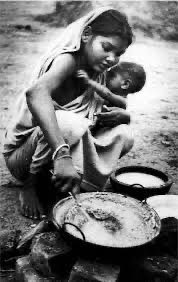
Hindu Bengali refugee women and children separated from their families, or widowed and orphaned in the Noakhali genocide and subsequent Partition Massacre of Hindus, rummaged in garbage bins and pitifully begged for morsels of food.
Hindu Bengali refugee children in rags with dark large sad eyes greedily licked on used banana leaves dumped on the streets by eateries, also known as ‘pice hotels’ in Kolkata parlance, of which there was a profusion in the post-War years. Emaciated babies and rickety children of Hindu Bengali refugees huddled with stray dogs on pavements.
Many Hindu Bengali refugees lived on ‘rice water’ or ‘fan’ (the starchy water that is thrown away after boiling rice) collected from homes of compassionate Bengalis who had little food to share.
In the morning and evening there were pheriwallahs hawking their wares; in the afternoon there were Hindu Bengali refugee women in tattered sarees that barely covered their bodies and naked children with battered and bruised aluminium pots going from house to house, begging for ‘rice water’: “Ma, fan daao Ma…”
Those voices of has hunger were to haunt Hindu Bengali refugees like my parents for long, often till death.
Driven by hate for Hindu Bengali refugees, Nehru ordered horrifyingly, nauseatingly squalid and disease-ridden refugee camps to be named ‘Permanent Liability Camps’ or PLCs — PLC 1, PLC 2… — reminiscent of the ‘Permanent Solution Camps’ of the Nazis.
When despite his best efforts Nehru failed to push back the Hindu Bengali refugees to be slaughtered in East Bengal/East Pakistan, Nehru brought his devastating Freight Equalisation Policy which collapsed industry in West Bengal. Tens of thousands of jobs were destroyed and the Hindu Bengali was rendered jobless: Those who lost their jobs and businesses began turning on Hindu Bengali refugees just as Nehru had hoped.
Yet Nehru could not break the spirit of the Hindu Bengali refugees who were grateful to Bharat and determined to help rebuild this great nation savaged by invaders and colonisers especially John Company.
Through generations we Hindu Bengali refugees toiled, we built, we paid taxes, we sacrificed for the Nation, our Nation, we succeeded in establishing ourselves as dutiful, law-abiding, loyal citizens of India. Having lost our home and hearth, we had no other home but India.
We Hindu Bengali refugees were hived off to malaria-infested inhospitable Dandakaranya and we cleared forests and made the soil fertile. We were packed off to Andaman and we rebuilt our lives there. When we tried to set up home at Marichjhapi we were slaughtered: the estuaries turned red with our blood.
We grieved, we got up, we overcame that setback.
We lived with dignity and honour, we earned our food, we were not freeloaders. We were poor but we were honest: we had integrity.
Cut to 2026.
So who have proved to be India’s ‘Permanent Liability’ cadging off the state and living on unearned money? Nehru Dynasty.
Keeping in mind the rising fuel costs in the country, I bought an MG Windsor EV a few months ago. I genuinely believed I was making a smart decision. Unfortunately, what followed has been one of the worst ownership experiences of my life.
About a month ago, while returning from my son's school, a speeding Mahindra Thar rammed into my car from behind. My vehicle was moving at barely 30–35 km/h when the impact pushed it into an Innova ahead. The rear section of the car suffered significant damage.
The very same day, I handed the vehicle over to MG's service center for repairs.
From that point onward, for weeks, I kept making the same phone call:
"When will my car be ready ?"
Every time, I received a different excuse.
Last Saturday , I was informed that the repair work had been completed and only the insurance company's delivery order was pending. I was assured that the order would arrive on Monday and the car would be handed over immediately.
Monday came and went.
By afternoon, having heard nothing, I decided to visit the workshop myself.
And that's when the real story began.
The service advisor responsible for my vehicle didn't even know where the car was parked. After searching across three floors, we finally discovered it in the basement.
What I saw there left me speechless.
The car was in worse condition than it had been immediately after the accident.
At that moment, I realized that my biggest mistake wasn't the accident it was buying an MG. In the last 20 years, I have owned vehicles from almost every major automobile manufacturer. I've dealt with repairs, insurance claims, and service centers countless times. But I have never experienced such disorganization, negligence , and lack of accountability from any company.
Keeping a customer's vehicle for nearly a month, providing misleading updates, and then not even knowing where the car is parked is not poor service it's complete disrespect for the customer's time , trust, and money.
As I was leaving the workshop, I told the advisor "Brother, sell this car for whatever you can get even if I have to take a loss of a few lakhs. I don't have the courage to bring it home anymore. If I ever have to come back to this workshop again, I might genuinely lose my mind."
People may debate how good or bad the MG Windsor EV is as a product.
But as far as MG's after-sales service is concerned, my verdict is final.
This has been, without a doubt, the worst customer service experience I have ever had with any automobile company.
If you're considering buying an MG vehicle, don't just visit the showroom. Spend some time at their service center first. The difference between the two may help you make a much better decision.
@MGMotorIn@MGSupportIndia