Some of us will live forever.
And if you’re reading this, that may or may not be you.
I am so bullish on this that I just renamed my company to Immortals.
Below:
+ why I think this
+ early signs of success
+ how to increase your odds
Yes, I know this sounds crazy.
Immortality has been an ambition for humanity since the beginning of recorded history.
The immortality I’m referring to is specific: increases in life expectancy will outpace the rate of aging. Meaning, we will no longer, by default, expect to die of natural causes.
I believe this for three reasons.
#1: Immortality already exists
Biology can reverse some features of aging, and in a handful of organisms escape it almost entirely. For example, a sperm and an egg from two people in their 30s carry the legacy of bodies that have aged for decades (the egg in particular has been arrested inside the mother since before she herself was born), yet they combine to produce an embryo that resets the aging clock to zero.
The immortal jellyfish goes further and resets itself within one lifetime, reverting its adult cells to an earlier stage through transdifferentiation and starting its life cycle again. And in the lab, scientists have begun doing this deliberately, making induced pluripotent stem cells (iPSCs) from mature adult cells such as skin fibroblasts, and using partial cellular reprogramming to turn the clock back in the tissues of living animals.
#2: AI offers new potentials
Biology is a hard problem. For most of history that complexity was beyond native human capacity. AI was made for this complexity. The clearest demonstration so far is protein folding. Predicting the three-dimensional shape a protein folds was an unsolved problem for roughly fifty years, and it mattered because a protein's shape determines what it does in the body.
DeepMind's AlphaFold2 effectively solved it in 2020, reaching a median accuracy of 92.4 out of 100, a level long thought to require the slow, painstaking work of crystallizing a protein and solving its structure by X-ray crystallography. It then released predicted structures for over 200 million proteins, nearly the entire catalogued protein universe, in a fraction of the time anyone expected.
#3: Early signs are encouraging
These aspirations are not imaginative. With the current tools in biotech Sid Sijbrandij, the co-founder of GitLab, was diagnosed with an aggressive bone cancer, osteosarcoma in his vertebrae. He treated his own disease like an engineering problem, he used AI to help direct several experimental, personalized therapies in parallel and drove the cancer into remission after standard medicine had given up. Around the same time, an Australian named Paul Conyngham, with no medical or biology background, did something similar for his dog. He used AI to help design a personalized mRNA vaccine targeting the specific mutations in his dog's tumor, and after it was given alongside another immunotherapy and within a few months the main tumor had shrunk by roughly three-quarters.
How to increase your odds…
I. Don’t die in the meantime
We don’t know when these longevity therapies will become available. Your goal is to be around when they come out. Buy yourself as much time as possible by looking after your body to the best of our scientific knowledge. Good diet, sleep, exercise will get you 80% of the results.
II. Find your achilles
Longevity therapies will likely be outcome specific. Individual specific drugs/therapies that target specific things like…
> prevent and remove arterial plaque
> prevent and reverse neurodegeneration
> specifically target and eliminate cancers, or pre cancerous legions
> prevent frailty and muscle loss, and regain muscle mass, strength and, bone density
> reverse skin aging
> rejuvenate eye health
> restore lost hearing
> etc
We don’t know what therapies will be available first. Your goal is to find what your body is struggling with most and keep that problem at-bay until a therapy is available that can fully cure or reverse it.
For example, do you struggle with cholesterol? Blood glucose control? Cognitive decline? Find your achilles heel and reduce your risk systematically.
III. Invest in the future
There are three macro trends happening on planet earth right now, and the people who bet on these areas have the highest risk + reward.
> AI
> Immortality
> Energy
As we know, power comes in many forms: money, social, political, health, etc. Those that can collect power in these fields will have the greatest chance of positioning themselves in the Immortal future.
With time, Immortal therapies will become broadly available.
If you’re reading this: don’t waste your chances by burning down your life points on a yolo-like mentality. Grind culture, addiction, social media pollution, fast food, porn, alcohol, these are all corporations turning your life into their profit. This is the Die Economy.
My company Immortals has the sole objective of turning your time, attention, and life into more healthy, functional, and prosperous minutes, days, and years. The Don’t Die Economy.
Good luck.
qPCR allowed us to measure transcripts, but just once, destructively, and only in post-mortem tissues. Here, we show we can record transcript level history in vivo and recover this information with a blood test to make a "noninvasive qPCR". https://t.co/fe6yjsrdGr
Congrats to the first author, our postdoc Sho Watanabe @alfort_123 and the rest of the team.
We are grateful to our funders @PackardFdn, @NIH@NIBIBgov for the DP2, @jsps_sns for Dr. Watanabes postdoc fellowship, and @NSF for our grad students' Emma Raisley's GRFP.
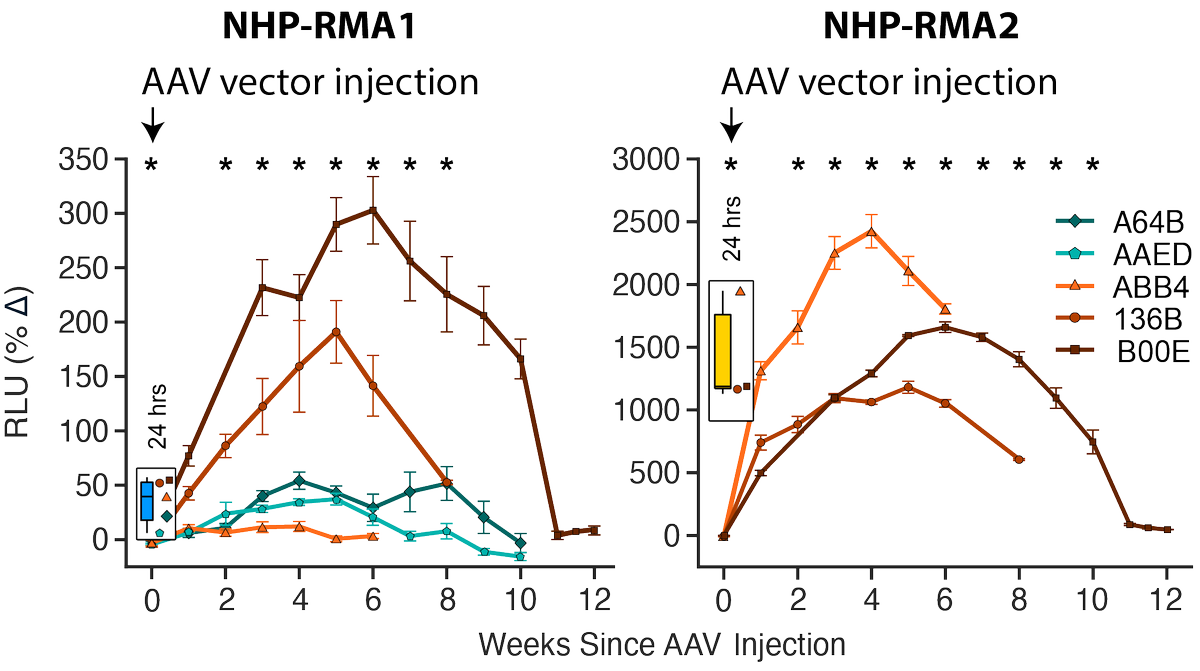
How can you know if gene delivery in a primate worked? Typically through expensive scans or histology. With @VincentCostaPhd and first authors @sangsin_lee and McKenna Romac we made synthetic markers that monitor gene delivery and Cre-dependent expression with a blood test. PDF👇
Usually serum markers are detected as they are - often hard to detect, long half-life, or with high background that reduces temporal resolution. What if we could modify the markers in vivo so they can better match our needs? Introducing this concept with erasable serum markers.
I am very thankful to @_BrightFocus and their donors, for the grant we received today. Using these funds we will enable monitoring of gene expression in the intact retina to understand the molecular basis and progression of age-related macular degeneration and improve diagnosis.
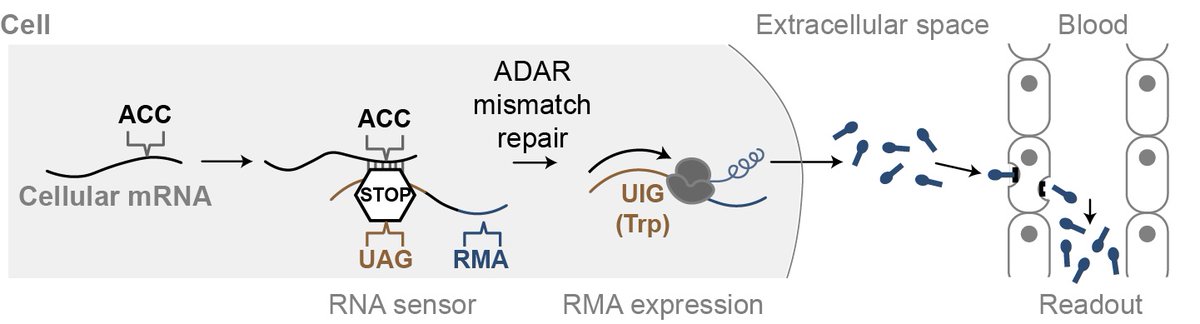
qPCR can measure expression of virtually any gene... in homogenized tissues. Here, we show an "in-vivo qPCR" equivalent, where we measure a sequence-specific transcript with synthetic serum markers and enzyme-based signal amplification.
https://t.co/pUisE5gesh
Could one envision a synthetic receptor technology that is fully programmable, able to detect diverse extracellular antigens – both soluble and cell-attached – and convert that recognition into a wide range of intracellular responses, from transgene expression and real-time fluorescence to modulation of innate cell behavior (excitation or inhibition of neurons, induction of cell migration, etc.)?
Today we report in Nature a new technology platform that provides a step in that direction: PAGERs, for Programmable Antigen-gated G protein-coupled Engineered Receptors, convert recognition of extracellular soluble or cell-attached antigens into diverse user-selected responses. PAGERs are based on G-protein coupled receptors (GPCRs), which themselves are not structurally modular, but we were able to build in modular antigen gating by fusing an antagonist peptide to the extracellular N-terminal end, and then gating the antagonist with a fused antigen-binding nanobody. When antigen binds, it sterically interferes with the antagonist, leading to relief of receptor inhibition. Drug or agonist can then turn on PAGER.
https://t.co/Clt8yjyk2y
I am looking forward to coming back to @MIT for Neurotech 2024 tomorrow!
I will talk about noninvasive interfacing with the brain, including new projects with our postdoc Sho Watanabe @alfort_123 and collaborators @VincentCostaPhd and Rui Chen (UCI).
https://t.co/YMwILPUTkO
Published today in @Nature, we describe an approach for single-molecule protein reading on @nanopore arrays. By utilizing ClpX unfoldase to ratchet proteins through a CsgG nanopore, we achieved single-amino-acid sensitivity. https://t.co/ZTFNZkwpcj
How could we check if a gene therapy reached the desired brain region? Here, we noninvasively measure gene delivery and endogenous gene expression in specific brain sites with ultrasound-released synthetic serum markers.
https://t.co/ADAbtHQKw0
🧬 🧠 Exciting news from Rice BIOE @JerzySzablowski team! Their innovative gene therapy method could revolutionize brain disorder treatments by targeting specific regions with unprecedented precision. Discover more in Nature Communications! https://t.co/5gIYTDSALe
Can AAVs be evolved for better brain delivery after targeted ultrasound insonation? We report new AAVs optimized for focused ultrasound BBB opening. Congratulations to all involved!
@Richieli_Biomed@ManwalHarb John Heath @JakeSTrippett @mikhailshapiro
https://t.co/ngDGr88YSW
A team led by the Ajo-Franklin group’s very own @Bacterioman99 has uncovered the mechanism through which E. coli utilizes redox shuttles for extracellular respiration and growth, showcasing the unexpected versatility of microbial metabolism https://t.co/N0OQrfe1j5
We are recruiting! Open projects related to enzyme engineering, protein directed evolution, computational protein design, spatial proteomics, RNA tools, protein therapeutics, and molecular technology development for cell biology and neuroscience.
We especially welcome trainees with backgrounds in chemical biology, machine learning, enzyme biochemistry, and molecular biology to join our team! We value diversity and aim to foster an inclusive and supportive environment for trainees. Please reach out to [email protected] to learn more!
Neurons and astrocytes closely coordinate their gene expression, in a program we call “SNAP” – a collaboration that we find to be central in protection from schizophrenia and cognitive aging.
https://t.co/dj0jMklreP
⚡️🧠Thrilled to share our new preprint on pain-related valence cell-types + circuits — A nociceptive amygdala-striatal pathway for chronic pain aversion
Check out the stellar work of Jessica Wojick, in a co-senior collab with @KorbLab
https://t.co/FC5RCA4j6b
THREAD 1/13