50 legendary internet rabbit holes you can spend hours exploring👇
1. https://t.co/ueX0rgHHma — Watch the world via live satellite imagery
2. https://t.co/ZvRw1wmNsJ — See every plane currently in the sky
3. https://t.co/ysMWhN8eU5 — Track all ships at sea in real time
4. https://t.co/ukJigDtLFY — Live map of winds and storms
5. https://t.co/Y1I20AitIs — Watch lightning strikes hitting Earth in real time
6. https://t.co/LmzpGivPqL — Live list of recent earthquakes
7. https://t.co/VU7EuP5SOm — Ocean cables carrying the internet
8. https://t.co/kAAdHcSNpt — Watch forests disappear from space
9. https://t.co/bbkThFLpz1 — The world's statistics, second by second
10. https://t.co/pMvZJO0YfM — Current number of tweets and searches being posted
11. https://t.co/VhEnQl9oax — Compare the true sizes of countries
12. https://t.co/XyyYYcRjdm — Maps from centuries ago
13. https://t.co/AOXvH90KFK — Archive of 150,000 historical maps
14. https://t.co/u0Zf6LJoDZ — World map drawn by volunteers
15. https://t.co/p2uu9hAQks — Look out the window of a random person around the world
16. https://t.co/powm7RRAmX — Virtual walks through cities
17. https://t.co/bcsy3ybL07 — Teleport to a random spot on Earth
18. https://t.co/5YbDgnYpF7 — Catalog of the world's strangest places
19. https://t.co/SJN9aIxuyM — Interactive knowledge experiences
20. https://t.co/bpyBnZgtz1 — Scale journey from atom to universe (Updated HTML5 link)
21. https://t.co/UP12t0jeRy — Explore the solar system in 3D
22. https://t.co/9xDWk6aGgf — Real sky map in your browser
23. https://t.co/ZSJokVTin1 — NASA's astronomy picture of the day
24. https://t.co/7XrqjHR7BR — NASA's entire visual archive, free
25. https://t.co/3tWvLaeyGu — Visual articles told through data
26. https://t.co/JY8FI1u9ls — The state of the world with real data
27. https://t.co/Ois9J7u7m7 — What we mistakenly think we know about the world
28. https://t.co/NtDVcv2cxN — Visualizing complex data
29. https://t.co/FqijxOqnJL — World Bank's open data
30. https://t.co/NyYgq0wMs7 — Turkey's official statistics database
31. https://t.co/KDjOuBVmft — Archive of millions of books, films, and software
32. https://t.co/9Y8pcXCzKu — 70,000 free books whose copyrights have expired
33. https://t.co/hJt2YM0nzp — Record of every book in the world
34. https://t.co/6kwMQCzdZq — U.S. Library of Congress digital archive
35. https://t.co/GAjugENT89 — Europe's cultural heritage archive
36. https://t.co/LPx73NbK1E — America's digital library collection
37. https://t.co/VjpuQq1BIZ — Tour museums from home
38. https://t.co/lkaoYLTy3S — Download artworks in high resolution
39. https://t.co/AX9cd7YatS — Archive of 250,000 artworks
40. https://t.co/WExwDy3e6F — Forgotten visual treasures of history
41. https://t.co/Bobq0w1hyR — Free archive of culture and education
42. https://t.co/bgBEuHixJo — Met Museum's open collection
43. https://t.co/jxj8X1LuEy — Family tree of music genres
44. https://t.co/d8lZJ9yWc3 — Pick a country and decade to listen to that era
45. https://t.co/avmQLINXhU — Turn Wikipedia edits into audio
46. https://t.co/7WDyOPTfU6 — Random knowledge well
47. https://t.co/4qVlBpRvCf — Time, sunrises, and sky events
48. https://t.co/V2ObL5vTSR — Live stream of science news
49. https://t.co/VFhRaZRXso — Free preprints of scientific papers
50. https://t.co/JUo9A2FPFW — Visualize data with live code
Save this. You’ll definitely need some of these later. 🔖
Follow @zakiraicoder for more useful websites, AI tools & tech resources.
I’m in love with this sentence:
“Every pattern in your life repeats until you learn the lesson. The moment you choose differently, the loop ends and growth begins.”
In the scorching summer of 1984, the Northern Railway reservation office at New Delhi station was a circle of hell.
100,000+ passengers descended on the station daily. Behind wooden counters sat clerks buried alive under 1000s of bound, leather-backed ledgers called Charting Sheets. To book a ticket, a clerk had to physically find the ledger, cross out a berth with a fountain pen, hand write a paper ticket, and file a duplicate slip.
If you wanted a return ticket from Madras to Delhi? You could not buy it in Delhi. You had to send a physical telegram to Madras, wait 48-72 hours for a manual reply, and pray the seat was not sold twice.
This is where CMC Limited (Computer Maintenance Corporation) slowly entes into the scene, a public sector company staffed by young, intense Indian systems engineers, working alongside a dedicated task force from Indian Railways.
The mandate was terrifying: Digitized reservation did not exist at this scale in the developing world. Foreign vendors wanted astronomical sums for custom software. The team had to build it from scratch, using bare metal hardware.
They chose VAX/VMS minicomputers and picked a language built for raw numerical calculation, not transaction processing: FORTRAN.
They named the software IMPRESS (Integrated Multi-train Passenger Reservation System).
On 15th Nov, 1985, a quiet pilot went live at New Delhi station for just 2 trains: the Tamil Nadu Express and the Grand Trunk Express.
There were no satellite beams / grand reveals. The software was bug riddled, the clerks were terrified of the green phosphor CRT monitors, and paper backups were kept open on the desks just in case the system crashed.
When the 1st green terminal screen printed a clean, automated ticket in < 60 secs without a clerk touching an ink pad, the engineers in the back room did not celebrate. They held their breath, waiting for the system memory to dump.
It did not......
By 1987, IMPRESS was expanded to Bombay, Calcuttta, and Madras. But there was a catch: They were island nodes.
Bombay had no idea what Calcuta was doing. A clerk in Delhi could still only sell tickets for trains originating out of Delhi.
To manage this growing digital beast, Indian Railways created CRIS (Centre for Railway Information Systems). CRIS inherited 5 massive regional databases: Delhi, Bambay, Calcutta, Madras, and Secunderabad.
Each region was an isolated digital kingdom running on different hardware iterations.
As travel exploded in the 1990s, the "Island Problem" became a crisis. Passengers did not travel in single regions.....
CRIS engineers were tasked with the ultimate computer science nightmare: How do you synchronize 5 massive, high throughput, realtime transaction databases across 4,000 KMs over unreliable copper telegraph lines and primitive telecom links?
If a user in Secunderabad tried to book a seat on a train running from Howrah to Bombay while a user in Ahmedabad tried to book the exact same berth at the exact same second, how do you prevent a deadlock without crashing the entire national network?
The CRIS team went to work on a master architecture: CONCERT (Country-wide Network for Computerized Enhanced Reservation and Ticketing).
They had to engineer custom distributed database protocols. They built networking software that could handle dropped packets, noisy BSNL landlines, and sudden power blackouts. Where landlines failed, they rigged up hybrid data pipes, combining microwave links, leased telecom lines, and early satellite VSATs for redundant failovers.
The system was rolled out region by region starting in 1994. The pressure on the CRIS software architects was unbearable, a single logic bug in memory locking could lock up 100s of 1000s of seats across the nation, halting the economy overnight.
Finally, in April 1999, the final switch was flipped....
For the 1st time in human history, a passenger walking up to a remote ticket window in Guwahati could instantly query, lock, and purchase a ticket for a train running between Trivandrum and Mumbai in < 2 secs.
It was a 15 year relentless siege by teams at CMC and CRIS, writing low level C and FORTRAN code, fighting hardware limitations, and building custom networking protocols long before modern cloud infrastructure existed.
When IRCTC was launched in 2002 to bring ticket booking to web browsers, it did not build the core reservation engine. It simply built a web frontend that plugged into the massive, bulletproof CONCERT backend built by CRIS.
Today, that same underlying architectural logic handles over 1.5M+ bookings a day, serving a population larger than entire continents.
Remember, this was done without any massive VC funding. Just pure, unyielding Indian engineering built line by line in the dark.
What @palkisu is saying makes sense. When algorithms become teachers, reels become textbooks , virality becomes truth, when reading disappears, it is misinformation that flourishes. An uninformed generation can be a potential national security risk.
Here are some highlights from the Wings India 2026 journey so far. We’re super excited for the Grand Finale tomorrow 31st Jan at Begumpet Airfield, 12 pm onwards!
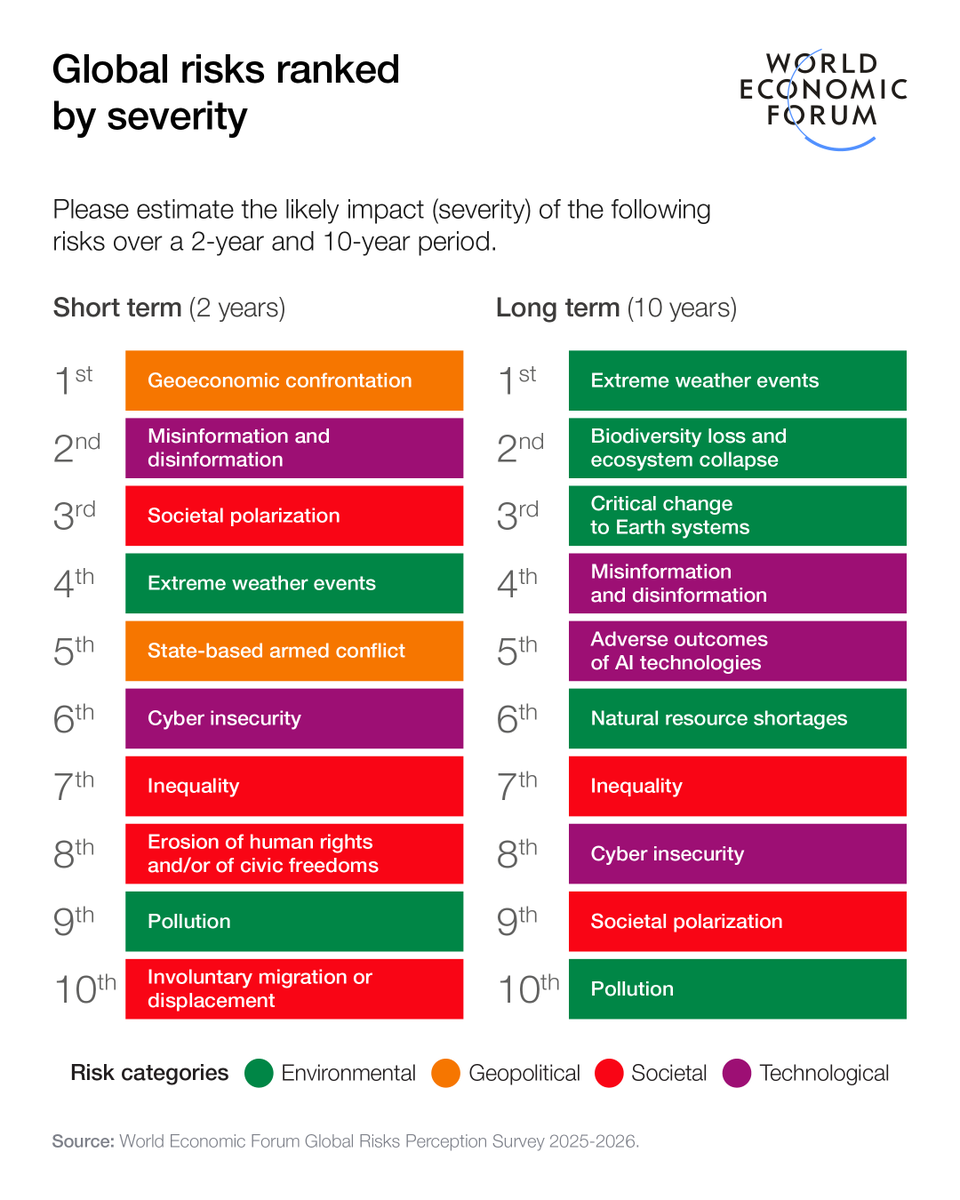
The Global Risks Report 2026 is live.
From #geoeconomic tensions and #inequality to #AI-driven disruption, the report outlines the risks shaping the next decade, and why rebuilding cooperation is more important than ever.
Read the full report: https://t.co/vSMFSDcrqu
#risks26 #wef26
If You Have Diabetes, Don’t Skip These 5 Important Tests | Dr. V. Mohan
Managing diabetes is not just about sugar levels, it is about protecting your eyes, kidneys, heart and nerves.
In this video, Dr. V. Mohan, Chairman of Dr. Mohan’s Diabetes Specialities Centre explains the 5 most important tests every person with diabetes should do every year to prevent serious complications and stay in control of their health.
These simple annual tests can help detect problems early, reduce long-term risks and ensure a healthier, complication-free life with diabetes.
Whether you have Type 1, Type 2 or prediabetes, this video is a must-watch for you and your family.
👉 Take charge of your diabetes. Prevention always starts with awareness.
Most students study, but very few learn. If you want strong memory, deep understanding, and top performance, stop passive reading and switch to ACTIVE STUDY. Here are 20 powerful methods to upgrade your learning.
Thread below. #Academic#Study#Learning (1/21)
AI works better when you pick the right model.
Here’s a simple way to do that.
Each tool has its own strength.
Once you know the pattern, your work moves quicker.
Here’s a clear breakdown anyone can follow.
ChatGPT
Great for writing, planning, editing, and multi-step workflows.
Strong when you need structure, creative ideas, or polished content fast.
Claude
Best for careful thinking and long documents.
Use it for reasoning-heavy tasks, legal detail, or sensitive material.
Gemini
Built for Google Workspace users.
Summarise Docs, fix Sheets formulas, label emails, and pull insights from Drive.
Copilot
Built for Microsoft 365 with live context from your files.
Rewrite documents, summarise long threads, extract insights from Excel or Word, and turn meeting transcripts into clear action steps.
When you match the task to the right model, results improve fast.
You stop guessing and start getting what you need.
Which model do you use and for what? Comment below.
This multi-functional truck container can be used as a folding restaurant, mobile supermarket, mobile service centre, mobile cinema, mobile camping vehicle, or RV.
Most people write prompts by guessing.
These frameworks give you structure that works every time.
Clear prompts shape clear output.
You get faster answers.
You make clearer decisions.
You stop rewriting the same request.
Here are six simple frameworks your team can use today.
1. R-A-C-E
Role, Action, Context, Expectation.
A clean way to tell ChatGPT who it is, what you need, and what success looks like.
2. R-I-S-E
Role, Identify, Steps, Expectation.
Perfect for decisions, meetings, and any task that needs direction.
3. S-T-A-R
Situation, Task, Action, Result.
A strong format for reviews, summaries, and explaining outcomes.
4. S-O-A-P
Subject, Objective, Action, Plan.
Great for project scopes, fixes, and outlining requests clearly.
5. C-L-E-A-R
Context, Learn, Evaluate, Action, Review.
Helps break down complex topics into simple steps the model can follow.
6. G-R-O-W
Goal, Reality, Options, Will.
A sharp way to plan, decide, and move work forward.
Use these frameworks across your week and your prompts stay consistent.
You save time.
You get stronger output without the back-and-forth.
Did I miss any frameworks your team uses? Comment below.