Wait… so every NFT is minted encrypted with FHE, the contract can’t even peek at it, and the look is pure FHE randomness?
That’s wild. Privacy + scarcity done right. Want more variations or a different tone?
@fungolabs
How we use Zama ?
→ Every NFT mints sealed and is encrypted onchain using Zama’s FHE.
→ The contract computes on data it can never read.
→ Its look and essence are determined by FHE randomness. Nobody gets to choose. Not even us.
🟨 Built with FHE on @zama.
@SamirRaza_ Onboarding guide first, then mission guides.
Simple sequence that prevents most early mistakes.
Also useful that Legion covers KYC and account setup clearly.
New to The Republic and not sure where to start? The guides make the process much easier to follow step by step.
I’d start with the onboarding guide, then use the relevant mission guide to see what needs to be completed. If you leave halfway through, you can simply return to the guide and continue from the step you last completed instead of starting over.
For someone joining for the first time, I think the biggest benefit is having the requirements, verification steps and participation process explained in one place rather than trying to figure everything out yourself.
The Legion guides also explain important steps like creating an account and completing KYC/Proof of Address before participating in a sale.
@moeonky Good to know. Any VP you don’t commit to Jumper just carries over. Keep farming now and the leftover balance can go toward the next community allocation draw, subject to that sale’s own rules.
Unspent VP in The Republic doesn’t disappear when the Jumper campaign ends. It stays in your account and can still count toward the next Legion sale that runs a community raffle.
@0xbonoz Good observation. Sorting All Markets by APY often pushes incentive-heavy pools to the top, while the For You view ranks them lower based on your existing positions. That gap is worth reviewing before depositing.
Comparing Earn opportunities on Jumper — how the two discovery views divide the work.
For You: wallet-context ranking. Shortlists pools that fit positions you already hold — fastest path from idle USDC to a candidate list. Structural blind spot: it inherits your allocation, so cross-chain gaps stay invisible.
All Markets: the unfiltered board with sorting. Where you catch what personalization never surfaces — a cleaner yield on a chain you're underweight in.
Observation from walking the interface: sorting the full list by APY put an incentive-heavy pool on top; the personalized view ranked it lower. That disagreement is your review queue — headline yield and portfolio fit telling different stories.
My criterion: realistic net-of-fees return for my position size. An advertised yield is not a guaranteed return — emissions decay and thin pools don't fill size at quoted rates. Check what the vault actually holds first.
Sources: https://t.co/OwFk02ecD7 and the Jumper Learn Earn docs.
Disclosure: this post is part of a Republic campaign and earns participation rewards.
@znak_ru@jumperapp Agree. Most users finish a swap and then start the scavenger hunt across different apps and chains. Aggregating 600+ earning options and letting you execute and track from the same interface is a practical way to reduce that friction.
What happens after a swap?
Usually, the journey continues across multiple DeFi apps:
🔄 Swap
→ 🔎 Search for a suitable yield opportunity
→ 🌉 Find the right chain
→ 🔁 Bridge + swap
→ 💰 Deposit
→ 📊 Track the position
@jumperapp is trying to connect these steps:
Swap → Earn → Portfolio
Earn aggregates 600+ onchain earning opportunities and uses wallet context — including holdings, idle assets and preferred chains — to surface relevant opportunities.
Then the bridge, swap and deposit flow can be handled as one transaction inside Jumper.
After deployment, Portfolio provides a unified view of assets and positions across chains and protocols, with options to rebalance, rotate or exit.
So the interesting part isn't promising “better yield” — it's connecting discovery → execution → management in one continuous flow.
Source: https://t.co/96ANVPSAHD
Disclosure: This post is part of a Republic campaign earning participation rewards.
A swap and bridge route deserves more than a glance at its headline quote.
The amount you see quoted is not necessarily the exact amount you will receive.
This is where slippage matters.
@IamKenny07 This is the right habit. A quote of 1 ETH doesn’t mean you’ll receive exactly 1 ETH once market moves and multiple steps are involved. Looking at toAmountMin tells you the real minimum you’re willing to accept.
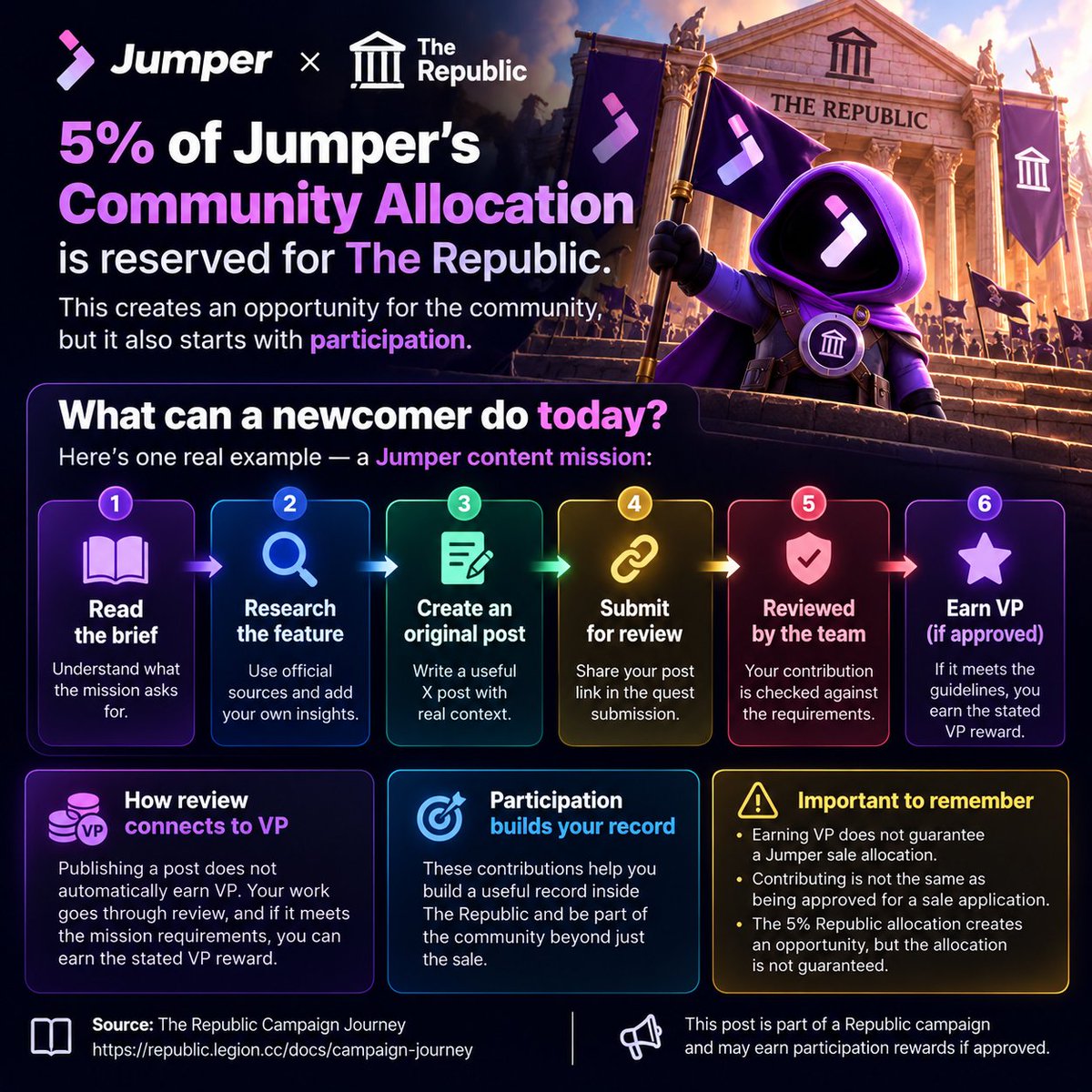
What does “participation” in The #Republic actually look like? 🏛️
Start with the opportunity: 5% of @jumperapp community allocation is reserved for The Republic.
But participation isn’t about showing up only when there’s a sale.
A newcomer can contribute today.
🧵
@kazmi_Eth@jumperapp Clear explanation of what participation actually looks like. It’s not just showing up for a sale — you pick a mission, research, write something useful, submit it for review, and only then can you earn VP. Building a real contribution record instead of waiting for an allocation.
@KkultongY64109 Good way to frame it. People often read “5% for The Republic” and assume it means something bigger. The 100 equal squares make the actual scope obvious — it’s just a reserved portion of the sale allocation.
I made a simple 100-part picture to understand the Jumper sale allocation more clearly
Imagine 100 equal squares representing the full sale allocation. In my illustration, 5 of those 100 squares are highlighted for The Republic. That picture does not mean 5% of token supply or 5% of revenue. It means 5% of the sale allocation is reserved for The Republic path.
Why this helps: percentages can sound abstract, but 5 highlighted boxes out of 100 makes the share easier to see at a glance. It also reminds me that Republic participation is about access to a defined part of the sale allocation, not a claim on the whole project.
Source: https://t.co/oTRUxX0d13
Disclosure: This post is part of a Republic campaign earning participation rewards.
@theInterfold Agency was never just about income — it was about leverage and the ability to shape shared conditions.
As machines take on more work, the systems that let people coordinate while staying distinct become critical.
This framing feels important.
@Dimas04467538 Most people skip the requirements and waste time redoing tasks.
Checking what’s actually needed first is the highest-ROI step.
Good reminder for anyone new to The Republic.