Desde hace algunos meses en @USFQ_Derecho hemos venido trabajando en una investigación de cómo se debe enseñar derecho en la era de la IA, lo que hemos encontrado es compatible con esto decidido por la @UChicago y que se implementará en mis clases, 1/2
básicamente hay que fomentar el pensamiento crítico, la capacidad de análisis y de argumentación, pasa por limitar el uso de la IA en los primeros años y volver al lápiz y al papel e incorporar progresivamente los recursos tecnológicos como apoyo https://t.co/IWLf4xRqga
I oppose guardrails for awesome new technologies.
Instead, I favor guardrails for the people who build guardrails for awesome new technologies.
They're the ones with a terrible track record of derailing progress.
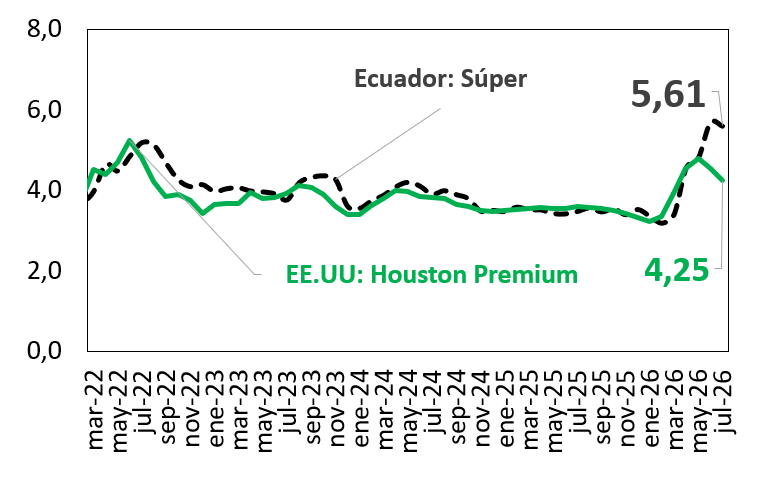
⛽ La gasolina SÚPER debió bajar MUCHO MÁS.
En Houston cuesta $4,25/galón; en Ecuador, $5,61: pagamos $1,36 MÁS😡.
Urge abrir la LIBRE IMPORTACIÓN y permitir acceso competitivo a la infraestructura estatal. Más competencia, mejores precios.
Quisiera hacer una reflexión, no sé si final, sobre todo este proceso del Museo Nacional.
Desde hace años, y más desde que se anunció el proyecto, he seguido con entusiasmo el proceso de creación de una nueva sede del Museo Nacional de Ecuador.
Entusiasmo que no era compartido, pues ha sido notoria la falta de interés de los “gestores culturales”, sectores sociales, políticos y ciudadanos en este proceso. No hay más que repasar que entre enero y junio de este 2026 apenas hay noticias, información, tweets, posts, columnas o comentarios sobre todo este proceso. Por tanto creo que ha habido una negligencia por parte de las autoridades, pero también mucha desidia por parte de otros muchos actores, especialmente todos aquellos que se autoproclaman “gestores culturales”.
Y a mí me parecía extraño, pues entiendo que la creación de un Museo Nacional es algo ilusionante, importante, pero también complicado para una nación, pues hay muchos debates latentes que afloran en un momento así. Debates sobre la historia, la identidad y la belleza, entre otros; aunque el más acalorado ha terminado siendo sobre la “democracia” y el populismo, sobre el caudillismo y la tecnocracia.
Y esos debates creo que es importante tenerlos, aunque yo no soy un relativista y tengo una posición firme y argumentada en cada uno de ellos. Pero me temía que si no se explicitaban no era por un consenso o resolución de lo conflictivo, era más bien pues unos pocos, sean los de siempre u otros, iban a tomar las decisiones importantes por todos. Y yo creía necesario y hasta sanador explicitar los debates, explicitar las diferencias y abrir un proceso de opinión, sea política o en medios, sea en redes o en foros al respecto, donde podamos los ciudadanos de Ecuador opinar sobre el Museo Nacional de Ecuador que lo va a representar. Más en un país que, como ha quedado evidenciado, tiene graves problemas con su identidad nacional, su historia y su relación con la belleza.
Cuando en la fase final ha salido ganador un edificio feo, muy feo, tan feo que ni sus propios defensores lo hacen en términos de “belleza” sino de volumen o funcionalidad, e intentan esquivar ese debate, ha habido una entendible reacción social en contra, que ha sido virulenta pues ha desbordado todo aquello que por meses y por años no se ha afrontado. Esto ha tenido consecuencias políticas.
Ahora la cuestión es si Ecuador es capaz de superar las divisiones políticas, los malentendidos y las desavenencias, para crear un proyecto de Museo Nacional ilusionante y que aúne a la nación de cara al bicentenario del 2030.
Es exactamente esto lo que estamos padeciendo en Ecuador con la polémica del Museo Nacional.
Arquitectos internacionales de renombre proponen cosas muy feas, y encima te argumentan que la culpa la tienes tú por no entenderlo, que te calles, pagues y te aguantes con esos horrores en tu ciudad por décadas.
@neiu11 Estoy de acuerdo en que la universidad debe formar criterio, no solo empleados. Pero precisamente por eso no debería venderse como trámite universal para conseguir estatus. Cuando todo se masifica y se burocratiza, también se degrada esa misión intelectual.
@luisesgo Pero hasta mas grave, la mayoría de arquitectos no está consciente que ha sido educado en una una sensibilidad estética particular, para bien o para mal. Entonces es imposible entrar en argumentación racional.
Otro de los problemas que están quedando evidenciados en esta polémica es la distancia entre “los expertos” y el sentido común,
Entre el pueblo y las élites.
Probablemente las personas menos adecuadas para elegir el edificio del Museo Nacional sean los arquitectos, a quienes les educan en un tipo de sensibilidad y estética que repele al ciudadano común.
National football identity, national styles were Schelling points that coordinated club players from different teams, playing around the world. Catenaccio, Jogo Bonito, total football are dead.The new equilibrium of euro club soccer is a severe loss to for the game.
This is sort of funny, and Brazil have definitely got worse, but it misdiagnoses the problem. In fact, this is a story of what has happened to society and with our economies, and the ideology of our ruling elites.
The first point to accept is that *all* football nations have lost their particular style: there has been a flattening of the way in which teams play. I first started watching football as a very young boy in the late eighties, and through until the early 2000s, most of the big nations maintained a distinct way of playing. The Netherlands, Germany, Italy, Brazil and England all spring to mind. But two things have happened -- the first connected to the latter.
First, the Champions League (and later the Europa League) means that the best teams in Europe play each other almost every week during the season. That provides a consistently present interface for an accelerated exchange of ideas, formations, and tactics. But it also acts as a kind of gain of function research for football: there is now an extremely rapid cycle of tactical, transfer policy/player selection, and fitness innovation, response and counter response. The football OODA loop has never been tighter.
Second, and connected to this, there has been an extreme version of the Pareto Principle income inequality that has happened among western societies as a whole. Wealth, partly due to the Champions League, and partly due to the Premier League, has accrued to a smaller and smaller number of teams, even as the size of the pie, due to the massive increase in TV revenue in Europe, has expanded beyond all recognition. This means that all the best players in the world end up in the same handful of clubs. We can name them: Arsenal, Manchester City, Manchester United, Liverpool, Juventus, Bayern Munich, PSG, Real Madrid and Barcelona. Furthermore, with the advent of global scouting networks and post-Moneyball databases, this means the best players from anywhere in the world, often at young ages. Remember when an unknown player would have a great World Cup and find himself playing for, say, Tottenham or Monaco or wherever? Those days are gone. We know about every player in the most minute detail. There is no mystery. The good players are already in Europe.
The first time I noticed this process of wealth accumulation was with the great Ajax team of 1995. I was only just a teenager, and that team was like a revelation for me in terms of the way football could be played. All of them (bar Danny Blind and Frank Rijkaard, who were an earlier generation) came up through the Ajax academy system and blossomed at the same time. They played in the Ajax/Dutch style (4-3-3, with two wingers that stayed very wide, and a centre back pushing into midfield when they had the ball, holding possession playing in the opponent's final third). But within two seasons, the entire team was broken up: Davids, Seedorf, Klijvert, Ovremars, Rijzeger, Kanu, Litmanen, even Van Gaal, the young manager -- they'd all gone to richer clubs elsewhere. In the 1960s or 70s, they'd have stayed together and won multiple European trophies. In England, we saw a similar thing with Southampton. Newcastle are suffering the same now.
All this means that players don't stay in their home environments and countries, with their clubs, and the process of mimesis breaks down. Add that to the first point, related to the way intra-European football forces a flattening through various mechanisms, and you have what we see now.
A couple of World Cups ago, the Netherlands played a 3-5-2, to my absolute horror. The Netherlands playing without proper wingers! Now we have a Brazilian team that has two Arsenal players, two Man U players, one Newcastle player -- even a Bournemouth player, for goodness sake. And they'll all have had the majority of their careers outside Brazil. Some will have left when they were 15 or 16, scouted by Shaktar Donetsk (famous for bringing in young Brazilian players) or Real Madrid. Why are we therefore surprised that they play like any other European team?
The Netherlands style lives on -- but through Barcelona and therefore the Spain national team (via Cruyff, and thence Guardiola), not in the Netherlands national team. But the Brazil style (a languid slow, slow, slow, punctuated by sudden bursts of incredible skill, raking passes, speed, and crackerjack long shots) is dead. When better Brazilian players emerge in future, and maybe they return to winning World Cups, they'll do so as Europeans would, not Brazilians. The German and Italian styles are also dead. The English style is also pretty much dead, although that was an evolutionary dead end in terms of International Football, so we do not lament it.
This, rather than boozing or religion, is the reason for what we see with the Brazil national team. I find it deeply sad. But no doubt the neoliberal progressives who run our countries will view it as a great success.
@AaronBastani@WilliamClouston@georgegalloway@jj_bull
Mi campaña para detener la construcción del Museo MuNa por carecer totalmente de sentido y tener fallas técnicas graves
por favor compartir y unirse si están interesados en salvar Quito
https://t.co/6aXCbh8KOE
GRACIAS Milena por liderar esta iniciativa.
Es imperativo que aquellas personas a quienes les importa la cultura, Ecuador, Quito y el patrimonio (aunque sólo seamos 5 ó 6) nos unamos para reconducir este proyecto de Museo Nacional.
Yo considero una iniciativa valiosa e importante hacer este museo, pero no con este proyecto museográfico, no con este despropósito de edificio.
Tienes todo mi apoyo y aquí estoy para ayudar en lo que pueda.
"The university’s real problem is not that it has been captured ideologically. It is that it lacks a soul or even a vision to find one. I would much rather confront ideological capture, which at least would be fixable over time. It is a lot harder to find a soul."
Amen.
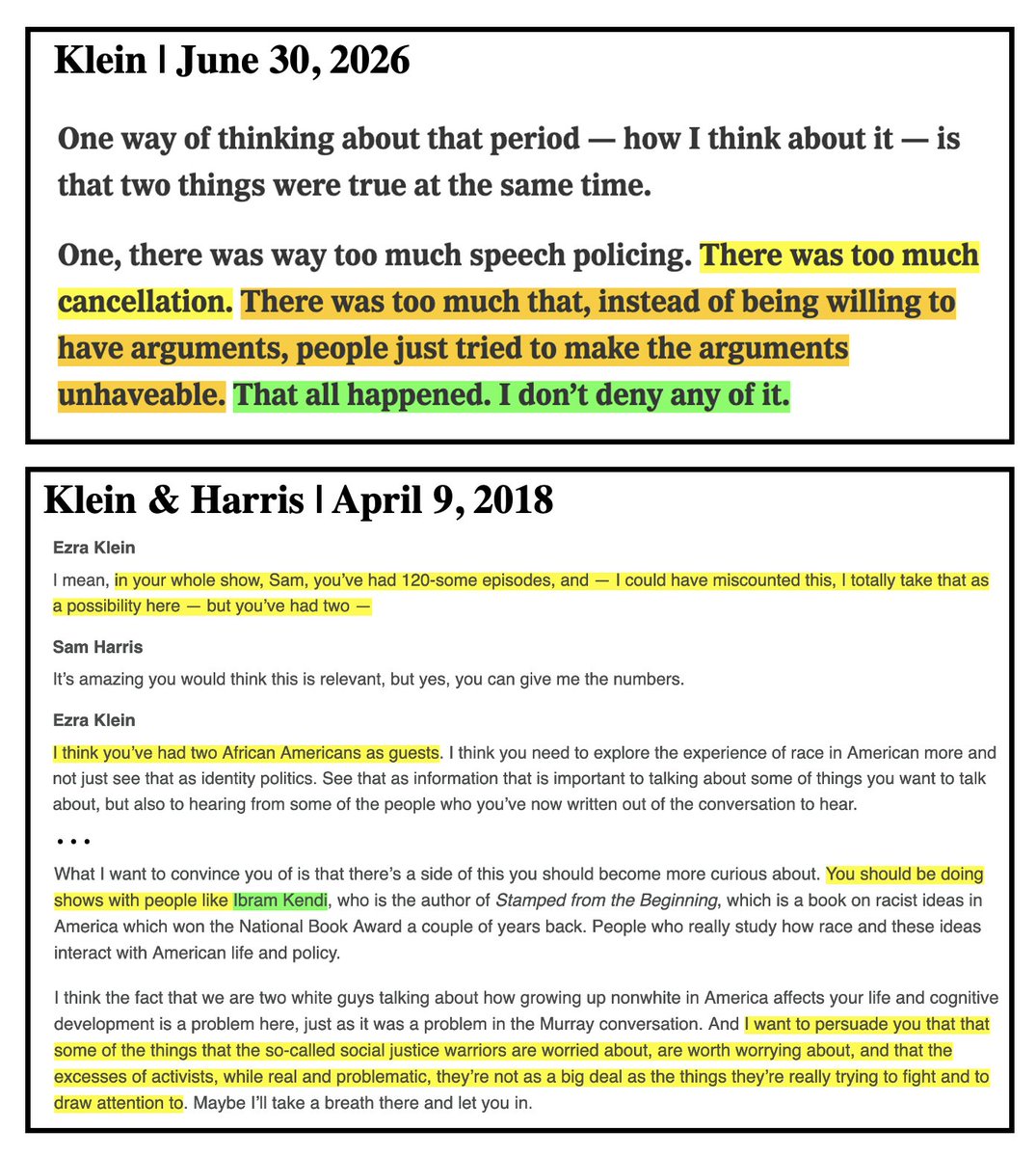
In his interview with @christopherrufo, @ezraklein conceded that there was "way too much speech policing" and "cancellation" during the Great Awokening.
But he hasn't apologized for his central role in it.
In 2017, Klein launched a massive cancellation campaign against Sam Harris for interviewing @charlesmurray on his podcast about race and IQ.
Klein accused Harris of spreading and platforming "junk science," "race science," and even rehabilitating "America's most ancient justification for bigotry and racial inequality."
In a conversation with Harris, Klein implicitly accused him of racism after tallying all of Harris' podcast guests and noting that only 2 out of 120 were black. He then admonished Harris for not "doing shows with people like Ibram Kendi...who really study how race and these ideas interact with American life and policy."
I remember that time vividly. The cancellation campaign against Harris led by Klein was immense and relentless.
Klein was one of the central figures who "tried to make the arguments unhaveable." It didn't just "happen" and it wasn't just "people" who did this—Klein himself was a field marshal.
If Harris had been a university professor instead of an independently-funded podcaster at the time, Klein's cancellation attempt would have likely been successful in permanently destroying Harris' career and livelihood.
Klein's behavior was absolutely grotesque.
I'll never forget what he did, nor will I ever forgive him for it.
I’ve designated the Ecuadorian gang Chone Killers as a Foreign Terrorist Organization and Specially Designated Global Terrorist. Ecuadorian gangs help Mexican cartels move and export illicit drugs to fund terrorism and criminal activity. The Chone Killers have attacked civilians, law enforcement officers, and government officials, including high profile assassinations of public officials.
Working with President @DanielNoboaOk in Ecuador, we will continue to strengthen our regional security and ensure narcoterrorists have no place in our hemisphere.