Small Account Completed
$1,000—> $192,588.35/$100,000 ✅
It took me 7 trading days to take a $1,000 account to $100K+ , used proper risk management & followed trends closely, it’s all you really need these days, nothing too complicated tbh
I’m going to run another one next week and try to take it to 7 figures in under a month. I’ll post all my entries and exits HERE!
@DeepValueBagger@dvb may I know in which platform I can request shares of openai to buy? checked in robinhood but seems its still not available. Thanks
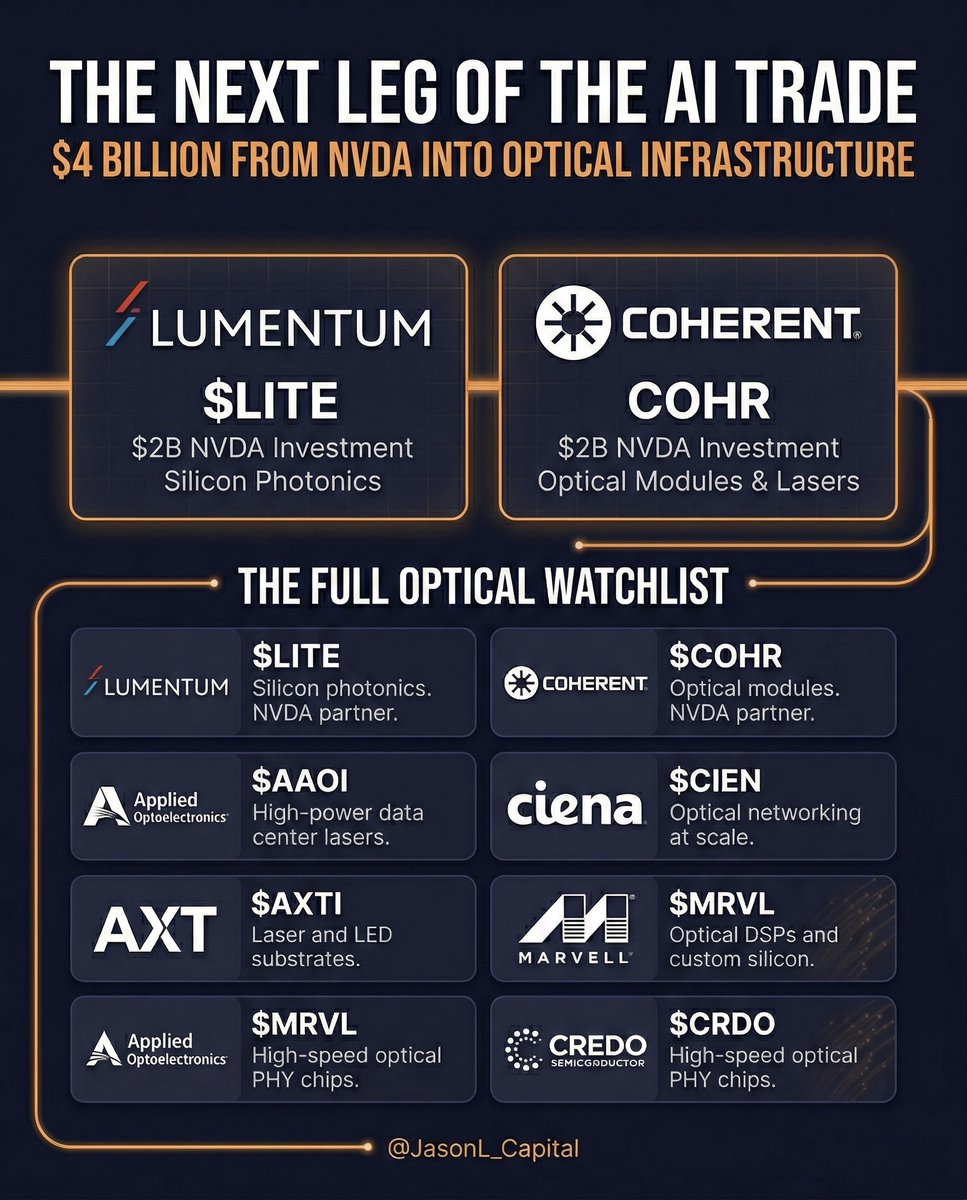
NVDA just told you the next AI trade.
They invested $4 billion into optical infrastructure today.
$2B into $LITE.
$2B into $COHR.
Why? Because copper is dead at AI scale. Data centers are moving to light-based interconnects. Optical is the new backbone.
$AAOI ran 22% on the news alone.
The full optical watchlist:
$LITE - Silicon photonics. Direct NVDA partnership.
$COHR - Optical modules and lasers. Direct NVDA partnership.
$AAOI - High-power lasers for data centers.
$CIEN - Optical networking at scale.
$AXTI - Substrates for laser manufacturing.
When NVDA puts $4B into a sector, it's probably smart to start paying attention
This is the next leg of the AI trade.
Most billionaires got to where they are by betting on 1 risky thing:
1. Jeff Bezos — Amazon
Bet: That e-commerce would eat retail
Outcome: Founded Amazon and held a huge equity stake for decades
Net Worth Driver: Amazon stock almost exclusively
2. Elon Musk — Tesla
Bet: That electric vehicles would dominate the auto industry
Outcome: Put nearly all his PayPal money into Tesla and SpaceX, but Tesla alone made him a centibillionaire
Net Worth Driver: Tesla stock
3. Mark Zuckerberg — Facebook
Bet: That a single social network could absorb the world’s attention
Outcome: Held a controlling stake and refused to diversify
Net Worth Driver: Meta and Facebook equity
4. Jensen Huang — NVIDIA
Bet: GPUs would become the future of AI and computing
Outcome: Bet the company on GPUs when almost no one cared
Net Worth Driver: NVIDIA stock
5. Larry Ellison — Oracle
Bet: Databases would dominate enterprise computing
Outcome: Focused on one product category for decades
Net Worth Driver: Oracle stock
6. Phil Knight — Nike
Bet: One athletics shoe brand could dominate the world
Outcome: Built Nike from scratch and held a massive equity stake
Net Worth Driver: Nike stock
7. Bernard Arnault — LVMH
Bet: Luxury conglomerates could consolidate and compound
Outcome: All in on luxury as the dominant theme
Net Worth Driver: LVMH stock
8. Warren Buffett — Berkshire Hathaway
Bet: One compounding machine through a single vehicle
Outcome: Kept almost all capital inside Berkshire and rarely sold
Net Worth Driver: Berkshire shares
9. Sam Walton — Walmart
Bet: Low cost retail focused on rural America
Outcome: Walmart grew into the world’s largest retailer
Net Worth Driver: Walmart family shares
10. Michael Saylor — MicroStrategy and Bitcoin
Bet: Bitcoin as the dominant digital asset
Outcome: Turned MicroStrategy into a leveraged Bitcoin vehicle
Net Worth Driver: Bitcoin exposure through MSTR
11. Brian Armstrong — Coinbase
Bet: Crypto exchanges becoming the on-ramp to digital assets
Outcome: Kept a massive stake through extreme volatility
Net Worth Driver: Coinbase equity
12. Reed Hastings — Netflix
Bet: Streaming would replace cable
Outcome: Pioneered streaming and held a dominant stake early on
Net Worth Driver: Netflix stock
13. Patrick and John Collison — Stripe
Bet: Online payments offered as a simple API
Outcome: Stripe reached tens of billions in valuation
Net Worth Driver: Stripe equity
14. Jim Simons — Renaissance Technologies
Bet: Quantitative trading with math models
Outcome: One firm and one strategy created enormous profits
Net Worth Driver: Medallion Fund and Renaissance Technologies
15. Changpeng Zhao (CZ) — Binance
Bet: Centralized crypto exchange dominance
Outcome: Binance became the largest exchange globally
Net Worth Driver: Binance equity and BNB
People who became billionaires from one bet typically had:
-Huge personal equity concentration (50%–99% of net worth in one thing)
-A 10–30 year compounding horizon
-A bet on technology, networks, or infrastructure
-Willingness to endure massive volatility
-Zero interest in diversifying until after becoming insanely wealthy
$HIMS I’ve added the stock back into my long-term portfolio.
In short, the more people adopt Labs, the stronger the flywheel becomes.
1. More Labs brings in more data.
2. More data improves the recommendations.
3. Better recommendations drive better outcomes.
4. Better outcomes increase retention.
5. Higher retention boosts lifetime value.
6. Higher lifetime value gives Hims the ability to lower prices.
7. Lower prices push adoption even further.
This loop is turning into one of the strongest moats the company has built.
The AI Revolution isn’t just chips it’s an entire ecosystem.
Compute: $NBIS $IREN $CIFR — power + hosting backbone
Robotics: $RR $PATH $SERV — automation in the real world
Nuclear / Energy: $OKLO $VST $CCJ — keeping the lights on for AI
Storage / Grid: $EOSE $FLNC $NEE — balancing the new power demand Space: $RKLB $ASTS — extending the network edge
How to trade it: Follow the chain of demand. → AI compute runs hot → energy demand spikes → grid upgrades → automation follows → satellites connect the world.
That’s the AI flywheel.
You don’t chase hype you position early in the next link of the chain.
A new ETF is launching that will mirror the US Government’s investment portfolio.
Retail will soon be able to invest alongside White House Asset Management.
Deep dive on $ASST, Bitcoin Treasury
Most posts remarks @mikealfred bought 1m shares (at 0.95) stock will moon - that's simply lazy talk. I'm going to provide the most sober take on Bitcoin Treasury. As you know I have been in Bitcoin since 2017 and also an ex senior exec at Bitcoin mining company. Previously I was bearish on Bitcoin Treasury narrative mainly 1) Attract new share holder aka Marketing 2) Price efficiency and 3) Differentiation.
A week ago, I looked at $MTPLF and initiated a position around $2.7 because I thought the mNAV was good, generating revenue with derivatives, and Bitcoin is compressed. I'm flexible enough to change my view with new information... and avoid risks. These mNAV used to be 5-10 and people were screaming to buy... I guess if price goes up, any theory is correct right?
Same goes for $ASST, the bullish argument was it was associated to Vivek, and they will acquire dying biotech companies. Price goes up and people will believe any reason despite mNAV was ridiculous.
Ok, let's get back to $ASST, what has changed.
1. With 5886 BTC in treasury, it is worth ~$683m + $108m cash. At current share price, the mNAV ratio is at 0.81x (Approximately, The point it's much more reasonable, low downside risk). Think of this as your P/B - book value.
2. Mike Alfred is bought the shares and will "engage". He is a marketing machine w/ reach into big market participants.
3. The market seem to like the new CIO,
@werkman. He has a long history of Bitcoin, and specialize in distressed assets. $ASST is definitely distressed. He should have a bunch of nice tricks up his sleeves in financial wizardly and I also like someone who has a long history of Bitcoin -- you want to have confident in knowing what team he is on (long btc, short fiat!!).
4. This is a new point, but I think it differentiates with $MTPLF - It's an American company🇺🇸🇺🇸🇺🇸. We love America!!!!
5. Expect them to purchase more Bitcoin, find novel way to make money like $MTPLF selling calls, lending, something!! I trust that @mikealfred will push these guys hard!
6. We are expecting Bitcoin to move to $135k-$150k toward in the year, so other people will be repositioning.
I think with all these new developments, it will address the concerns I had before: Mike will "engage" much like @saylor or Thomas Lee; lower mNAV/downside risk; more revenue generation; higher BTC.
You're welcomed!