@tacourba@jonathanchait Watching someone post a graphic that literally is showing zero while they are saying it does not show a zero was totally bizarre. I was completely enthralled by it. A literal crackup of people who say they are reality and numbers driven unfolding in front me.
I see a bunch of Very Smart people responding to this by saying that immigrants only look net-positive if you exclude their US-born kids. No, the report included a section specifically addressing that and finding that 2023 immigrants and their kids were still net-positive.
Our CellularAI algorithm won @arcinstitute’s Virtual Cell Challenge! 🏆🧬 Here’s how we built a method to predict cellular responses to perturbations in unseen cell lines. 🧵👇
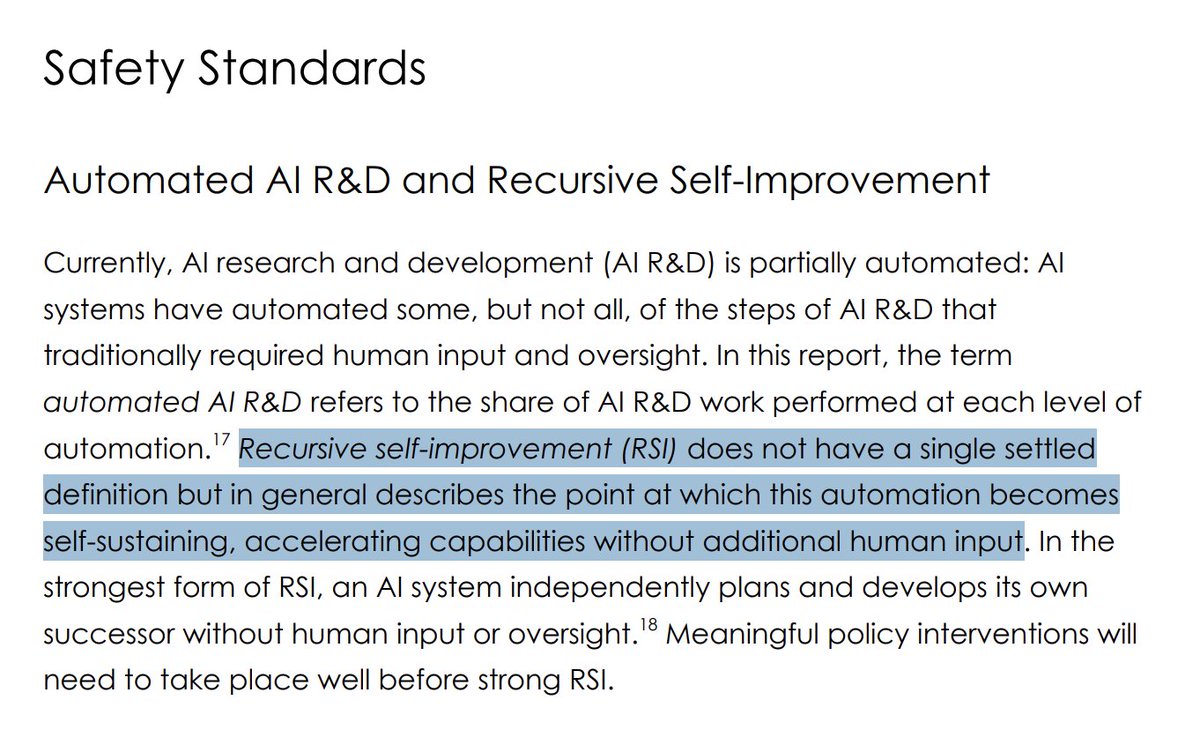
The recommendations from Governor Newsom's recently convened expert panel - Professor Alondra Nelson (Princeton), Jason Goldman, Professor Robert Reich (Stanford), and Professor Gillian Hadfield (Johns Hopkins) - were just released and are a clarion call for urgent action to address risks to public safety from advanced AI systems.
Some of the most notable recommendations:
• Emergency shutdown authority
• Minimum safety standards for AI developers
• Mandatory third party oversight
• Authority to cap the amount of compute used for RSI
The next weeks and months will determine whether these recommendations are words on paper, or whether the Governor and legislature can work together to accomplish something historic to protect CA and lead the country on guardrails to prevent catastrophic risks from runaway AI development.
"SIQReg scales lie between default and logarithmic, indicating that traits are neither purely additive nor purely multiplicative. ... It eliminates most nonadditive signals, including 97% of variance quantitative trait loci, indicating that they may be scale-induced"
@SashaGusevPosts My 2018 paper also argued that most variance qtls were scale dependent and could be removed by an appropriate variance stabilizing transformation: https://t.co/un0Xm0JK2v
I had a weekend Claude project recently that produced a method that, in earlier times, I would have submitted to an IF-20 journal. It was completed over the course of a few days mostly on my phone. I think it will be a very useful tool but given the little amount of human time spent on the project, I started writing it up as a blogpost (with the parallel intent of eventually submitting it as a short paper to a low impact factor methods journal).
Around the same time, I bumped into a colleague and described the project to him and we chatted about it for ~45 minutes. This informal conversation produced several novel ways to think about what the method was estimating that greatly clarified the broader research question, none of which had ever come up in the interactions with Claude.
The blogpost would have still been useful without this additional clarity (and possibly the blogpost would have led to conversations like this), but it does seem to me that allowing an idea to marinate over time and through interaction with others provides something valuable that rapid publication (including informal publication) can miss.
@vsbuffalo That's also why I'm lukewarm on the blog-as-first-release model, because I think human feedback around work in progress does genuinely improve it in a way that post-pub comments do not.
@anshulkundaje@jmschreiber91 My question is how do you get people to do it. IMO anon review is important, so that requires some impartial third-party to track reviewers. Then you need infrastructure to push reviewers to return reviews and authors to respond. At that point you basically have a journal.
My hot take is that it is still useful to have a scientific deliverable that corresponds to [a human spent a ~year thinking about this question, and the output was peer-reviewed], and that is the role academic papers should continue to play.
I am increasingly of the opinion that the academic paper is no longer a good medium for disseminating CS research. I think we should move to (1) blog posts and (2) books.
The lab can always argue that the feedback is not worth addressing, or withdraw their paper and submit it elsewhere. But IMO there is value in having a (soft) adversarial step where reviewers raise concerns and authors feel *some* pressure to address those concerns. First, because authors can develop blind spots around their work and not probe important weaknesses that reveal flaws. Second, because reviewers represent a non-negligible segment of the reading public and addressing their concerns increases the chance that other readers will feel confident in the findings (even if the authors don't think the concerns have much merit).
@antonioregalado It's a good question. Claude is definitely in the role of co-author as it did nearly all of the implementation. And for a project that took 40 hours, maybe a 45 minute conversation that meaningfully changes the idea is sufficient for co-authorship.
Yeah I agree the value is not in the journal system itself. I think the challenge is that the journal system creates the incentive to do peer review that is otherwise hard to replicate. People publish in a journal, they then feel an obligation to review for that journal. While reviewing they are motivated to take it seriously and keep the standards of the journal high so that their own prior publications in the journal are not devalued. Lots of abuse still in this system, of course, but incentives are somewhat aligned.
I think the manuscript structure has intrinsic value: summarize the motivation for the work, present a fairly comprehensive research output, describe the broader context, limitations, and future work. One could space this out over shorter outputs but the act of going through these steps over a period of time improves the research output itself IMO.
@anshulkundaje Multiple people read the manuscript seriously and provide detailed feedback and the authors are obligated to address the feedback in some capacity.
@vsbuffalo That's also why I'm lukewarm on the blog-as-first-release model, because I think human feedback around work in progress does genuinely improve it in a way that post-pub comments do not.
@vsbuffalo I think human peer-review can clearly be abused but it does create the motivation for researchers to identify conceptual flaws or improve the quality of their work.