Therapist; Decade of experience w gender dysphoria. "Gender" is a metaphor. Let's exhibit more wisdom, discernment, and compassion with dysphoric youth.
PREMIERING NOW!
Sasha Ayad (@SashaLPC), co-author of When Kids Say They're Trans, joins Yvette (@AndInTheEnd2) and I on Agree to Disagree About Gender, Ep 23.
In this clip, Yvette asks Sasha how parents can remain supportive even when their kids might see them standing in the way of medicalization as the opposite of support
A Clarification:
In a recent essay, I outlined my opinion about several different errors that clinicians make when working with gender-dysphoric adolescents and young adults.
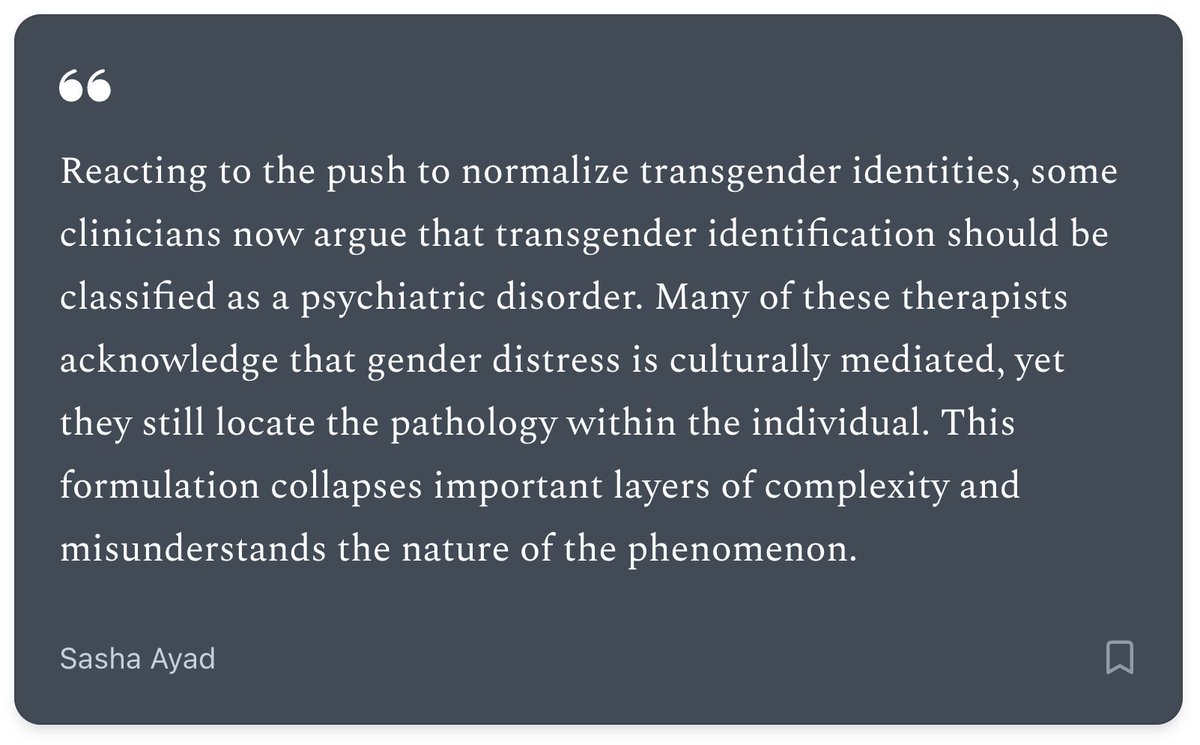
I posted one short quote (below) with a statement that I don’t agree with some clinicians who seek to pathologize trans identities.
In the full article, I discuss 6 different errors I see. I highlight the serious flaws in "gender affirmation," which will be familiar to most people here. Anyone who has followed my work will recognize critiques about blindly affirming - critiques that I've been writing and speaking publicly about for nearly a decade now.
But in the piece, I also address therapists who, like myself, aim to help young people manage their underlying distress first, understand how gender identity may be operating in a maladaptive way, and encourage non-medicalized and reality-based strategies to feel better.
Sometimes therapists with this approach treat the adolescent as though he or she is broken and in need of fixing.
Sometimes therapists come out and say (in the first or second session) that the client’s trans identity is likely not real or sign that other things are amiss.
Sometimes these therapists pathologize their client’s identity before taking the time to understand a specific formulation of what’s going on, what function the identity is serving, or before taking the time to build trust and a relationship with the client.
I'm a pragmatist and I know that different approaches may work for different people. So if any of the above help a client to be more curious, more flexible and more willing to engage meaningfully with the therapy process, then great.
But after talking with hundreds of families, I've observed that well-meaning therapists implying (or telling) a young person that their identity is mistaken and/or a sign of something else being wrong, or a mental illness or a psychopathology…this will only cause the client to shut down, withdraw and become even more guarded.
I’m not going to rewrite the entire piece here, but I wanted to clarify that piece is my opinion about errors therapists are making in their clinical work.
It’s not about political advocacy.
It’s not about social movements.
It's not about organizational strategy educational campaigns, or legislative maneuvers.
It's about therapy.
In fact, if you read it, you’ll notice that I directly encourage therapists to stay out of political currents altogether. While politics have largely forced the idea of gender identity inot so many families’ lives, I still believe clinicians should attempt to be apolitical and to be supremely sensitive to what will and won't work in the therapy room.
This doesn’t mean clinicians shouldn’t have reality-based formulations about what is hurting or harming their clients.
If you felt confused by that single X post or the quote from my article, I encourage you to read the whole thing and look at the quote in context. I’ll pin it above at the top of my feed 👆🏼
I strongly disagree with the push to psycopathologize trans identities
True clinical work begins when we understand “trans” not as an essence or an illness, but as a strategy—one that can be explored, understood, and either relinquished or refined through the therapeutic process.
@jbvconnor When @stellaomalley3 and I spoke, we shared our points of view and she clarified her position on trans identities and whether or not they should be psychopathologized - you can read a summary here: https://t.co/3hQm5S0nHf
I strongly disagree with the push to psycopathologize trans identities
True clinical work begins when we understand “trans” not as an essence or an illness, but as a strategy—one that can be explored, understood, and either relinquished or refined through the therapeutic process.
@jbvconnor This article had nothing to do with Stella. This article was about stories I've heard from parents who took their child to a therapist and the article is about the common things therapists do wrong in my opinion
@_Happy2BeMe_@VitoComedy Well that's not how we successfully help or rehabilitate people with dangerous beliefs. Anyone experienced in this area will say the same thing.
@ErinFriday75490@kimber_tweets - doesn't actually address the root issue
- doesn't alleviate the distress it was meant to alleviate
- isn't worth the tradeoffs involved
That parallel makes no sense.
Nobody thinks their depression is the key to their "authentic self" and the pathway to true freedom.
Identities hold a great deal of personal meaning to people, even if they are maladaptive.
Everyone wants to get rid of their depression but today's trans-identified youth protect their identity like their life depends on it.
@fringetranny If someone had told you this in the midst of your transition or while you were pursuing transition, do you think it would have been helpful, or made you defensive?