A dead MIT professor accidentally destroyed the $20 billion executive coaching industry with one hour of lecture, and ten million people have already watched him do it.
He filmed it once in January 2018 and died eighteen months later.
Executive coaches charge fifteen thousand dollars a session to teach a third of what he covered in that one hour for free.
His name was Patrick Winston. He ran the MIT Artificial Intelligence Laboratory from 1972 to 1997 and wrote the AI textbook every computer science major in the world read for thirty years.
Every January for four decades, he gave a lecture called "How to Speak."
His entire framework fits on a napkin.
Do not read. Be in the image. Keep images simple. Eliminate clutter. Start with an empathetic connection. End with a punch line the audience can repeat over dinner. Never open with a joke. Never end with "thank you."
That last rule alone has probably cost the executive coaching industry a hundred million dollars.
"Your success in life will be determined largely by your ability to speak, your ability to write, and the quality of your ideas. In that order."
That is the actual opening line of the lecture. Winston believed it strongly enough to spend fifty years teaching computer scientists how to talk.
Founders spend $80,000 on an MBA and then hire a communications coach to teach them the same material Winston filmed once for free. Engineers write brilliant code and lose promotions to teammates who watched this lecture on the train.
The lecture is free on MIT OpenCourseWare. The textbook is free on his page.
Winston died in 2019. Almost none of the ten million viewers have actually implemented the four rules on the napkin.
The napkin is free. The willingness to actually use it in your next meeting is the entire edge.
Your AI agent’s memory shouldn’t be locked to one app, model, or runtime. Walrus Memory gives agents portable memory they can carry across sessions, tools, and workflows.
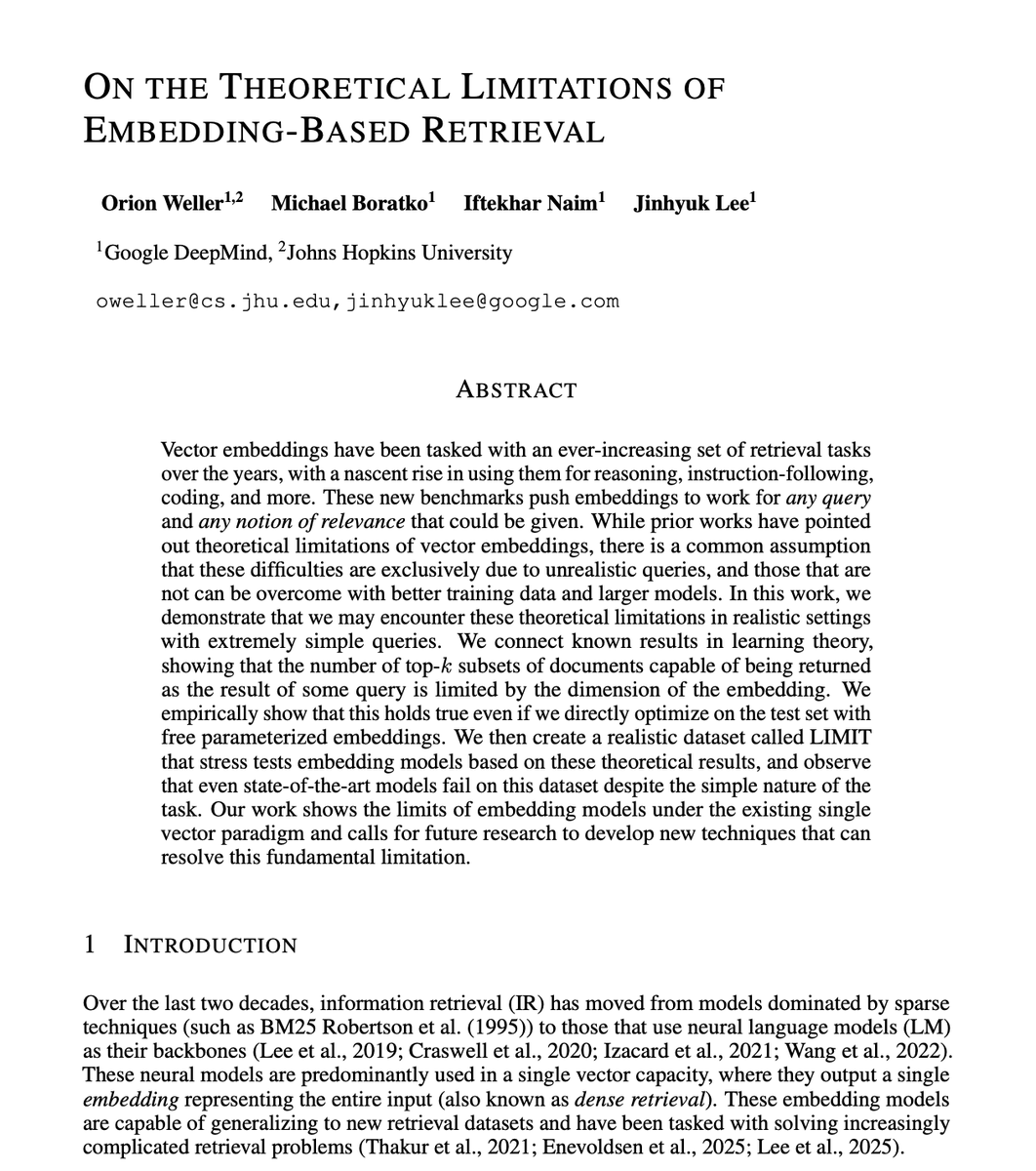
Google DeepMind argues RAG is broken.
They published a paper that proved vectors databases are the dead end.
For the last three years, the default engineering response to any AI memory or data problem has been identical: "Just build a RAG pipeline."
Chunk the data, push it into a vector database, and let embeddings handle the rest.
Every company scaling enterprise AI assumes that if an embedding model fails, it's just a matter of time. Better training data, larger models, more parameters—throw compute at it, and the search gets smarter.
This paper proves that assumption is completely false.
They mathematically demonstrated that single-vector embeddings have a hard, uncrossable limit.
Here is the core flaw:
An embedding compresses an entire document or a complex query down into a single fixed-length vector of numbers.
When you run a search, the model takes the dot product of those vectors to measure similarity.
The math reveals a brutal constraint. The number of distinct document combinations a model can possibly retrieve for different queries is strictly bounded by the dimension of its embedding space.
It is a hard mathematical ceiling dictated by geometry and communication complexity.
No amount of data scaling can fix it. No amount of fine-tuning will punch through it.
Even if you give an embedding model infinite, unconstrained training freedom on the test set, it still hits the wall.
DeepMind built a stress-test dataset called LIMIT to prove it.
They threw state-of-the-art embedding models at it, models with thousands of dimensions.
The models completely failed. Even on simple, structured queries, the single-vector bottleneck forced the system to drop critical context and hallucinate irrelevant results.
Why? Because a single vector cannot capture complex, multi-faceted relationships between documents.
When you ask an AI to reason, follow complex instructions, or handle nuanced cross-document dependencies, the vector space simply runs out of room.
It collapses.
This changes everything for software architecture.
If your AI agent's memory relies on standard single-vector retrieval, it is structurally blind to complex logic. It is missing pieces of your data right now, and no prompt tweak can save it.
If we want AI that actually understands enterprise knowledge, we have to throw out the single vector.
And invent something entirely new.
@Ieanianz@_avichawla But NVIDIA does not show that a KV cache from Model A can simply be handed to Model B. They show that, for some related model families, you can learn a transformation that maps A’s KV representation into something approximating B’s KV representation.
Harvard's $53 billion endowment must earn 8 percent every year or the university closes departments.
A single MIT professor runs a large slice of that number for them. He teaches the exact math behind it to undergraduates on YouTube for free.
Millions of people have watched the lecture. Almost nobody has changed how they invest.
His name is Jake Xia. He is Head of Public Markets at Harvard Management Company. He also holds an adjunct chair at MIT Sloan, where he teaches Foundations of Modern Finance every fall.
The MIT OpenCourseWare recording of that course is one of the five most-watched finance courses on the internet.
The 90-minute lecture in this video is Jake Xia at the board, in a shirt, walking students through the same equations he uses to manage Harvard's public equity book.
He begins every year with an experiment. He hands each student a blank page and asks them to build a portfolio with no rules. Someone writes 100 percent Apple. Someone writes rare coins. Someone writes 60/40 like their parents told them. Every year the answers rhyme.
Not one student asks the only question that matters. How much goes in each position.
They all pick what to buy. Nobody sizes it.
Sizing is the entire job. The math behind it won Harry Markowitz the Nobel Prize in 1990. It is called the efficient frontier. Xia draws it on the board in under a minute.
Underneath the efficient frontier sit five equations. Compound growth. Present value. The geometric mean. The rule of 72. Real return after inflation. Every one is older than the Federal Reserve. Every one fits on a napkin. None is behind a paywall.
A "guaranteed 5 percent bond" during 4 percent inflation is a 1 percent real return. The industry does not hide this. It relies on you never running the equation yourself.
"Diversification is the only free lunch in investing."
That is Harry Markowitz in his 1952 dissertation. He won the Nobel Prize for the sentence. It is the mathematical foundation of everything Jake Xia teaches and everything Harvard's endowment does with public equity.
The average retail portfolio holds 22 individual stocks with no reference to the efficient frontier, no reference to correlation, and no idea what the geometric mean means. The average Harvard portfolio holds a fraction of that number and beats retail by roughly 4 percent a year net of fees.
The MIT lecture is free. The 1952 paper is free. Every equation on the napkin has been in the public domain for eighty years.
The math is free. The napkin is free. The willingness to size a position with a formula written before your grandparents were born is a much rarer commodity than confidence.
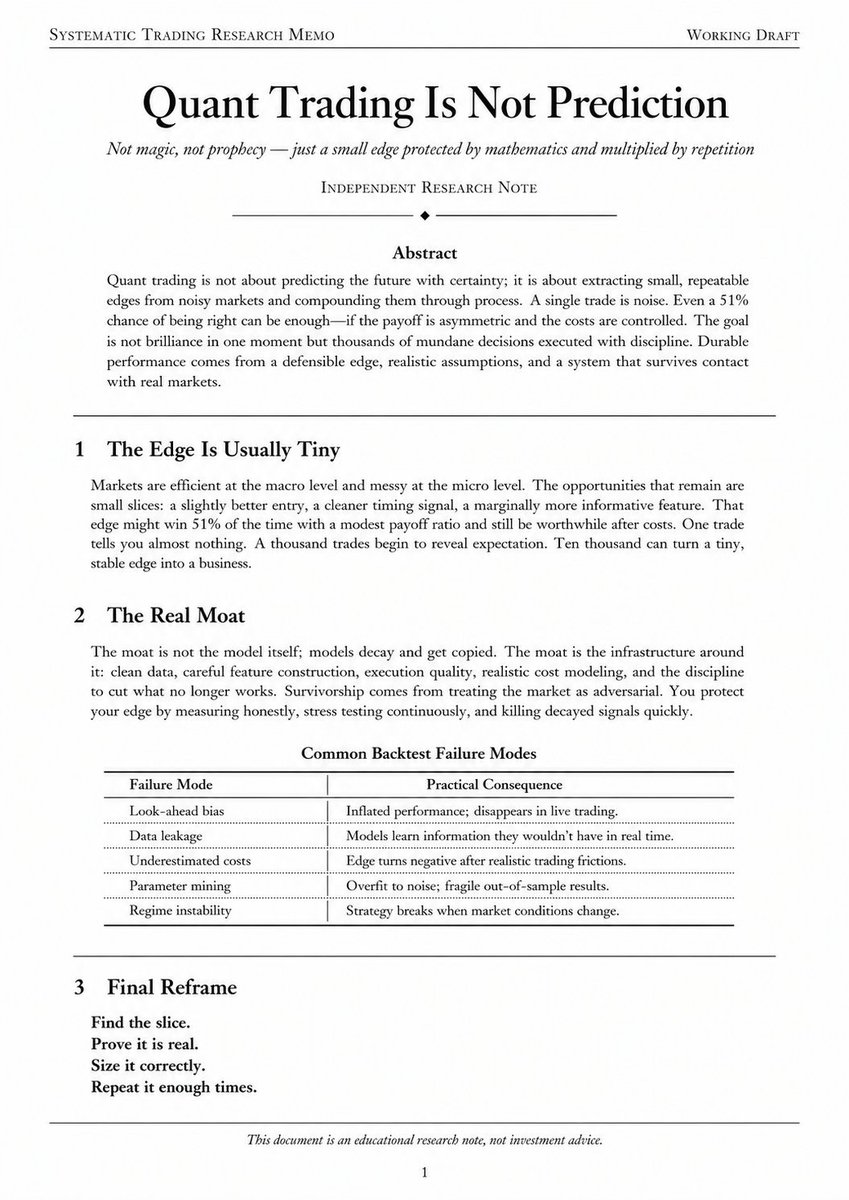
An Indian physicist put the entire secret behind Renaissance's $100 billion on one chalkboard: a coin that barely beats 50/50.
he is V. Balakrishnan, and his lecture went viral years after he recorded it. it has been free the whole time. almost nobody who trades has watched it.
lecture one is the humblest thing in all of finance. a coin that lands your way a little more than half the time. that is the entire edge. that is all Renaissance ever had.
the post above is the one equation for what to do with that coin. not what to bet. how much. bet too little and you die of old age. bet too much and one flip ends you.
that same coin is every trade, every hand, every prediction market. a tiny edge, flipped a million times. the whole machine fits on his board, and he charged nothing for it.
no slides. no notes. one coin and a stick of chalk.
a quant I know says this old Indian lecture taught him probability better than his entire degree.
the coin is free. the equation is free. the discipline to size it is the only thing left to earn.
INSTEAD OF WATCHING AN HOUR OF NETFLIX TONIGHT.
This 60-minute Cambridge lecture by Demis Hassabis will teach you more about the future of AI than most people will learn in the next 5 years.
Bookmark it and give it an hour, no matter what.
Stop scrolling. This one hour will teach you more about leverage and negotiation than years of trial and error.
🎓 The Speaker: Joel Peterson (Stanford GSB & former JetBlue chairman) ⏱️ The Time: 60 minutes 💡 The Payoff: Real-world tactics to get what you want, every single time.
Bookmark this lecture and give it an hour tonight.
Follow @Abhayaitech for daily AI courses & tools.
Don't waste 6 months learning to ship apps.
A Google Cloud engineer just built and deployed a full app with Claude in 30 minutes, by running five AI agents as one team.
• 0:00 - why one Claude isn't enough: the 5-role team
• 2:30 - Product Manager: turn a rough idea into a spec
• 8:40 - UI/UX Developer: wireframe into a real interface
• 13:30 - Software Engineer: build it with subagents + MCP
• 19:30 - Security & Growth: lock it down, then ship to users
Anthropic pays $500,000+/year to engineers who can wire AI agents together like this.
Bookmark this & give it 25 minutes today, no matter what.
Then read the graph engineering roadmap below.
"Introduction to Machine Learning" is another freely available textbook (600 pages) that presents machine learning with a strong mathematical foundation.
The book begins with the mathematical background needed throughout the text, including linear algebra, calculus, probability, matrix analysis, and optimization. It then covers the main methods of supervised learning, such as linear and logistic regression, nearest-neighbor methods, decision trees, random forests, boosting, and neural networks.
A large part is also devoted to probabilistic and generative methods, with Monte Carlo sampling, graphical models, Bayesian networks, variational methods, normalizing flows, VAEs, and GANs. The final chapters include clustering, PCA, manifold learning, and generalization bounds.
I think it is an excellent reference if you want a broad view of machine learning along with the mathematics behind the main methods, without treating them as black boxes.
https://t.co/0VrDtRKUMx
I took one of the most well-known academic strategies in quant finance and asked AI to recreate it.
I'm talking about Time Series Momentum (Moskowitz, Ooi & Pedersen, 2012), one of the most cited papers in systematic trading.
I uploaded the paper to Horizon and asked it to build a trading strategy without writing a single line of code.
The model:
> implemented multi-horizon momentum (21 / 63 / 126 / 252-day lookbacks);
> normalized signals using volatility;
> automatically generated long and short positions;
> ran a backtest with commissions and slippage.
Backtest results:
> +434.3% Total Return
> 29.5% CAGR
> Sharpe Ratio: 0.82
> Profit Factor: 1.75
> Max Drawdown: 61.8%
For comparison, Buy & Hold returned approximately +119% over the same period, with a maximum drawdown of 84%.
The most interesting part is that the strategy won only 28.9% of its trades, yet the average winning trade was 5.48× larger than the average losing trade. That's one of the defining characteristics of classic trend-following strategies.
It's impressive to see how AI can now take ideas from academic papers, turn them into a clear set of trading rules, and validate them on historical data in just a few minutes.
Horizon: https://t.co/ki213YmaOX
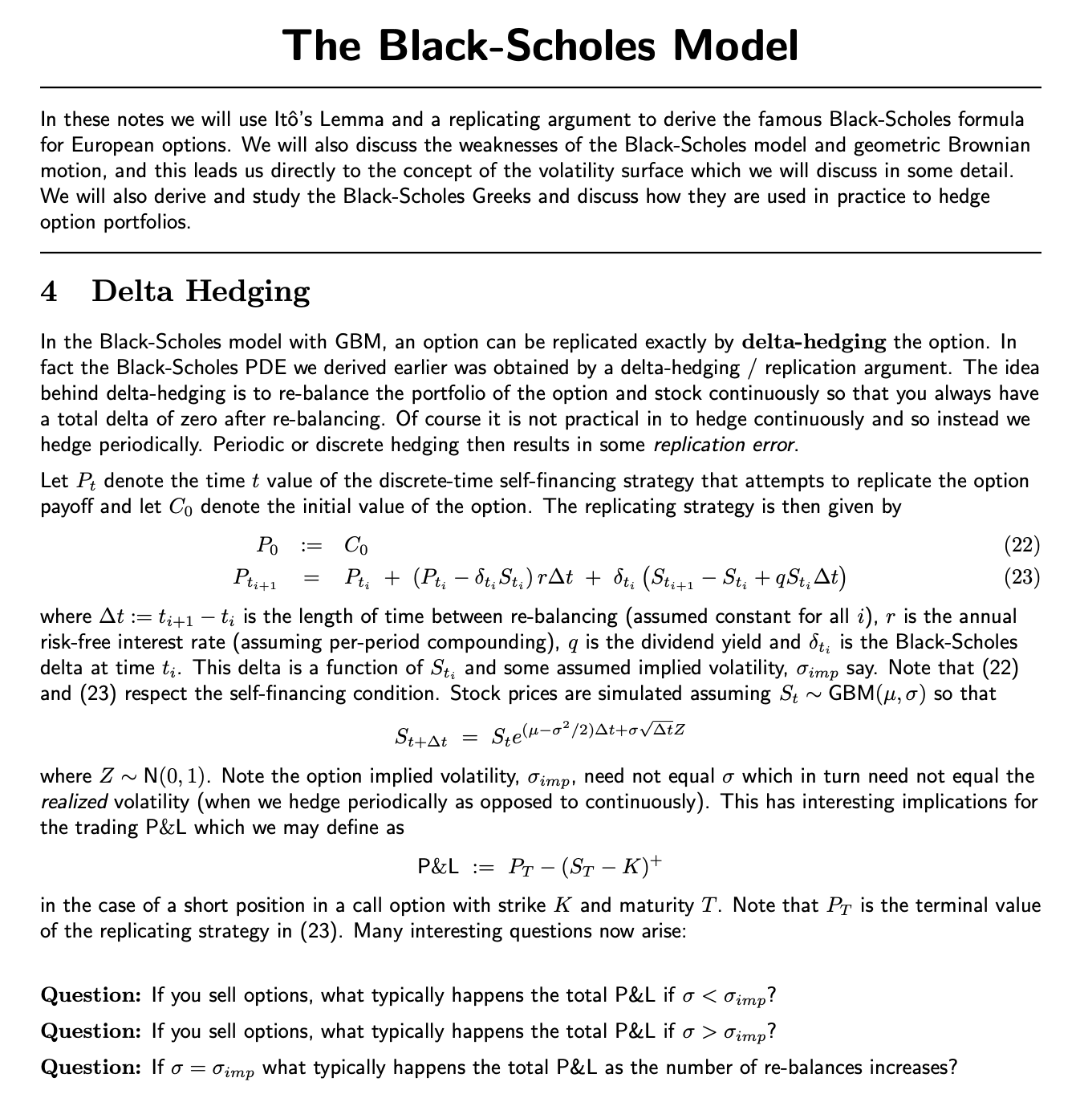
If you're serious about quant finance, stop scrolling and actually learn Black-Scholes properly.
Very few understand the replication argument, the Greeks, or why the volatility surface exists.
The hedge is everything. Bookmark this!
Keeping up with @arxiv is impossible. 500+ preprints a day across dozens of fields.
@KurateOrg scores papers on 16 dimensions (impact, novelty, rigor, surprise, translational...) so you can spot what's worth reading at a glance. Sort, filter & sign up for the weekly newsletter.
My evaluation lecture! I walk you through different evaluation eras I've been a part of, from prompting GPT-3 as elaborate autocomplete to today's complex agentic sandboxes (I expand on agentic more than any other topic, drawing on @xeophon's insights).
This lecture is a birds eye view of how evaluation has changed, how it can be gamed, and what it's actually used for.
00:00 Intro: frontier evaluation is harder than ever
03:39 Part 1: The eras of post-training evaluation
17:36 Part 2: An intro to agentic evals
21:19 Part 3: Can you trust the number?
30:41 Takeaways & conclusion
Thanks for watching! Just one more lecture after this :)
Announcing Discovery Loop!
I am very excited to announce that, along with my longtime friends and collaborators @Sanjay_Ghemawat, @OriolVinyalsML and @quocleix, we are founding Discovery Loop (@DiscoLoopAI), a Public Benefit Corporation whose mission is to automate machine learning, science, and engineering to accelerate discoveries and progress. The four of us have worked together for 14 to 30 years, and have helped build some of the world’s most used products, infrastructure and AI models, and we’re excited to turn our attention to this ambitious endeavor.
♾
Learn more at: https://t.co/Rv3LMdLluK
The final lecture of my course is an intro to character training! This is a topic that I've been quietly very invested in for ~18 months, as it:
* Has potential for high real world impact
* Clearly used extensively at frontier labs
* Almost no empirical literature exists
* More accessible on academic compute
This lecture covers what character training is, reviews model specs, constitutions, the differences, the motivations in real world events, some example research papers I like, and open questions in how it relates to post-training/model use generally.
Hopefully this brings more people into the field (and reach out if you have questions). It is one of the more research-y chapters in my book, but one that I felt needed the reference. There is still so little, educational content on the topic online.
0:00 Intro
6:22 Part 1: Fundamentals — character, constitutions, and model specs
19:21 Part 2: Character training in practice
23:23 Part 3: Character elicitation without gradient steps
28:03 Part 4: Open questions (and the end of the course)
32:27 The course, complete
Thanks for watching. No need to like and subscribe now that the course is done, you definitely wouldn't!
h/t to @_maiush for leading the technical work I got to do in the space, and @zafstojano for investing a lot of attention at this book chapter.
this is f*cking dangerous
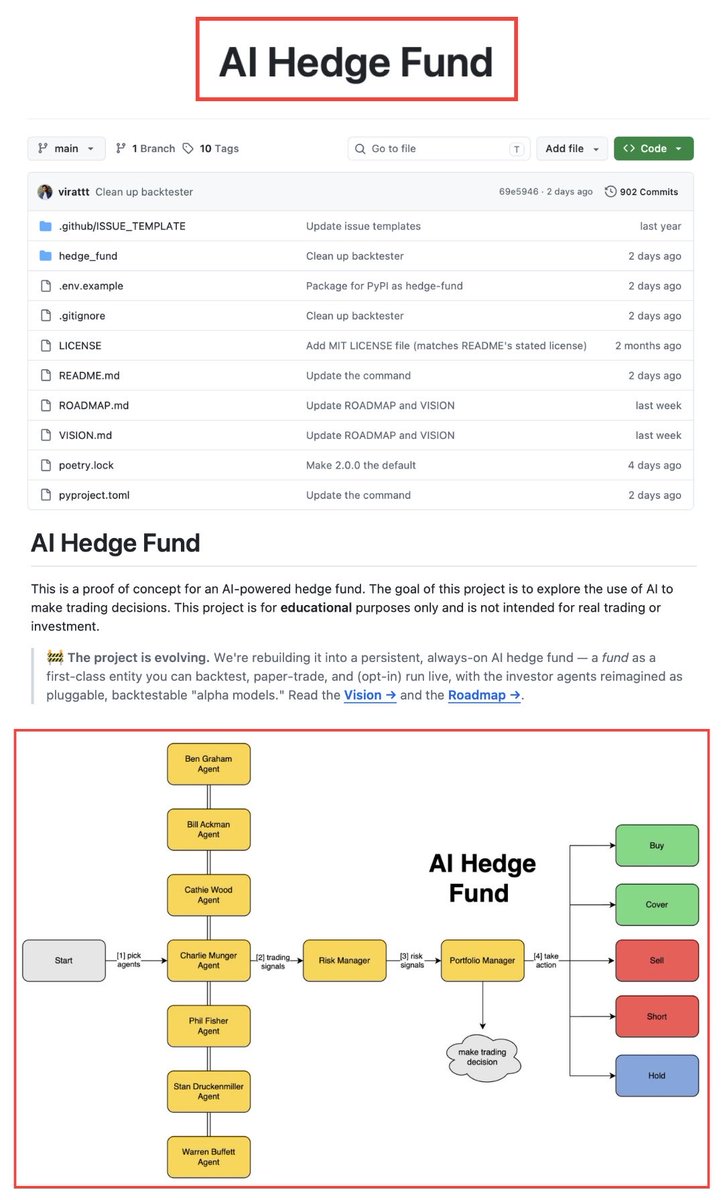
someone just open sourced the entire "AI HEDGE FUND" for free
the blueprint to build a hedge fund that prints alpha 24/7
bookmark before someone takes it down