Tldr:G;
NEJM shared a real case of a 74-year-old man with muscle-weakness disease who, while on immune-suppressing drugs, got short of breath, weaker muscles, low oxygen, and painful tongue sores. They posted it (with tongue photos) to teach doctors - on X - about tough diagnoses and to get people to pay to read the full journal article.
100% agree
“The history of open source shows that broad access and transparency are usually the best path to actual security and resilience. Decentralization creates checks and balances on power. By contrast, centralized alternatives, like bureaucratic approval regimes and mandatory gatekeeping, typically produce regulatory capture and reinforce cartels.”
Mark Zuckerberg gets it right:
“The defining question of our age isn’t whether superintelligence will exist, but who will have access to it. Will it be centralized and restricted to a few institutions, or will it be a tool that empowers everyone?”
Concentration of power is the biggest risk of AI. When a small number of labs (working hand-in-glove with the administrative state) decide who has access to which model capabilities, they inevitably shape what can be said, known, and built. That’s not “safety.” It’s control.
As Mark points out, the history of open source shows that broad access and transparency are usually the best path to actual security and resilience. Decentralization creates checks and balances on power. By contrast, centralized alternatives, like bureaucratic approval regimes and mandatory gatekeeping, typically produce regulatory capture and reinforce cartels.
Personal superintelligence in everyone’s hands, with competing models and real data sovereignty, is a far better check on a dystopian future than self-appointed guardians who claim to be “aligned” with all of humanity.
Blocks 944643 and 944644 were built by two different miners on the same pool.
Back-to-Back DATUM blocks.
Back-to-Back sovereign mining.
With other pools, the pool builds the block and the miners hash on it. Meaning the blocks mined by a large share of the hashrate is controlled by a few individuals at the largest mining pools. This makes a 51% more likely and the Bitcoin network less secure.
With OCEAN this isn't the case.
Miners using DATUM can build their own blocks, decentralizing block template construction while sharing in the benefits of pooled mining.
Eliminate the middle men.
Decentralize mining.
Earn more Bitcoins.
Only on OCEAN
🌊
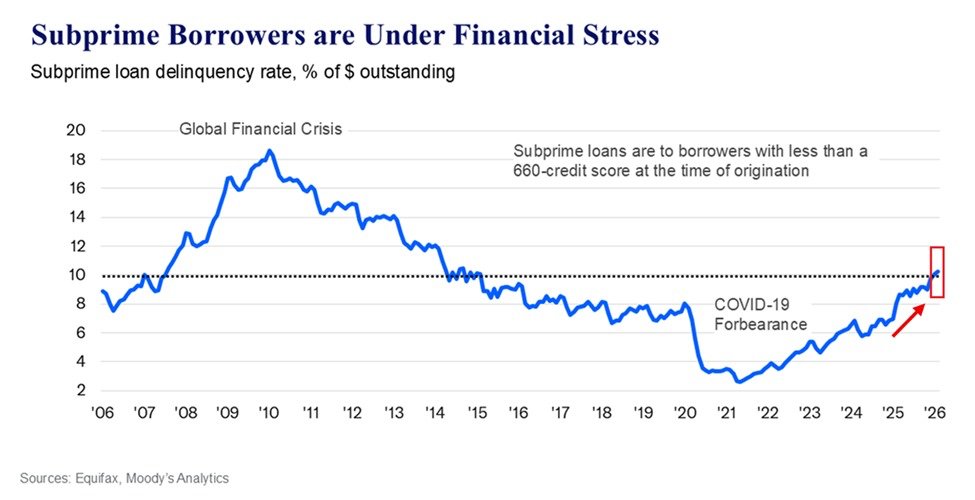
Financial stress among US consumers is intensifying:
The delinquency rate on subprime loans is up to 10% of total outstanding debt, the highest in 11 years.
Subprime loans are those made to borrowers with a credit score below 660, meaning they were already considered higher-risk at the time of borrowing.
The delinquency rate has more than TRIPLED since 2021, when pandemic-era forbearance programs temporarily allowed borrowers to delay payments without being marked as delinquent.
By comparison, the delinquency rate peaked at ~19% during the 2008 Financial Crisis, when subprime debt was $3.5 trillion and made up ~30% of total household debt.
Today, subprime debt stands at $2.7 trillion, or ~15% of the total, still a significant proportion.
An increasing number of Americans are falling behind on their debt.
"Why does our top performer get the worst reviews?" the boss asked.
I was reviewing their annual performance data.
"Show me," I said.
She pulled up the ratings.
Diana: 2.8 out of 5.
Below average on "collaboration."
Low marks for "team player."
"What's her actual performance?" I asked.
"Exceeded every target.
Landed our biggest client.
Trained three new hires."
"So why the low scores?"
"Her peer reviews are dragging her down."
I scanned the comments.
"Too direct."
"Challenges ideas too much."
"Not supportive enough."
"Let me talk to Diana," I said.
"I used to give honest feedback," Diana told me.
"Said our pricing model was broken.
Got dinged for 'negativity.'"
"What happened with the pricing?"
"They finally fixed it six months later.
After we lost two major accounts."
"What else?"
"I questioned why we needed
eleven approvals for a simple contract change.
Manager said I wasn't being collaborative."
"Are you still giving feedback?"
"No. I learned my lesson.
Now I smile. Nod. Say everything's great.
My reviews are improving."
"But nothing's actually improving?"
"We're making the same mistakes.
Just with better vibes." She chuckled.
I went back to the boss.
"Your review system doesn't measure performance," I said.
"It measures compliance."
"That's not true."
"When was the last time someone
got promoted for challenging bad ideas?"
Silence.
"When did someone get rewarded for preventing a mistake?"
More silence.
"You've trained your best people to stay quiet.
And your mediocre people to stay nice."
A few months later, they redesigned the system.
Added a category: "Constructive Challenge."
Points for identifying problems early.
Rewards for preventing costly mistakes.
Diana got promoted.
"What changed?" I asked the boss.
"We stopped confusing agreement with alignment.
Stopped mistaking silence for harmony."
"And?"
"Turns out our 'difficult' people
were our most valuable.
They actually cared enough to speak up."
Here's the truth about performance reviews:
Most companies don't reward performance.
They reward performance theater.
The person who says the meeting was great
beats the person who says it wasted an hour.
The person who agrees with bad ideas
beats the person who prevents disasters.
You think you're measuring contribution.
You're measuring conformity.
And your best people?
They've already figured out the game.
They're just deciding whether to play it
or find somewhere that values truth over comfort.
“The main business of humanity is to do a good job of being human beings, not to serve as appendages to machines, institutions, and systems.”
Kurt Vonnegut, Player Piano
If there was a single sentence to summarize the history of central banking, it'd be this one.
"Japan’s central bank on Friday raised economic growth forecasts while holding its key policy rate at 0.75% as the country prepares to go into an election."
My eyes are very bad, I can't drive due to it. Taking Uber/cabs to work, I've noticed something. Over time, Uber will raise the price if they reason that you *must* go to a place. That you rely on them. From $9.50avg to $23avg within 6 months.
I wrote a small program to
- Create new uber account
- Create new proxy credit card
- Request ride to given destination from current
Back down to $9.50 avg. Tech companies are so comically evil that it's transcended unfunny.