Chinese Hamster Ovary, or CHO, cells are widely used in the pharmaceutical industry. And, incredibly, these cells can be traced back to just twenty hamsters that were packed into a crate and smuggled out of China in the 1940s.
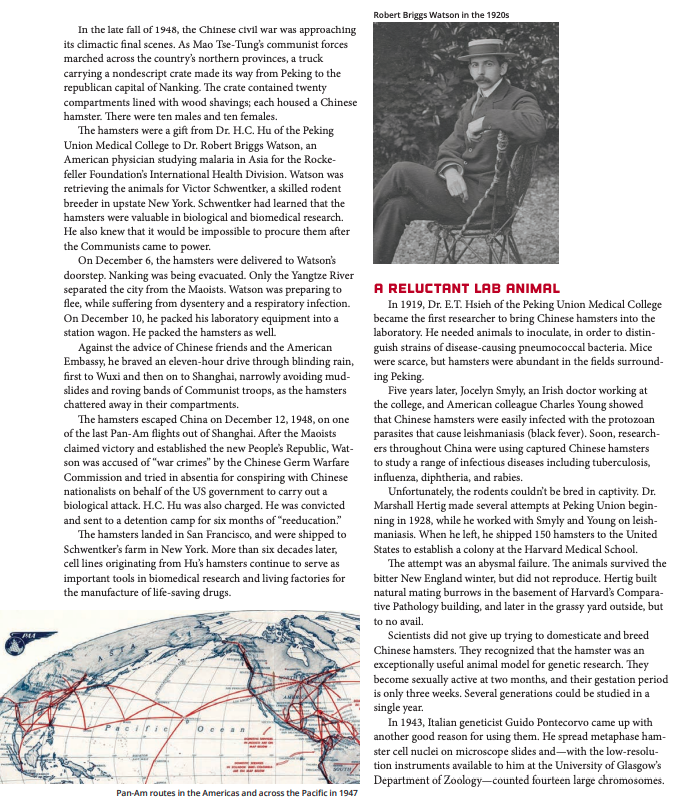
Chinese scientists had been using these hamsters — native to northern China and Mongolia — to study pathogens since at least 1919. The hamsters were unusually well-suited to scientific research because they have short gestation periods (18-21 days), a natural resistance to human viruses and radiation, and it was thought, early on, that they possessed just 14 chromosomes, making them easy to work with for mutation studies. (They actually have 22 chromosomes.)
During the Chinese civil war, a rodent breeder in New York named Victor Schwentker worried that, if the Communists won the war, he’d never be able to get his hands on these special rodents. So in 1948, Schwentker sent a letter to Robert Briggs Watson, a Rockefeller Foundation field staff member, and asked him to “acquire” some hamsters so he could begin breeding them.
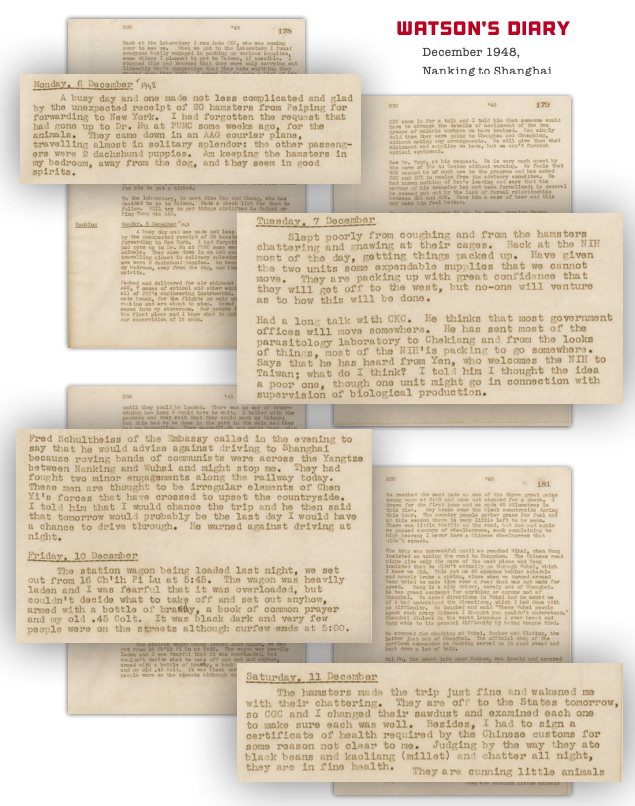
Watson collected ten males and ten females and packed them into a wooden crate with help from a Chinese physician (who was later imprisoned for this act). Watson slipped the crate out of the country on a Pan-Am flight from Shanghai, just before the Communists took control.
In New York, Schwentker received the hamsters and then began breeding and selling them to other researchers.
In 1957, a geneticist named Theodore Puck, intent on creating a new mammalian “model system” for in vitro experiments, learned about the Chinese hamster and contacted George Yerganian, a researcher at the Dana-Farber Cancer Institute, to obtain a specimen. Yerganian shipped Puck one female hamster.
Puck took a small piece from this hamster’s ovary, plated the cells onto a dish, and passaged them repeatedly. He eventually isolated a clone that could divide again and again; an “immortalized” CHO cell with a genetic mutation that rendered it immune to normal senescence.
Today, descendants of these immortalized CHO cells make about 70 percent of all therapeutic proteins sold on the market, including Humira ($21 billion in sales in 2021) and Keytruda ($17 billion). Many of these drugs are monoclonal antibodies, or Y-shaped proteins that lock onto, and neutralize, foreign objects inside the body.
CHO cells are well suited to biotherapeutics because they can perform a biochemical reaction called glycosylation. Many human proteins, including antibodies, are decorated with chains of sugars that control how they fold or interact with other molecules in the body. Only a few organisms, mostly mammalian cells and certain yeasts, can do this chemical reaction.
I first learned about this history from a really spectacular article in LSF Magazine, called "Vital Tools: A Brief History of CHO Cells." I recommend it. (You can find it with a quick search.)
A Brief History of Parafilm (for the upcoming @AsimovPress book, "Making the Modern Laboratory.")
In 1830, a German chemist named Carl Reichenbach (who spent decades of his life extracting various chemicals from tar, for some reason) cooled petroleum and noticed that a thick layer of wax formed on top. He dubbed this wax paraffin, from the Latin for parum and affinis, meaning “very little” and “lacking affinity.”
Paraffin remained quite obscure until 1859, when Edwin L. Drake drilled the first-ever oil well in the small town of Titusville, Pennsylvania. In the decades following, as hundreds of oil wells sprung up across America, paraffin wax became an extremely common byproduct of oil manufacturing. And since it is entirely odorless, this wax was commonly used to make candles.
Paraffin was also used, oddly enough, in some historic physics experiments. In 1932, for example, James Chadwick, the Nobel Prize-winning physicist, used paraffin to discover the neutron. He stuffed chunks of wax inside his neutron detector, and then blasted a beryllium target with radioactive particles. Chadwick detected neutrons after the high-speed particles “dislodged protons from a piece of the wax.”
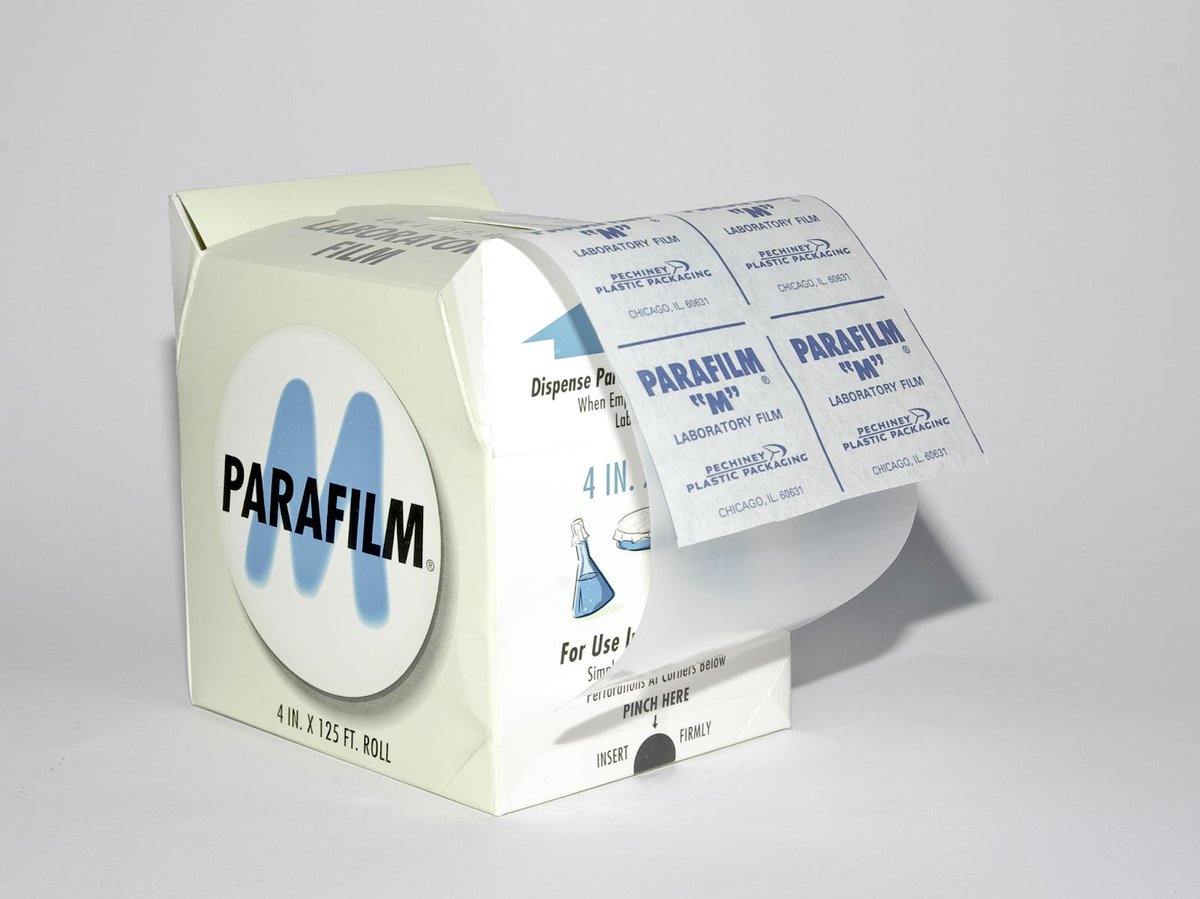
The word “parafilm” -- that ubiquitous thing that scientists use today to seal flasks, due to its ability to allow gases through while blocking liquids -- was first trademarked by the Marathon Paper Mills company in 1934. The company marketed it as a moisture-proof, self-sealing wrapper. But initially, it was marketed not to scientists but rather to sailors, primarily for map mounting.
Sailors would place a flat layer of parafilm between a map and fabric, and then apply a hot iron for about ten seconds. The parafilm wax would partially melt and join the map to the fabric, making it more resilient to saltwater and harsh ocean winds. Even today, the parafilm recipe is closely guarded. What we know for certain, based on chemical analyses, is that parafilm is made from 56 percent wax and 44 percent polyolefins, and that it has a boiling point above 550 degrees Fahrenheit.
In the 1950s, the Marathon Paper Mills Company sold its Wisconsin plant (and the rights to manufacture parafilm) to the American Can Company, one of the largest military contractors during World War II. Around the same time, advertisements for parafilm began appearing in magazines, including Scientific American. A 1952 advertisement touted parafilm as a “wonder material” for sealing flasks and culture dishes, and also as “airtight,” even though it is permeable to gases.
The rights to manufacture parafilm passed around to various companies until Amcor, one of the world’s largest packaging companies, bought the rights for $5.25 billion in 2019. Today, parafilm is manufactured in a factory located about 40 miles southwest of Green Bay, Wisconsin.
Adapted from an essay I co-wrote with @Meta_Celsus a couple years ago!
The only rule in biology is that there are exceptions to every rule. This is what makes biology infinitely exciting; even when you think you’ve got the complete view, the floor can drop out from underneath you at any given moment.
Case-in-point: The nucleus is the thing that makes eukaryotes...well, eukaryotes. It's the part of the cell that stores the genome, separating DNA from the cytoplasm and other organelles. (Bacteria do not have nuclei.) For decades, scientists thought that each nucleus contains one or more haploid sets of chromosomes.
But there are exceptions. Red blood cells, for example, don’t have nuclei at all. (They expel their nuclei during maturation to maximize hemoglobin concentrations.) Cells in the eye lens, too, lose their nuclei and organelles during differentiation, thus becoming transparent. And so on.
But now there is yet ANOTHER exception to this rule, and it’s one I hadn’t seen before. For a study in Science, researchers discovered that two types of pathogenic fungi that infect plants, called Sclerotinia sclerotiorum and Botrytis cinerea, have two different nuclei. And instead of storing a full set of chromosomes in each nuclei, they instead “distribute their chromosomes such that each of their nuclei contains only a subset of the haploid chromosomes.” The authors confirmed this by throwing a kitchen sink of methods at these cells; chromosome counting, DNA measurements using flow cytometry, single-nucleus PCR, and more.
Nobody knows why the fungi do this, but the scientists claim (in their discussion) that it could enable them "to respond and adapt more effectively to local environmental stresses within their extensive mycelial networks. Nuclear shuffling may facilitate the rapid generation of new genotypes, enhancing adaptability to changing environments.” There is also evidence that the chromosomes within each nucleus may briefly collide during cell division, before going back into their separate nuclei.
This is a great paper. It is simple, to the point, and challenges the status quo. It has serious potential to become a “classic” of the genre.
Link: https://t.co/AtsN5Kufpl
She understands the plight and sorrow as a mother whom the system has failed before . Let us stand with our women and doctors and ensure that they are protected.
#JusticeForMoumita#GoastandswithRGKarVictim
JUSTICE BEING DELAYED in such a crucial matter is itself a shame .We fail as a society when such incidents happen to a girl at her workplace.She was a woman before being a doctor and this is not something just medical community should be fighting for….
#GoastandswithRGKarVictim
@GaryLineker@woody44z@BBCSport There's a time and place to ask them though. Also have you ever asked Guardiola about the 115 charges against Manchester City ?
@gauravsabnis If I recollect correctly the owners of Manchester United were linked to buying franchises in this upcoming league. Their involvement in any sports business after what they've going to United is criminal to say the least
@OGtrashtalk I've seen the exact same story that fits this description several times now and I still don't know where in Goa and more importantly why ? 🤣🤣