Today, we’re launching /mission by Medley.
Give Claude Code an outcome, not a task. Medley turns it into a live graph, coordinates Claude Code + Codex workers, then reviews and keeps going.
SOTA on 4 public benchmarks—from coding to healthcare and drug discovery.
https://t.co/gdDVceoWbr
Inspiring video with advice from 50 top entrepreneurs.
I’m trying to learn more about business/entrepreneurship — what resources (websites, YouTube, courses, podcasts) do you recommend?
https://t.co/bjh4moH9zB
greg brockman talks about a compute powered economy — compute is directly proportional to the complexity of problems we can solve accurately.
deep research is the integral part of the agent stack here. long horizon problems where tasks take not hours but sometimes days — drug discovery, financial due diligence, legal research, scientific lit reviews, consulting work. trustworthiness is the biggest priority.
I am building an agentic deep research harness, built from first principles, just how a human would do deep research.
excited about how this compute powered economy will help us solve some of the most important and complex problems for our future generation, and happy to be contributing a small percentage to it.
building this at Spine — https://t.co/OEKeShaRYh
greg's full talk — https://t.co/82zqNrTlkn
Strategically transforming an enterprise with AI requires both a bottom-up and a top-down approach.
The bottom-up approach is about building the platform foundation — the right connections, knowledge, and frontier model capabilities that compound over time. While bottom-up helps, businesses run on long, complex workflows that span multiple different types of teams. That's where the top-down approach comes in — rethinking what those processes actually look like in a world of AI agents. (for eg. onboarding a new hire, a bank processing a loan application, or a retailer managing supplier contracts — all of these involve multiple teams, endless handoffs, and weeks of back and forth that can be reimagined end-to-end)
Great breakdown from Derek at JP Morgan on how they're thinking about this. https://t.co/J53lPSo541
Most companies striving for PMF working at an extreme pace only call LLM APIs, however as the product scales and inference costs rise alongside proprietary data concerns, this hybrid inference strategy makes a lot of sense for most use cases.
- APIs for low-volume or experimental tasks (OpenAI, Anthropic)
- Managed platforms for compliance-sensitive production workloads (AWS Bedrock, Google Vertex AI)
- Self-hosted open-weight models for high-volume, cost-sensitive work (DeepSeek, Qwen)
Full article linked:
https://t.co/QKes9myMBa
Connecting X as an MCP was a bit of a maze but now my agents can search, analyze, and manage X data autonomously.
Here's how to set it up:
1. Create a Composio account at https://t.co/NuRWcqwLzU
2. Create a Composio API key from Settings → API Keys
3. Create an X developer account at https://t.co/wBlRzY7xGB and get your Client ID, Client Secret, and OAuth Bearer Token
4. Go to https://t.co/PU7M5hffpY<workspace>/<project>/mcp-configs and create a new MCP server for X
5. Enter your X credentials (Client ID, Client Secret, Bearer Token) in the setup
Claude Code:
6. Run in terminal: claude mcp add --transport http <name> "<your-mcp-url>" --header "x-api-key:<your-composio-api-key>"
7. Restart Claude Code and verify with claude mcp list
Claude Desktop:
6. Run the npx @composio/mcp@latest setup ... --claude command from your MCP config page
7. Add --header x-api-key:<your-composio-api-key> to the args in your claude_desktop_config.json
8. Restart Claude Desktop
There are other third party X MCP servers out there, but Composio is the most reliable one I've found.
An AI agent is a function of Model Intelligence + Shell + File System + Heartbeat Loop. This means the AI isn’t just talking to you—it has the "hands" to access your machine and execute tasks autonomously until the goal is reached.
The real breakthrough is introspection. Agents can inspect their own logic, fix errors, and evolve by adding new capabilities. This is software that can rewrite and extend itself.
At their core, Claude Code, OpenClaw, and similar agent harness systems share the same underlying architecture.
Full video from Marc Andreessen for deeper context.
https://t.co/jtmxHKRsDP
Agents working effectively in an enterprise setting is a data problem more than it is an AI problem.
Imagine you delegate a task to a bunch of AI agents. They’re incredibly smart, but they’re essentially "new hires" who joined one minute ago.
The bottleneck isn't their intelligence; it’s enterprise data. They can't be effective if:
- Information is scattered across 20 different systems
- Agents have to connect context diffused across those systems
- Tribal knowledge is undocumented
- Data is outdated or conflicting
The real vision for knowledge work automation depends on how well we organize the context these agents need to actually do the work.
Great breakdown from @levie on this here https://t.co/9ZF1bZSego
As engineers get more productive with tools like Claude Code, the role is starting to feel like a blend of engineer + mini PM.
This is exciting to me because:
• Better product sense
• More systems thinking
• Greater focus on outcomes over implementation
Many more valuable insights from Amol on Lenny’s Podcast ↓
https://t.co/x3LDJM4U9Z
Canvas from @Spine_AI is an unlimited visual workspace for AI — where you can think, branch, and collaborate across hundreds of models.
Chat works for Q&A. Canvas is for thinking.
https://t.co/thZKTQWq0w
Congrats on the launch @BudhkarAkshay & @AshwinVRaman!
trillions spent on ai, and we’re still stuck in a chatbox.
chat made ai accessible, but it trapped thinking in a box.
we built spine canvas — the unlimited visual workspace for ai.
think, branch, and build — the way real work actually happens.
🎥 ↓
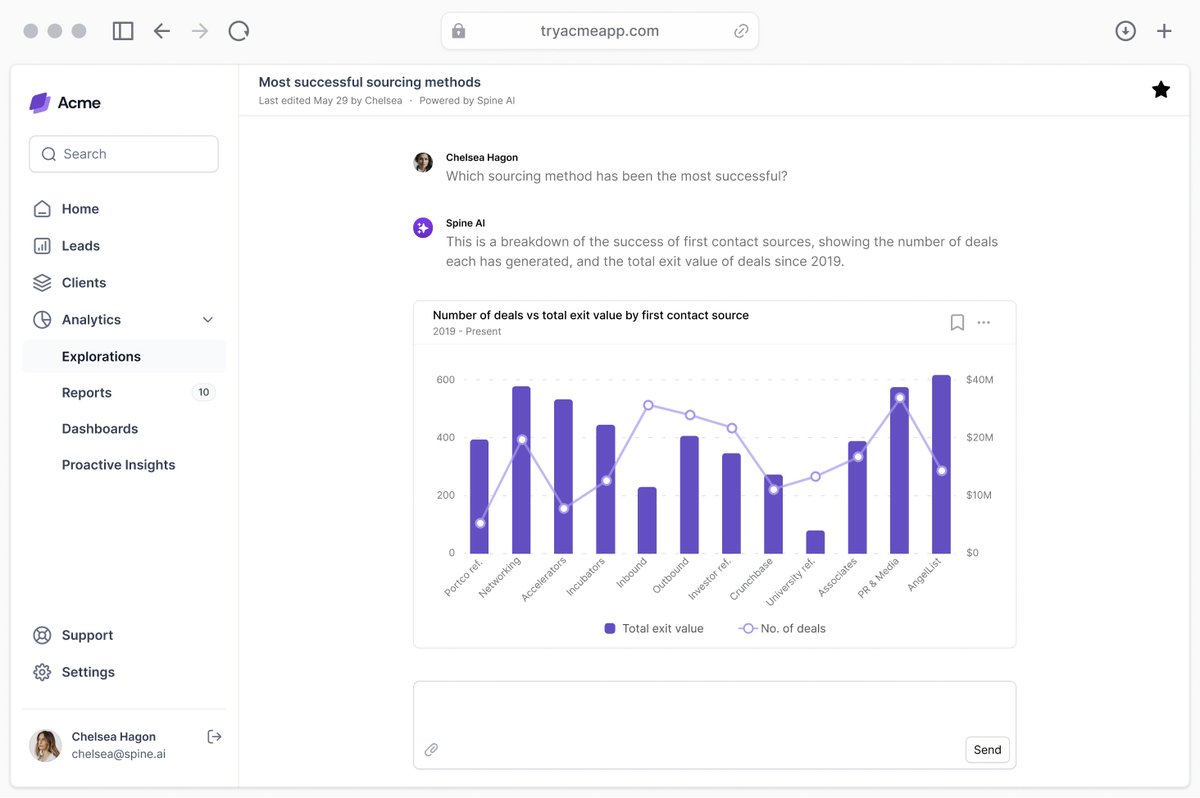
YC S23's @Spine_AI creates reliable AI data analysts that know your business. It captures and embeds your business context to enable real, plain-language data questions — without burdening your technical teams.
https://t.co/3uE6ULD33L
There is my prediction on where RAG is headed. In this video i talk about
- Shift from RAG as question-answering systems to report generation tools
- Importance of well-designed templates and SOPs in driving business value (selling to people with money)
- Room for AI-generated templates and template marketplaces to do better generation with AI tools
The best paper award is awarded to the paper "Contextualizing Internet Memes Across Social Media Platforms" by Saurav Joshi, Filip Ilievski, and Luca Luceri (@LucaLuceri)! 🏆
The award (which consists of AUD 500) is sponsored by Macquarie University-Cyber Security Hub (@MQCSH)!
Amazing talk from @LucaLuceri about work on contextualizing internet memes at MM4SG workshop @TheWebConf.
Read the paper here: https://t.co/WTHOcbf6un
#MM4SG2024
The mysterious AI called “gpt2-chatbot” is back as "im-a-good-gpt2-chatbot"
Capabilities seem to exceed GPT-4, Gemini 1.5, Claude, and anything else currently available.
Here's EVERYTHING you need to know (and how to try it for free):