Presented my paper "Automatic Report Generation for Histopathology images using pre-trained Vision Transformers"
@SymposiumML4H. Very rewarding experience with intriguing discussions with talented folks!
For anyone interested here is the paper; https://t.co/8K0xYpoHud
Altman, Hassabis, and Amodei are the ones doing massive corporate lobbying at the moment.
They are the ones who are attempting to perform a regulatory capture of the AI industry.
You, Geoff, and Yoshua are giving ammunition to those who are lobbying for a ban on open AI R&D.
If your fear-mongering campaigns succeed, they will *inevitably* result in what you and I would identify as a catastrophe: a small number of companies will control AI.
The vast majority of our academic colleagues are massively in favor of open AI R&D. Very few believe in the doomsday scenarios you have promoted.
You, Yoshua, Geoff, and Stuart are the singular-but-vocal exceptions.
like many, I very much support open AI platforms because I believe in a combination of forces: people's creativity, democracy, market forces, and product regulations.
I also know that producing AI systems that are safe and under our control is possible. I've made concrete proposals to that effect.
This will all drive people to do the Right Thing.
You write as if AI is just happening, as if it were some natural phenomenon beyond our control.
But it's not. It's making progress because of individual people that you and I know. We, and they, have agency in building the Right Things.
Asking for regulation of R&D (as opposed to product deployment) implicitly assumes that these people and the organization they work for are incompetent, reckless, self-destructive, or evil. They are not.
I have made lots of arguments that the doomsday scenarios you are so afraid of are preposterous. I'm not going to repeat them here. But the main point is that if powerful AI systems are driven by objectives (which include guardrails) they will be safe and controllable because *e* set those guardrails and objectives.
(Current Auto-Regressive LLMs are not driven by objectives, so let's not extrapolate from their current weaknesses).
Now about open source: your campaign is going to have the exact opposite effect of what you seek.
In a future where AI systems are poised to constitute the repository of all human knowledge and culture, we *need* the platforms to be open source and freely available so that everyone can contribute to them.
Openness is the only way to make AI platforms reflect the entirety of human knowledge and culture.
This requires that contributions to those platforms be crowd-sourced, a bit like Wikipedia.
That won't work unless the platforms are open.
The alternative, which will *inevitably* happen if open source AI is regulated out of existence, is that a small number of companies from the West Coast of the US and China will control AI platform and hence control people's entire digital diet.
What does that mean for democracy?
What does that mean for cultural diversity?
*THIS* is what keeps me up at night.
The debate on AI risks and need for legislation is a complex one and my own position is not exactly identical to anything any of the key players have already publicized.
I will however list some points of concurrence. )Not that anyone asked.. 😅)
I am fully supportive of open-source R&D--something @ylecun has admirably carried the torch since the beginning (and said so: https://t.co/B935c3654k;
https://t.co/NmAKmV9mjw;
https://t.co/tapRECs7ug).
I do believe that there is a critical need for legislative and societal oversight on the deployment of #AI systems.
https://t.co/Eyj2Drttoa;
https://t.co/pxFvIfUUkM
But, any discussion on #AI deployment risks often seems to be hijacked by the hypothetical existential risk arguments that suck the oxygen right out of the room.
https://t.co/vO67H7yxeo;
https://t.co/J6Nx5XWyNO
On the xrisk positions themselves, I don't doubt that some of the people worried about that (e.g. Stuart Russell from way before it became fashionable) are sincere. But having spent quite a bit of time listening to those arguments, I am not convinced.
As I said, before, #AI will unquestionably be a potent tool as well as weapon in *our* hands--and there is every reason to be concerned about its careful deployment. But the extinction angst seems to me to be largely a distraction (even a convenient one for some interested in regulatory capture).
https://t.co/nu8eWG2ARC;
https://t.co/LATXpNRWYP;
https://t.co/phhslFkkEa
Even with those sincere about their xrisk worries, I fail to understand what remedy they are advocating (beyond the "leave it to us who know how to do it" cynicism). Pauses and bans, however sincere, seem quite ineffective to me as #AI R&D doesn't have the kind of natural barrier to entry that made such things work in other cases such as nuclear non-proliferation. This is one reason why I didn't sign even the "autonomous weapons" ban--despite being a died-in-the-wool pacifist. https://t.co/7R1mL8K14A
Red teaming and eternal vigilance seem like the only viable alternatives (for which open-source R&D provide the best support).
I hit a bug in the Attention formula that’s been overlooked for 8+ years. All Transformer models (GPT, LLaMA, etc) are affected.
Researchers isolated the bug last month – but they missed a simple solution…
Why LLM designers should stop using Softmax 👇
https://t.co/3TqSo13RKN
Wrote a new blog post outlining techniques for improving the training performance of your PyTorch model without compromising its accuracy.
By changing only a few lines of code, we are going from 22.63 minutes to 3.15 minutes when finetuning BERT:
https://t.co/36ptnaFOzz
We’ve released v1.1 of WILDS, our benchmark of in-the-wild distribution shifts! This adds the Py150 dataset for code completion + updates to existing datasets to make them faster and easier to use.
Website: https://t.co/bwOiG9R5Ct
Paper: https://t.co/tj74IwiIec
Thread 👇
(1/8)
🚀 The ML Reproducibility Challenge is an amazing opportunity for students to learn about cutting edge ML research. @JesseDodge explains how you can incorporate it in your course to help your students: https://t.co/adSGFu8xiG
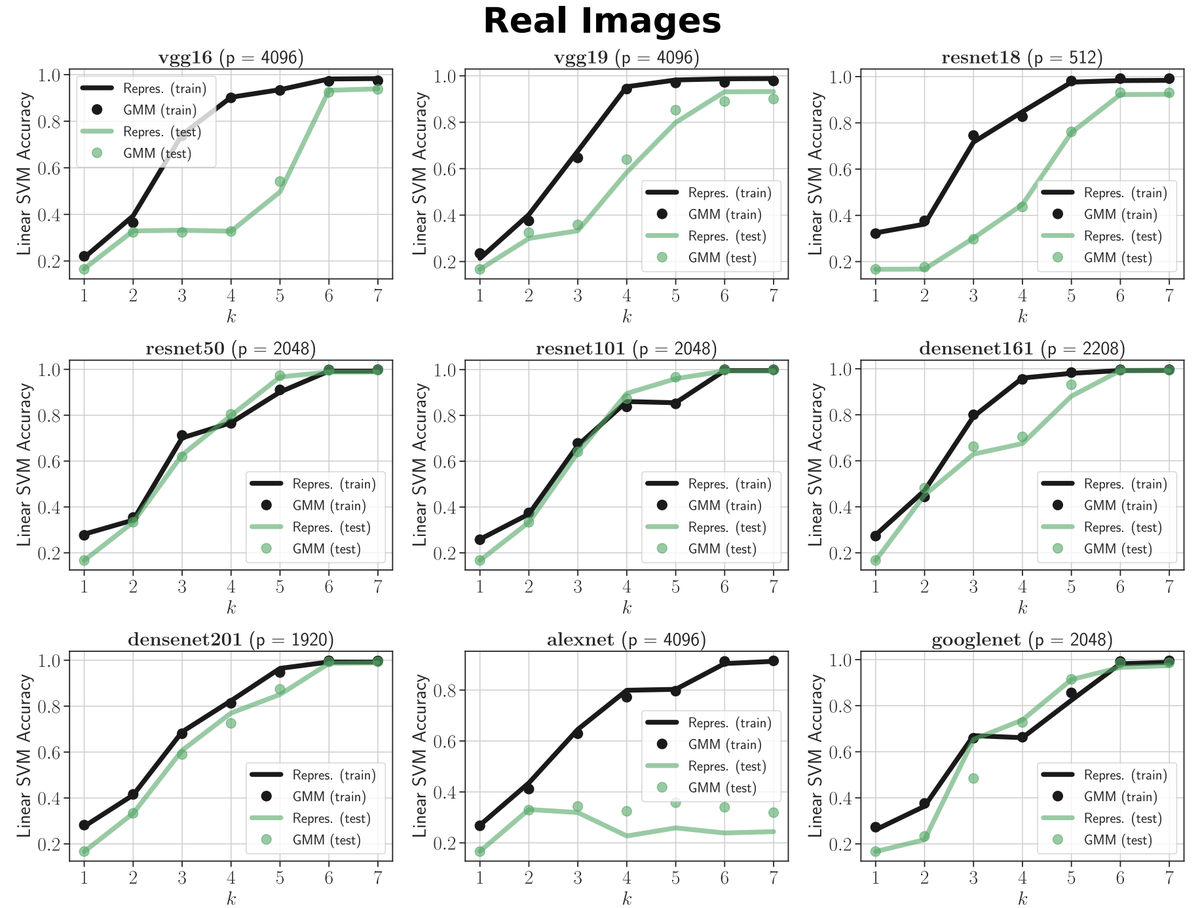
1/ Crazy exp: take Resnet embedding of Imagenet as dataset A. Train linear predictor on A; get accuracy p. Now make fake dataset B = a mixture of Gaussians w/ same class mean & covariance as A. Train linear predictor on B => get *SAME ACCURACY* p. WTF https://t.co/HAx9iV5c09
So excited to work with Ted Denson and other @NASPGHAN colleagues on this IBD Data Science project - Data Science in GI! Big thank you to my mentors & students for getting us here @sauravsen111!
I find myself wildly invested in the outcome of this. It feels like a test of how far people tolerate this. Not just here..anywhere.
https://t.co/i8EwNK4VCM
This talk by @karpathy https://t.co/w2yNib59x4 has convinced me that Tesla is several years ahead of most CV labs in regards to pushing the limits of DL. Commonplace questions like "how do you do early stopping for a multi-task model?" are non-trivial when at scale.
In anticipation of @deeplearningai_‘s new AI For Medicine Specialization, I’ll be speaking at our online event with @EricTopol, @lhpeng, and @pranavrajpurkar about this fast-growing application area. You can register here: https://t.co/HNYiUmtvvK
So, the last week I have been battling COVID-19 & Pneumonia. Never in my life have I been this ill. “Young people aren’t at risk, they’ll only have mild symptoms” Wrong.
I want to open up about the difficulties I’ve gone through these past days, what it was like in the ICU...
Great thread for people into interpretability and deep learning. Personally I feel there's a lot needed to be done on creating generalizable interpretations of deep learning models in computer vision and not limit ourselves to GradCAMs.
***ML Tragic Pattern*** (1) Propose algorithm that makes no sense. (2) Ignore obvious examples that illustrate the incoherence. (3) Implement it anyway (4) Fool reviewers @ a top conference. (4) Celebrate. (5) "Discover" method has problems. (6) Write "critical" paper.