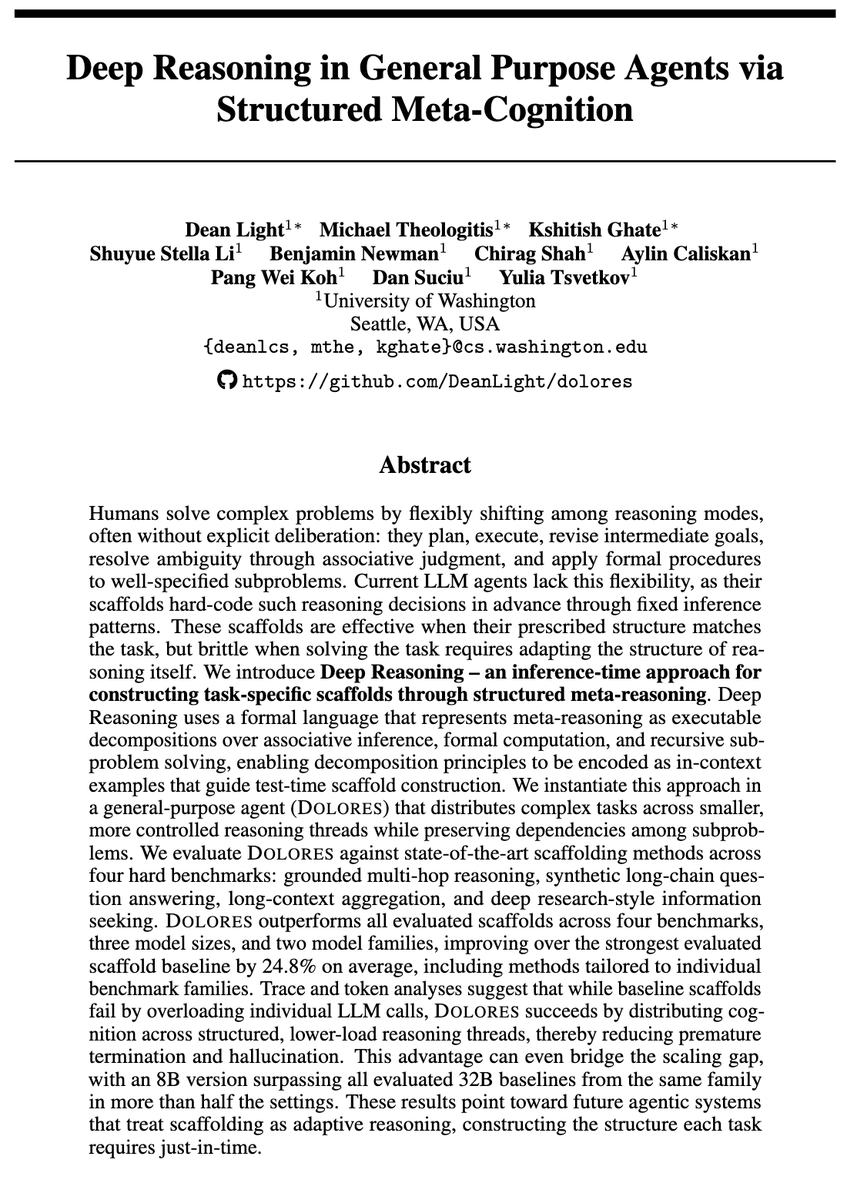
New #NeurIPS2026 paper 🧵
We introduce 🌟 Deep Reasoning 🌟, an approach for building just-in-time agentic harnesses for solving diverse reasoning problems.
Inspired by human cognition, we recursively decompose tasks into atomic units of formal and associative reasoning steps. We instantiate deep reasoning through DOLORES, our structured meta-harness:
DOLORES achieves ~25% higher accuracy against SOTA baselines (including RLMs and Deep Research) 🚀
enabling 8B models to outperform 32B variants of the same family 🤖
…all training-free!
🧵 below,
Anthropic is digging in at South Lake Union.
113,000 sq ft at Dexter Yard North in July. 50,000 more in October.
An 11-year lease with an option to buy the building.
Not a company testing Seattle. A company staying.
Every one of those desks is someone deciding where to live.
Hi @ReviewAcl , I've been trying to contact you for about 6 months for a reviewer certificate for a secondary reviewer. However, nobody has gotten back by email. Could you please guide us on how to receive the certificate? Thank you very much in advance!
Introducing S1, our new foundation model that learns from one example.
It can be taught 10-minute long tasks that it has never seen before, from one video prompt without any fine-tuning.
Watch S1 operate in real-time via in-context learning:
"Chatting" with LLM feels like using an 80s computer terminal. The GUI hasn't been invented, yet but imo some properties of it can start to be predicted.
1 it will be visual (like GUIs of the past) because vision (pictures, charts, animations, not so much reading) is the 10-lane highway into brain. It's the highest input information bandwidth and ~1/3 of brain compute is dedicated to it.
2 it will be generative an input-conditional, i.e. the GUI is generated on-demand, specifically for your prompt, and everything is present and reconfigured with the immediate purpose in mind.
3 a little bit more of an open question - the degree of procedural. On one end of the axis you can imagine one big diffusion model dreaming up the entire output canvas. On the other, a page filled with (procedural) React components or so (think: images, charts, animations, diagrams, ...). I'd guess a mix, with the latter as the primary skeleton.
But I'm placing my bets now that some fluid, magical, ephemeral, interactive 2D canvas (GUI) written from scratch and just for you is the limit as capability goes to \infty. And I think it has already slowly started (e.g. think: code blocks / highlighting, latex blocks, markdown e.g. bold, italic, lists, tables, even emoji, and maybe more ambitiously the Artifacts tab, with Mermaid charts or fuller apps), though it's all kind of very early and primitive.
Shoutout to Iron Man in particular (and to some extent Start Trek / Minority Report) as popular science AI/UI portrayals barking up this tree.
SICon 2024 is featuring a shared task: GenSICon, aiming to investigate the generalization capability of a model across different social influence tasks or scenarios.
Get your machines running! 🧑💻 We have prizes for the winners 🏆🎁
More details at https://t.co/Eg6Vl93KrP
Humans are usually proficient in communication, especially in recognizing the subtleties in text. Can we vocalize these hidden intents to understand the meaning behind conversations ?💬
Our #ACL2024 paper investigates how to generate and use such rationales for dialog .🧵1/n
(7/7) Thanks to my awesome collaborators: Alex Xie, @Divyanshu_Sheth, @dan_fried, @stefan_fee, Carolyn Rosé!
Check out our code repository at: https://t.co/RFRDGWoXr7!
(1/7) Do you want to test code generation models on the domains you care about?
Struggling to find existing benchmarks that suit your needs?
Our new work *CodeBenchGen* helps you build execution-based benchmarks based on your selected code fragments! (https://t.co/cWL6xXSkOg)
India-based startups are finally eating the US consumer market.
PocketFM, founded by IIT Kharagpur alums, is Netflix for audio with 100M+ users and is #14 in Entertainment in the US Apple App Store!
They have $150M in revenue, are a Unicorn, and $100M+ comes from the US!!
Today we're excited to introduce Devin, the first AI software engineer.
Devin is the new state-of-the-art on the SWE-Bench coding benchmark, has successfully passed practical engineering interviews from leading AI companies, and has even completed real jobs on Upwork.
Devin is an autonomous agent that solves engineering tasks through the use of its own shell, code editor, and web browser.
When evaluated on the SWE-Bench benchmark, which asks an AI to resolve GitHub issues found in real-world open-source projects, Devin correctly resolves 13.86% of the issues unassisted, far exceeding the previous state-of-the-art model performance of 1.96% unassisted and 4.80% assisted.
Check out what Devin can do in the thread below.
Once you are first, you are never second or third. The first open source LLM time series model from Carnegie Mellon. 🔥🔥🔥🔥🔥🚀🚀🚀🚀🚀
#timeseries#opensource#forecasting#llm
BOOM 💥 The competition in LLM time series space is heating up.
Lag-Llama was making rounds yesterday and some people claimed it was “the first” open source LLM. But it turns out on 6 February before Lag Llama Carnegie Mellon released their own open source LLM “Moment”. 🔥🔥🔥🔥🔥
So MOMENT, not Lag Llama is THE FIRST open source time series LLM. 🚀🚀🚀🚀🚀
“MOMENT: A FAMILY OF OPEN TIME-SERIES FOUNDATION MODELS”
#llm
#timeseries