$SIVE roadmap to $10B MC along with timeline and events.
When you keep gaining confidence in $SIVE, pls review what happened in the past. It will reinforce why we begin this investment journey.
$SIVE roadmap to $10B MC along with timeline and events.
When you keep gaining confidence in $SIVE, pls review what happened in the past. It will reinforce why we begin this investment journey.
@talethdabm89 The research firm got their glass core substrate timelines off.
H2 2026 should be production start (SKC Absolics), not 2028. And TAM figures seems off toward 2040, so thought it was better not to cite it.
Even though it’s not full value chain like $LPK and GCS in specific
Sivers Semiconductors $SIVE Q1 2026: Strong pipeline growth of 77% YTD, with softer sales YoY. Effected by US ChipAct delay and Fx in the short term.
Main focus in the investor call on pipeline growth, as well as the three super cycles AI, SATCOM and DoD.
2027 multiple ramp is anticipated;
Highlights:
-Opportunity Pipeline strengthened significantly
May 2026 Pipeline at $799M (77% increase from end of FY2025)
-US CHIPS Act Year 2 funding ($6.6M) for Electronic Warfare program
-Broad market beamformers and lasers igniting strong customer interest
Executing well on multiple product ramps for 2026/2027:
-Production builds in progress for Automotive LiDAR customer
-On-track for product readiness in 2027 for AI datacenter lasers
-Tachyon production PO ($3M) for 2026 and new 60 GHz contract
-Production orders imminent from lead SATCOM customer for 2027 ramp
-Tier-1 Telco vendor FWA product in advanced integration and trials
US Listing:
Investing in higher standards of financial control for US listing
$JBL update - Collaboration with Jabil:
- 1.6T Pluggables Differentiated, Low Power Linear Receive Optics (LRO) Pluggable Solution
- World-leading Contract Manufacturer (>$30B sales)
Investing in rapidly growing Intelligent Infra segment
- Strong entry into existing Pluggables market in AI datacenters
-Supporting builds for upcoming product qualification and field trials
Interesting near term triggers:
- Jabil Collaboration has triggered strong interest from other potential customers
- Production orders imminent from lead SATCOM customer for 2027 ramp
Only thing to look at with $SIVE earnings is forward growth.
Nobody cares about pre-development contract earnings from 2025 or last quarter, especially for qualification cycle optical players.
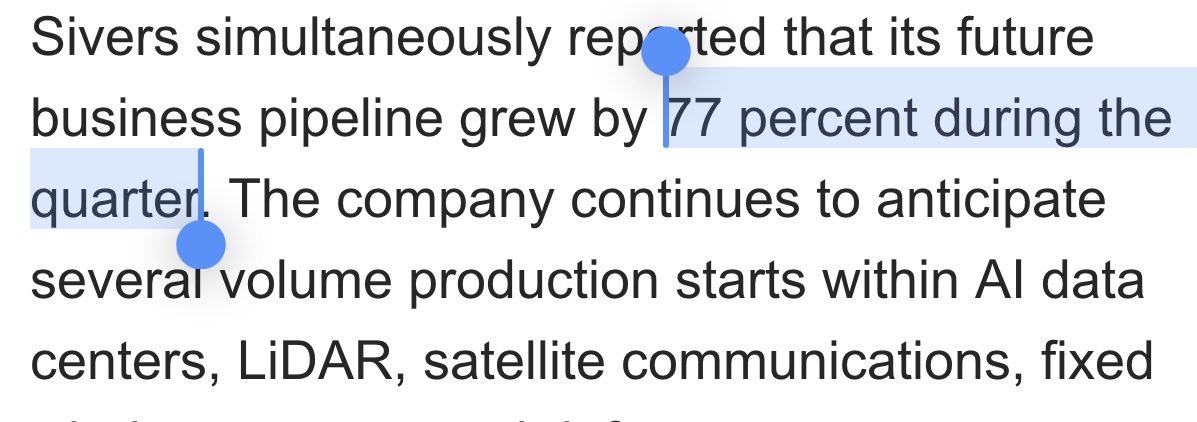
Having 77% growth of opportunity pipelines (revenue volume ramp projections), to $799m
In a quarter is absolutely incredible growth. And, I’d expect to see that continue compounding.
“The company continues to anticipate several volume production starts within AI data centers” (photonics/lasers).
Is also very positive and validates the thesis about volume ramp for photonics.
Now next thing to look at is earnings call transcript, once they’re indexed, which is the most important signal of what’s to come.
Overall, very positive.
▶ Embedded substrates draw AI chip interest as packaging turns strategic
- The growing interest in embedded substrates from major players like Nvidia, AMD, and Intel signals a potential shift in the AI datacenter supply chain.
- The technology can improve signal integrity and power stability for high-performance chips.
- Industry players are also developing EIPD (Embedded Integrated Passive Device) modules to simplify substrate processing and advanced packaging for AI and high-performance computing (HPC) chips.
- An embedded substrate features pre-formed cavities within the substrate to house passive components.
- The most commonly embedded component is the MLCC, with structures divided into semi-embedded and fully-embedded approaches.
- Compared with mounting passive components on the substrate surface, the embedded structure shortens signal paths and reduces parasitic inductance, making it advantageous for achieving impedance matching in the power delivery network (PDN).
- This is expected to improve signal integrity and power stability for AI and HPC chips.
- Embedded designs have already been adopted since the iPhone X-generation application processor (AP) as a way to free up limited PCB surface space.
- That said, large-scale adoption in the AI and server markets remains at an early stage. Embedding capacitors and resistors within the substrate raises costs, and no clear market leader has yet emerged in the industry.
- As a result, whether AI chip customers ultimately adopt the technology is set to become a key competitive variable.
- A range of suppliers—Japan's Ibiden, Korea's Samsung Electro-Mechanics, and Taiwan's Unimicron, Kinsus Tech, and Nan Ya PCB—are scaling up investment in embedded substrate development.
- Some market observers see Samsung Electro-Mechanics as holding an edge, given that it produces both MLCCs and package substrates and is reportedly planning new equipment investment at its Vietnam plant.
- Others, however, point to the stringent control required over materials, drilling precision, and surface flatness in embedded substrate manufacturing, and expect Ibiden and Unimicron to be the preferred partners for demanding AI customers.
- According to Taiwanese suppliers, inquiries about embedded substrates have surged from Nvidia, AMD, Intel, and ASIC customers focused on AI datacenter and HPC server chips.
- Design optimization concepts such as integrated passive device modules are still in the technology validation phase, but industry sources expect mass production to accelerate within the next few years.
- Substrate technology is emerging as a critical platform for supporting the rising power, bandwidth, and integration density of chips.