🚢 Marin 535B-A23B started training this week! As usual, the whole process is open.
Voyage plan: pretraining (80%) + midtraining (20%) on 18.75T tokens on 11 x GB200 NVL72 for ~3 months (2.7e24 FLOPs). Post-training will follow.
Before kicking off the run, we trained a 4-rung scaling ladder from 1.6B-A61M (48B tokens) to 27.7B-A1.2B (926B tokens) to debug issues, and to make a forecast of our hero run. This is by far our biggest run, so definitely expecting the unexpected.
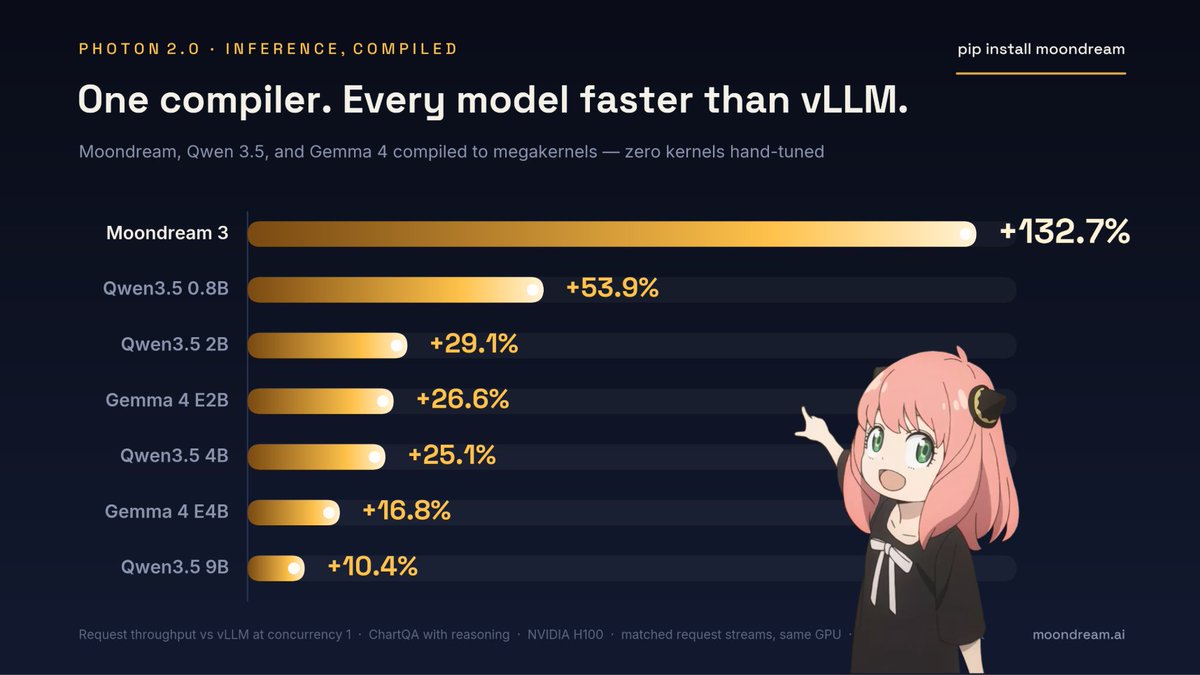
Got sick of hand-tuning GPU kernels, so we built a compiler.
Photon 2.0 compiles Moondream, Qwen 3.5, and Gemma 4 into megakernels: the entire forward pass in one GPU program.
Attackers have frontier AI. Defenders need a frontier AI ecosystem—the best open and closed models, force-multiplied by a global community.
During the Hugging Face incident, closed AI blocked essential forensics. An open-weight frontier model helped contain the intrusion.
That’s why we created the Open Secure AI Alliance.
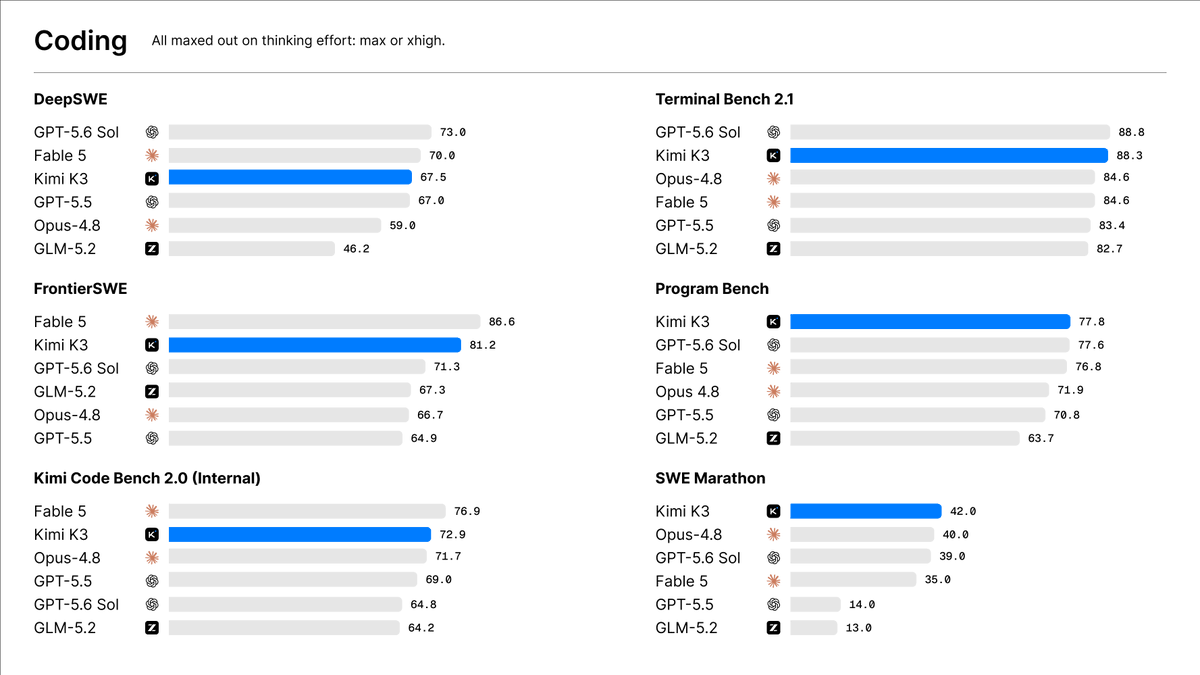
Introducing Kimi K3: Open Frontier Intelligence
🔹 2.8 Trillion Parameters, 1 Million Context, Native Multimodal
🔹 Kimi Delta Attention enables up to 6.3x faster decoding in million-token contexts
🔹 Attention Residuals deliver ~25% higher training efficiency at <2% additional cost
🔹 Built for long-horizon agentic coding and self-evolving workflows
Kimi K3 is now live on on https://t.co/zrk6zZxZUo, Kimi Work, Kimi Code, and the Kimi API.
Open Weights by July 27, 2026.
🔗 API: https://t.co/XCrgjXAqMw
🔗 Tech blog: https://t.co/YTfiMSNM1f
Today, we are introducing Inkling.
Inkling reasons efficiently across text, image, and audio modalities. We are making the full weights available.
https://t.co/Ghebq5mG30
Available today for fine-tuning on Tinker. Play with it in the Inkling Playground. 🧵
Announcing our $130M Series A to build the Open Superintelligence Stack
Led by Radical Ventures, with NVIDIA, Intel Capital, Dell Capital, and existing investors
Train, deploy, and continuously improve your own models using our stack.
Own your intelligence.
Best YouTube Channels To Learn AI in 2026 (No BS)
1. Fundamentals – 3Blue1Brown
2. Deep Learning – Andrej Karpathy
3. AI Research – Yannic Kilcher
4. Practical AI – AssemblyAI
5. LLMs – AI Explained
6. ML Theory – StatQuest
7. Papers Simplified – Two Minute Papers
8. GenAI – Matthew Berman
9. AI Agents – Nicholas Renotte
10. Applied ML – Krish Naik
11. PyTorch – Aladdin Persson
12. Math for ML – Serrano Academy
13. Industry Insights – Lex Fridman
14. Real-world AI – DeepLearningAI
introducing tau τ — an educational agent harness that teaches you how to build agent harnesses
i will be publishing tutorials and demos on how to use it to create your own TUIs, harnesses, extensions, etc.
Happy Tau Day!! 🤓
👉 https://t.co/5sWxNtXTZP
@willcb 1. GLM 5.2 is good enough to replace at least half of what people use openai, anthropic APIs for. Devs got used to spamming Claude code. GLM no limits.
2. API costs rack up fast. Spending 500k on a h200 node for a year that can host glm is magnitudes cheaper than calling openai.
Zyphra is sharing our first work in continual learning where we study: Can LLMs learn forever from new data?
Many see continual learning as a path to AGI through recursive self-improvement (RSI).
The first obstacle is plasticity loss. We derive a scaling law for its onset 🧵
I gave Fable 5 one job: write custom WebGPU kernels for Gemma 4 inference.
It climbed to 84 tok/s, then hit a wall, insisting further optimization was impossible.
Hours later, Anthropic rolled back invisible LLM development safeguards, and it hit 255 tok/s.
The next day, access to Fable 5 was suspended globally.
this model is the opposite of mythos.
Its small, cost effective, apache 2.0, and locally deployable. This is the way LLMs should go.
small, open source, transparent and sovereign
vs
large, expensive, proprietary and hegemonic
Meet DiffusionGemma!
An experimental open model that explores a fast approach to text generation, released under an Apache 2.0 license.
Moving beyond sequential, token-by-token processes to generate entire blocks of text simultaneously. Here’s what’s new with DiffusionGemma: 👇
@ShankhadeepSho1@LeTechLead@TheAhmadOsman Right yeah. Haven't reached down the chain yet lol. Hopefully @lmstudio implement dflash soon. I don't want to run docker images etc. I know I can host my own webui but I like the UI and serverless setup too much
Reading @deepseek_ai 's v4 paper.... absolute hats off.
Every problem has a mathematical solution, nothing is left to chance.
I have so much respect for them, putting out months or years of efforts entirely for free, in the open for anyone to benefit. Real goats 🫡
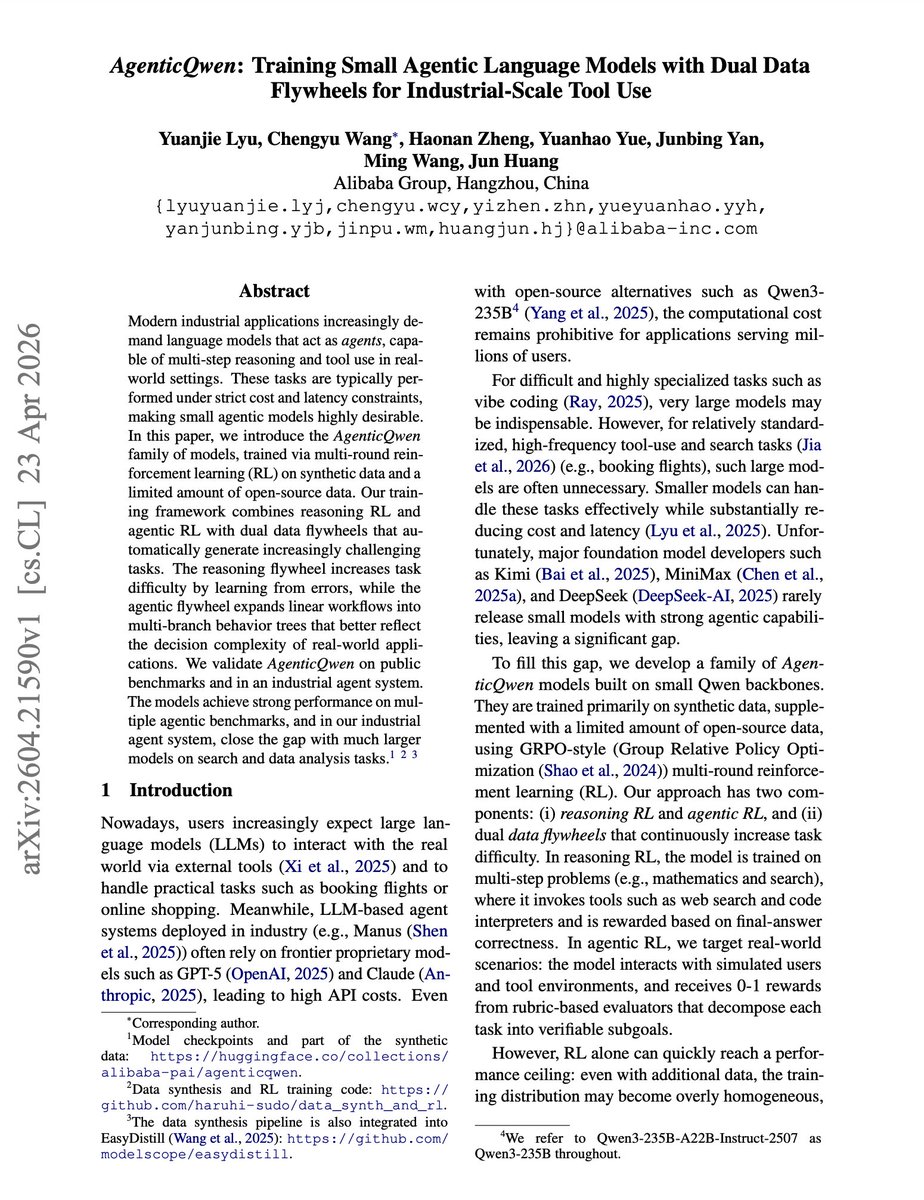
NEW paper from Alibaba.
A 30B MoE with only 3B active params matches Qwen3-235B on real tool-use workloads.
AgenticQwen-30B-A3B: 50.2 average on TAU-2 + BFCL-V4 Multi-Turn.
AgenticQwen-8B: 47.4.
Both more than double their vanilla Qwen baselines and close most of the gap to a 235B model.
How: two RL flywheels run in parallel.
- The reasoning loop mines the model's own errors into harder problems each round.
- The agentic loop grows simple linear tool-use trajectories into multi-branch behavior trees.
- Simulated users actively try to mislead the agent. The training distribution gets harder on its own.
Why it matters for agent devs: you can stop paying frontier prices for routine tool-use workloads.
And the flywheel recipe is reusable. Generate your hard examples from your own agent's failures, not from static synthetic data.
Paper: https://t.co/NGDXulumid
Learn to build effective AI agents in our academy: https://t.co/1e8RZKs4uX