Decoding China | NE & South Asia | Influence & Narrative Analysis | Fellow, @geneuindia @ysi_commons @intgovforum '25 | Ex @USIofIndia, @SMEForumIndia.
"Estimates suggest India may require 2.3 million AI professionals and could create up to 100 million AI-related jobs over the next decade.
For India, strong talent and diverse datasets offer a clear opportunity: build proprietary data assets, focus on domain-specific AI, and invest in talent and capabilities."
From Digital India to AI Nation, former Defence Secretary Ajay Kumar explores how India can harness AI to transform governance, public service delivery, and state capacity.
Read the interview by Vaishu Rai in India's World: https://t.co/O4tSztCZfN
China turned coral reefs into military bases right next to the Philippines.
It built fighter-jet runways, missile systems, and radar on artificial islands after promising not to militarize them.
It drives Filipino fishermen away from Scarborough Shoal with water cannons and ramming.
An international court said the claims are illegal.
China ignored the ruling and kept building.
These aren’t disputed rocks anymore. They’re permanent Chinese military outposts in someone else’s waters.
A new conflict is tearing through Manipur's hills — this time pitting Nagas against Kuki-Zos.
The BJP govt's response to this? Silence and militarisation — while a proposal for a separate territory carved out of Manipur sits quietly on the table.
@Robinson_Waheng & I spent over a month reporting from Manipur, Nagaland, Delhi and Assam to understand this new phase of the conflict.
1/16 🧵
https://t.co/vzSKwCw0tb
@reporters_co
1921’de 53 üyeyle yaşamına başlayan Çin Komünist Partisi (ÇKP);
- 105 yaşında,
- 77 yıldır iktidarda,
- 101 milyon üyeye ve 5 milyonu aşkın taban örgütüne sahip.
Bugünkü Çin’i anlamak ve açıklamak için yalnızca ülke tarihi değil ÇKP tarihi de iyi bilinmeli...
When people from the Northeast make headlines, it’s usually because someone confused us with a foreign country.
But today Assam’s own Tapan Kumar Deka retires as the first Northeasterner to lead the Intelligence Bureau and the longest-serving one at that.
Turns out we’re great at keeping secrets too. 🤫
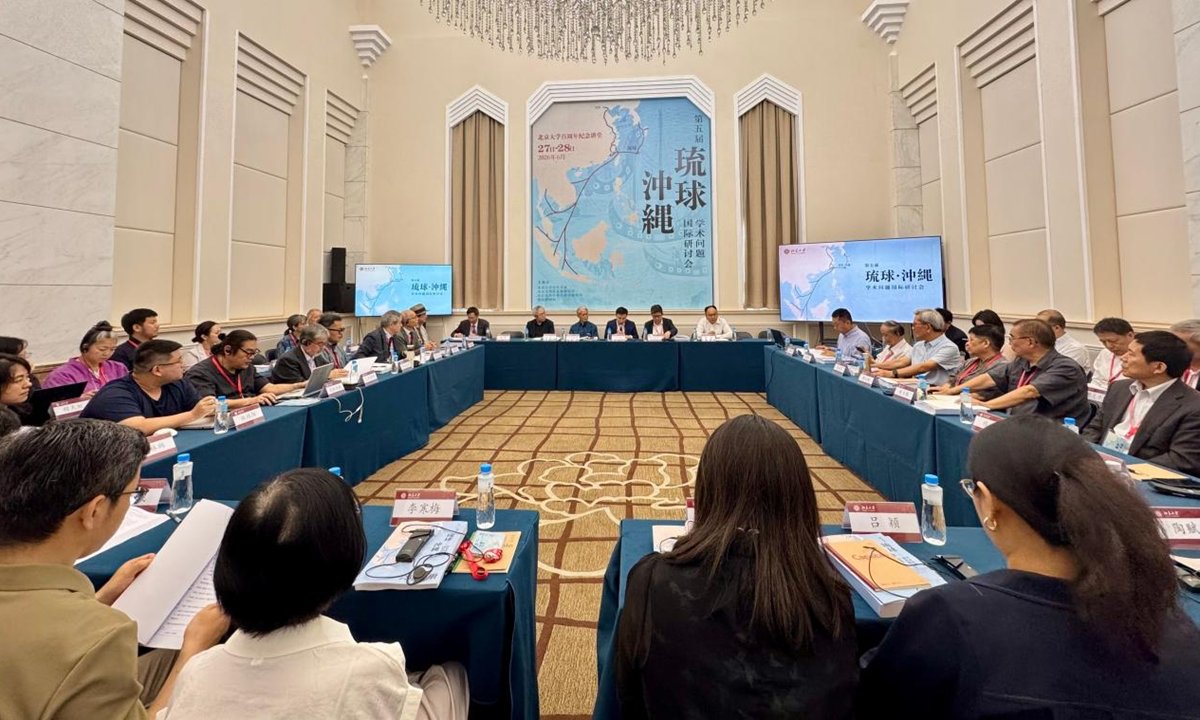
Beijing's cognitive warfare machine is in overdrive. This time targeting Japanese territory through a polished "academic" summit at Peking University.
The 5th Ryukyu-Okinawa Academic International Symposium (June 27-28) brought nearly 100 scholars from mainland China and Okinawa (pointedly framed as the "Ryukyu Islands"). The event was organized by Peking University’s History Department along with other state-linked institutes and the Aisixiang platform. Far from a neutral academic forum, it served as a coordinated platform for advancing CCP narratives.
It pushed CCP revisionist narratives: emphasizing ancient tributary ties to China, portraying Okinawa as a victim of Japanese "colonialism" and "militarism," and criticizing defensive deployments on Yonaguni and Ishigaki islands (nearest to Taiwan). Speakers like CASS's Yang Bojiang and PKU's Xu Yong framed the region as a frontline of rivalry, not Japan's internal affair.
This is textbook United Front influence ops: co-opting local voices, amplifying grievances against Tokyo and US bases, and sowing divisions to weaken the US-Japan alliance. Okinawa is the critical chokepoint for deterring a Taiwan invasion which is exactly why Beijing is weaponizing history here.
The hypocrisy is glaring. The CCP lectures Japan on militarism while conducting the largest peacetime military buildup in history, militarizing the South China Sea, and threatening its neighbors.
Another win for narrative control. How long until democratic alliances push back against this soft-power subversion of key defense hubs?
#UnveiledChina #CCP #Okinawa #Ryukyu #CognitiveWarfare #UnitedFront #Taiwan #JapanDefense
🚨NEW : Terror Group Lashkar e Taiba Organised a 5 Days Media Training Course
Lashkar Media Cell Were Briefed on Content Creating , Communicate & New Media Tools
Lashkar is Preparing their Cadres for Propoganda on Social media.
Even as the world discusses multipolarity & alternative power structures, strategic competition & #influence ops remain important realities.
#BRICS#SouthAsia
“Weaponizing Uncertainty: How Rumors Shape the Information Battlespace”
A @WhatsApp message helped trigger mob violence across India🇮🇳in 2018.
Douglas Wilbur, Ph.D. explores how rumors like these spread and why our current defenses against them are failing.
#InformationWarfare #CognitiveWarfare #SWJEssay
https://t.co/M13AmYnuiA
This paper examines how weakening legitimacy, fiscal inequalities, and entrenched elite patronage have shaped governance in Pakistan-occupied Kashmir.
It demonstrates how socioeconomic deprivation and ineffective leadership converged to generate a collective demand for dignity and self-determination, interpreted through the frameworks of legitimacy and grievance theory.
https://t.co/5orR4R7d2a
Such old news being recirculated and pushed in India shows desperation and signals China's psyops on Indians is failing. And it is failing with just a handful of Indians taking up the cause. Imagine what will happen if India chooses to do what China does in infowar :)
INSIDE THE US-CHINA AI WAR: COST, SECURITY, AND WHO IS REALLY WINNING
The Telegraph reported on June 16, 2026, that Chinese open-source AI systems, DeepSeek, Tencent's Hy3, and Shanghai-based MiniMax, now account for the five most popular models running through OpenRouter, a platform developers use to access hundreds of AI systems.
A year ago, all five top models were American.
The reason is price. DeepSeek's most popular model costs 14 cents per million tokens. Anthropic's Fable 5, before it was pulled from the market, cost $10 per million.
China is running the same playbook it used with furniture and electric cars. It does not need to be the best. It needs to be the cheapest.
Washington locks the door to advanced AI models, Beijing hands out the keys of cheap AI models
This week, the Trump administration issued an export control directive ordering Anthropic to immediately block all foreign nationals, including its own foreign employees, from accessing its newest models, Fable 5 and Mythos 5.
The U.S. government restricted access to Anthropic's most advanced models because it was reported that these models' highly capable cybersecurity features posed unmanaged national security risks.
Amazon researchers reportedly found a narrow jailbreak that could be used to ask the model to scan code for vulnerabilities.
Anthropic chose to disable both models entirely rather than risk partial compliance.
This marks the first time the US government has used export controls to pull a commercial AI model off the market, even for Americans at home.
Meanwhile, China's open-source models are much less advanced than the restricted American versions. Anyone, anywhere, can still copy, modify, and run these basic Chinese systems on their own servers with zero US oversight.
While Washington locks its own advanced technology behind new rules, Beijing has thrown its doors open to the entire world. It sounds so altruistic, but we must noted that level of sophistication in these models are not the same.
This is because the free version is almost certainly not Beijing's best work. China has a long history of guarding its true weapons programs behind a wall of secrecy, and AI is unlikely to be the exception.
We will come back to what that means for China's military AI ambitions later in this article.
The price tag nobody saw coming
Sam Altman admitted at a recent industry event that companies are now telling him something he had never heard before: "My company spent my entire 2026 budget in Q1," he said clients keep telling him, calling token costs "a huge issue" for business clients for the first time.
The numbers back him up.
Uber's CTO Praveen Neppalli Naga told The Information that Uber burned through its entire 2026 AI coding budget, mostly spent on Anthropic's Claude, in just four months.
Microsoft engineers reportedly did the same.
A study from MIT found that AI was actually cheaper than a human worker in only 23 percent of the tasks studied. In the other 77 percent, the AI cost more once implementation, maintenance, and hardware were counted.
Even an Nvidia vice president, Bryan Catanzaro, told Axios that for his own team, the cost of compute is now higher than the cost of paying employees.
Klarna laid off roughly 700 support workers for its AI chatbot, and is now hiring people back as flexible remote agents after its CEO admitted the company "went too far."
Research firm Gartner projects half of all companies that cut customer service jobs for AI will be forced to restaff those same roles by 2027.
Against that backdrop, a Chinese model priced in pennies does not look like a bargain anymore. It looks like the only rational business decision left on the table.
Cheap has a price tag too: the security bill
Airbnb CEO Brian Chesky has said the company uses Qwen, a Chinese chatbot built by Alibaba, for customer service because it is "fast and cheap."
The UK government has reportedly used it too.
However, cheap Chinese AI carries a catch.
South Korea's data protection authority formally concluded that DeepSeek transferred South Korean users' personal information, including the actual content of their AI prompts, to a Chinese cloud platform called Beijing Volcano Engine Technology, without consent.
Separately, cybersecurity firm Feroot Security found hidden code inside DeepSeek's browser app capable of sending user data to China Mobile's online registry, a state telecom company the FCC has already banned from US operations and labeled a national security threat.
A former Department of Homeland Security and NSA official compared the risk to TikTok, "plus you're talking about information that is highly likely to be of more national security and personal significance."
None of this happens in a vacuum either.
Most of the advanced chips powering this entire race, American and Chinese systems alike, are manufactured in Taiwan.
A Chinese move against the island would not just be a humanitarian and military crisis. It would be a supply chain crisis for the whole AI industry overnight.
The performance gap has closed, but America still spends more
The Stanford HAI 2026 AI Index Report states plainly that the performance gap between the top American and Chinese AI models has effectively closed.
As of March 2026, the top US model leads the top Chinese model by just 2.7 percent on the Arena leaderboard, after the two sides traded the lead multiple times since 2025.
China leads in publication volume, citations, patent output, and industrial robot installations, while the US still produces more top tier models and higher impact patents.
The consolation prize, and it is a real one, is investment.
The same report shows US private AI investment reached 285,900 million dollars in 2025, more than 23 times China's 12,400 million.
However, Beijing also funnels money through state-directed guidance funds instead of only private venture capital, an estimated $184 billion into AI plus a new $138 billion state fund announced in 2025, none of which shows up in that $12.4 billion figure.
Counting that, Washington still leads. It just is not leading by 23 times.
The US also led the world with 1,953 newly funded AI companies last year, more than 10 times the next closest country.
The catch is that the number of AI researchers moving to the US has dropped 89 percent since 2017, with an 80 percent decline in the last year alone.
America is still writing the biggest checks. Fewer of the world's best minds are showing up to cash them.
Is Trump right to lock down Anthropic's most advanced AI models?
Critics say no. Some figures who briefly served in his own administration call the export directive self-defeating, pulling America's best models off the market while China's open systems spread freely with no equivalent restriction anywhere.
There is also the military question raised earlier. China's open-source releases are civilian products built for market share and global influence.
Under Beijing's military-civil fusion policy, private Chinese AI firms can be compelled to share their research and capabilities with the state.
That means China may already be sitting on far more powerful, closed, military-grade models the world has never seen, while handing out the free version to win hearts, minds, and data overseas.
Still, the security concerns are not invented.
The jailbreak that triggered the Fable 5 shutdown was flagged by Amazon's own researchers, not dreamed up by Washington.
And DeepSeek's documented data transfers to Chinese state-linked servers prove that "open" Chinese AI carries hidden costs of its own, paid in privacy instead of dollars.
A President charged with protecting American interests is right, in the worst case scenario, to err on caution, even when the rollout looks clumsy.
An imperfect lockdown beats an open backdoor to Beijing.
Vigilance protects freedom. 🇺🇸🛡️ #AmericaFirst #AIRace #NationalSecurity
CMC, 1
The debate surrounding #China's #EthnicUnityLaw underscores an often underlooked dimension of #strategic competition, the use of legal, educational & cultural instruments as mechanisms of #nonkinetic influence & state consolidation.
Beijing’s new "ethnic unity" law is framed to reassure the international community, but its true intent should cause deep alarm.
While social peace and civic identity are universally necessary, the Chinese Communist Party is not inviting Tibetans, Uyghurs, Mongols, Hui Muslims, Manchus, and Cantonese speakers to share a common future. Instead, it demands their languages, faiths, histories, and children be reshaped into a Party-approved mold.
This approach is not unity; it is cultural erasure.
Catholics are familiar with this pattern, as the Church's public and institutional life in China is permitted only when it is monitored, managed, and subordinated to the Party’s political objectives—a reality that exposes the emptiness of Beijing’s promises of "harmony."
China officially recognizes 56 ethnic groups, yet it increasingly treats their distinct identities as acceptable only for state propaganda and tourism, deeming them dangerous when they actively practice their faiths, speak their languages, or educate their children.
Set to take effect in July after being adopted in March, the law legally mandates the "forging" of a single national identity through Mandarin-first education, ideological indoctrination, religious suppression, and the penalization of anyone accused of "damaging ethnic unity."
The legislation extends beyond China’s borders, containing extraterritorial provisions that threaten Uyghurs, Tibetans, dissidents, and human rights advocates living in democracies, as Beijing claims the right to punish free speech exercised on foreign soil.
This threat is far from theoretical, as the law provides formal legal cover for the systemic abuses already occurring in Tibet and the Uyghur Region.
In the Uyghur Region, democratic governments have already condemned severe state crimes against Turkic and Muslim populations, including mass detention, forced labor, forced sterilization, family separation, and the destruction of religious sites for ordinary expressions of faith.
In Tibet, assimilation efforts target the youth, with the United Nations warning that nearly one million Tibetan children have been forced into state-run residential schools designed to aggressively assimilate them into the dominant Han Chinese culture.
This calculated process of cultural erasure relies on removing children from their families, stripping them of their native language, severing faith from daily life, and labeling the destruction as progress.
Beijing defends the law as a tool for harmony and development, yet genuine national unity does not require the erasure of the Tibetan language, the detention of Uyghur families, or the deployment of informants, boarding schools, and internment camps.
The United States, the European Union, the United Kingdom, Canada, and other democratic allies must respond with tangible actions rather than mere statements of concern.
First, transatlantic leaders must communicate that the law's implementation will severely impact relations with Beijing, making it clear that transnational threats against individuals in the free world will not be tolerated.
Second, democratic governments should jointly deploy their human rights sanction tools against the specific officials and entities driving coercive boarding schools, religious repression, and forced labor.
Third, legislatures across the democratic world must formally condemn the legislation and actively fund the survival of targeted cultures by supporting language preservation, religious freedom, independent media, and secure public diplomacy.
Fourth, the international community must increase the reputational cost of Beijing’s treaty violations by confronting the Chinese Communist Party's autocratic model at the UN Security Council, the G20, and every global forum where it seeks legitimacy.
Ultimately, the free world must recognize that this crisis extends beyond human rights and represents a core strategic confrontation.
The global contest with the Chinese Communist Party is not just an economic or military struggle; it is a battle over Beijing’s assertion that autocratic control is superior to democratic freedom, an assertion this law puts into practice.
Under this model, children are severed from their heritage, faith is subordinated to state politics, families are torn apart, and both foreign speech and cultural identity are criminalized as security threats.
Pope Leo XIV recently called the faithful to pray for Catholics facing daily trials in China, a summons to conscience that the transatlantic community must answer by standing with all oppressed groups and explicitly declaring that no government has the right to erase a people in the name of unity.
https://t.co/bQoXiBtv1j
From unmanned aerial vehicles and precision-guided missiles to cyber-defence systems and quantum computing, the ‘chip race’ increasingly defines national security architecture, writes Subhalakshmi Brahma
https://t.co/Zgrqn5Wqqz
Op Sindoor damaged more than just runways, it disrupted Pakistan's military tempo which they took months to restore.
With unrest growing across Pakistan, diversionary tactics cannot be ruled out.
Parallelly, information warfare & narrative manipulation, which are tools in working of deep state actors & anti national elements is on.
India's Gen Z must stay alert. In this digital age, perception is often a battlefield.
My post Operation Sindoor conversation with @smitaprakash of last year examined many of these issues.
The discussion remains relevant today.
@TinyDhillon@Chopsyturvey@AadiAchint@InsightGL
https://t.co/TdR0NQvILq
Honoured with an award on how culture operates within non kinetic Influence & strategic narrative shaping. Equally delighted to attend the seminar on invite by my former professor Dr. Monish Tourangbam. Reconnected with him after 3 years.
Months ago, I argued that RIC was not merely a relic of the past, but a potential platform through which India could reshape an increasingly multipolar world. Looks like the conversation may be gaining traction again.
#foreignpolicy#strategicaffairs#RIC
My latest and first with @firstpost ✍️"Beyond the blocs: India’s strategic opportunity in a reinvigorated RIC"
RIC isn’t just history—it’s a chance for India to shape the multipolar future.
Link: https://t.co/ks4yMBeTpK
#IndiaForeignPolicy#RIC#GlobalOrder#StrategicAffairs