Cool. But a thought: amid breathless reports and photo gawks of #ArtemisII: the mission will break the furthest-from-earth human travel record set in 1970 by 4,000 miles. On a miles per hour basis, that’s 8/thousandths of a mile per hour (0.008 MPH). 43 ft! < 1 ft/hour! Worth it?
Artemis II has reached its maximum distance from Earth.
On the far side of the Moon, 252,756 miles away, Reid, Victor, Christina, and Jeremy have now traveled farther from Earth than any humans in history and now begin their journey home. Before they left, they said they hoped this mission would be forgotten, but it will be remembered as the moment people started to believe that America can once again do the near-impossible and change the world.
Congratulations to this incredible crew and the entire NASA team, our international and commercial partners, but this mission isn’t over until they’re under safe parachutes, splashing down into the Pacific.
Here’s a thought, amid breathless reports and photo gawks of #ArtemisII: the mission will break the furthest-from-earth human travel record set in 1970 by 4,000 miles. On a miles per hour basis, that’s 8/thousandths of a mile per hour (0.008 MPH). 43 ft! < 1 ft/hour! Worth it?
@AsstSecStateCA@SecRubio@StateDept As of March 2, several Middle Eastern countries have closed their airspace and airports: Iran, Iraq, Israel, Syria, Kuwait, Qatar, and Bahrain have fully closed their airspace, while UAE has partially closed airspace. Major airports in Dubai, Abu Dhabi, Doha, Manama are affected.
Why anti-Zionism can't properly be treated as antisemitism for purposes of federal civil rights law, in ~ 2 minutes
(Full hearing: https://t.co/dAaHKd7VyA)
@Jenny_1884 I can tell you, at the charity I’m privileged to lead @AneraOrg (for only the past 8 years of its 57-year history), the money goes to the people it’s meant for. About 95% of what comes in — in cash and donated goods — goes to people in need in Gaza, the West Bank, and Lebanon.
@fopminui Shame on us, shame on our governments - at the school board, local, state, and federal government levels who allow this to happen. Can this fantastically rich country really not figure out how to provide free public school meals for everyone?
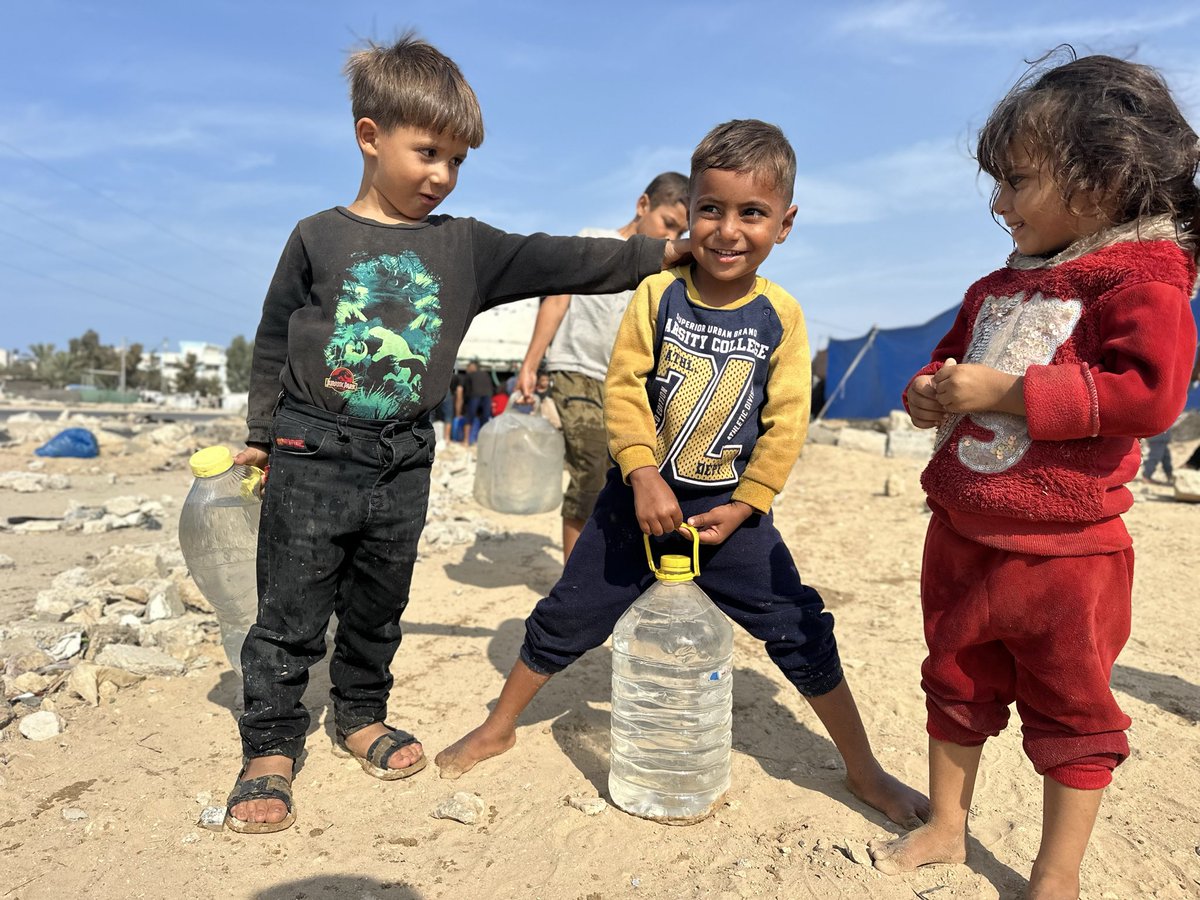
Within the week, our team has distributed a total of 153,220 gallons (580 cubic meters) of potable water to displaced families in southern Gaza, reaching an estimated 193,333 individuals.
In Gaza City, we delivered 250 fresh vegetable parcels to displaced families. Each 35-pound (16.05 kilograms) parcel provides enough produce to support a family for about one week.
And we continued distributing hot meals, including 60 pots of rice in the Middle Area camps, and another 60 pots in Khan Younis, collectively serving hot food to 18,000 displaced people.
Thank you to our supporters for making all of this possible.
Step inside one of Anera's clinics in Gaza and meet Ahmad Najjar, our medical donations program coordinator. Our medical team has faced immense hurdles, but through determination, they’ve found innovative ways to care for those in need. “We build these spaces because healing begins here. Even now, life insists on itself,” says Ahmad. These clinics, supported by Anera’s partners and donors, are not just facilities; they are lifelines.
Our emergency response in Gaza is ongoing. Your support will cover clinic costs, including medicine, provide meals, and much more. Donate at https://t.co/00iefaPRZC.
The incredible reporting in Haaretz gives an overview of all the obstacles Israel creates to the delivery of aid in Gaza.
1) Strict Registration Requirements:
Many humanitarian organizations are denied registration or have their applications delayed, especially if any of their staff have criticized Israel or if they refuse to provide lists of Palestinian employees—which can violate their home countries’ laws.
2) Rejection of Dozens of Aid Organizations:
The Israeli Welfare Ministry, especially under Minister Shikli, has rejected dozens of organizations seeking to send aid, citing new, more restrictive procedures.
3) Bureaucratic Delays and Permit Issues:
Aid convoys face complex and frequently changing bureaucratic processes for approvals, which delay the movement of trucks and increase costs.
4) Police Escort Requirement (and Delays):
Israel now demands police escorts for every aid convoy from Jordan, but police often fail to show up, causing further delays or cancellations.
5) Military Delays and Logistics at Kerem Shalom Crossing:
The Israeli military accelerates loading but then delays trucks for hours at the crossing, limits loading and tying time, and sometimes sends them on dangerous routes.
6) Limited and Unpredictable Crossing Access:
Crossings like Kerem Shalom and Be’eri are often closed on Fridays and Saturdays, and there’s no simultaneous passage for aid teams and trucks.
7) Physical Barriers and Checkpoints:
Additional checkpoints and physical barriers block or slow convoys, often trapping trucks for hours or even days.
8) Restrictions on Allowed Goods:
Israel restricts or bans certain food items (e.g., dates, potatoes), medical supplies, generators, solar panels, and even prefab clinics, often with unclear or shifting justifications.
9) Forcing Use of Vulnerable Routes:
The army directs convoys through dangerous, looted routes, sometimes suspected of encouraging theft to show the UN as “ineffective.”
10) No Military Escort for Convoys in Gaza:
Convoys aren’t accompanied by military or police once inside Gaza, leaving them exposed to looting and attacks.
11) Collapse of Social Order:
Israel’s attacks on Gaza police and governance have led to chaos, making it even harder to distribute aid safely.
12) Crippling UNRWA and Humanitarian Agencies:
Israel has expelled international UNRWA staff, barred them from coordinating with Israeli authorities, and made it nearly impossible for the agency to function.
13) Targeting the UN Humanitarian Office (OCHA):
The Israeli government has taken steps against OCHA staff, including revoking the visa of the Gaza office chief, further hampering coordination.
14) No Time to Secure Loads:
Aid organizations aren’t given enough time to safely tie down food on trucks, causing food to spill or be stolen before reaching those in need.
15) Delays in Final Distribution:
Even after entering Gaza, aid is often stuck at logistics areas near the crossings, with organizations barred from freely collecting and distributing supplies, which limits how much food actually gets to people.
Remember that list of obstacles Israel creates the next time someone blames the UN or Hamas for hunger in Gaza. This is an intentional policy of making it seem like Israel iss providing aid without actually providing it.
Abdulrahman lives in a Palestinian refugee camp in northern Lebanon. With support from Anera, he now has a thriving rooftop garden with tomatoes and uses the produce from the garden for his falafel shop, which helps him cut costs and maximize his family’s income!