Be inspired by Sacred-Places, Wonder-Lands and Crypto-Realms, in a quest to get a 360 degree understanding of the physical and digital world around us.
Beside crypto, I also find inspiration from Chado (Japanese Tea Ceremony). Here I am showcasing this discipline to a class of kids. We need to teach kids not only the 3 R's, but also spiritual/cultural traditions from around the world.
https://t.co/ThMS3PtpfE
This is one video I need to watch again to try and better understand what's happening in the tech world that is above my paygrade. Fascinating what's being built!
https://t.co/vEVFnFZyC1
"Chinese immigrants were a huge economic driver in Eastern Oregon". I learned some new historical tidbits about my home state. Everyone has a story that can enrich the knowledge of another.
https://t.co/RK0eblrOoD
A great re-cap of "America-260 Fever" that was celebrated around the good ol' U.S. of A. In my neighborhood, there were plenty of fireworks and family BBQ's to celebrate this wonderful anniversary.
https://t.co/rWEhpoQrG2
Gather around Max Miller's table and get a dash of storytelling with a serving of a historical dish. A fun show to inspire your cooking skills while traveling in time.
https://t.co/5YEaVqd8ho
🚨#BREAKING: A German soccer fan who flew to the USA but was fearful about coming because of news about criminals and people being mean...
...breaks down into TEARS, live on air saying he has FALLEN IN LOVE with America after a random man named "Bob" in Boston gave him a ride home after he was stuck at a game with no way back to his hotel
The German soccer fan's name is Sebastian, he said after meeting Bob, he extended his entire trip.
He said leaving America will hurt worse than watching Germany get knocked out of the World Cup.
"I fall in love with America. I'm sorry, it's just so emotional. Americans are not rude... if we are together, we can achieve great things."
THIS IS THE AMERICA I KNOW!!!!!! 🇺🇸🇺🇸🇺🇸
We love watching Freddy’s journey on his road trip across the U.S.
There is no better way to learn about America’s story than from the open road, in our towns, and with the people! 🇺🇸
To Love America is to See America. Can’t wait to see where you are headed next @FreddyLA7
SUMMARY OF FED DECISION (6/17/2026):
1. Fed leaves rates unchanged for the 4th straight meeting
2. 9 out of 18 officials expect at least one rate hike this year
3. Fed lowers its median 2026 US GDP projection from 2.4% to 2.2%
4. Fed now sees PCE inflation not returning to its 2% target until 2028
5. Fed says inflation "remains elevated" relative to their goal
6. Today's Fed decision was reached in a unanimous 12-0 vote
The Fed appears to be bracing for more inflation.
When Tocqueville came to America in 1831, just shy of 200 years ago, what he observed astonished him. His expectations, much like the expectations of the elites in Europe and our own country today, began with our “remarkable tendency to organize themselves in pursuit of shared goals.”
“Americans of all ages constantly unite,” Tocqueville wrote in his book Democracy in America. “Not only do they have commercial and industrial associations, in which all take part, but they also have a thousand other kinds: religious, moral, grave, futile, very general and very particular, immense and very small.”
When Tocqueville visited the U.S., we were in an era of rapid change, not unlike today. Some were moving westward, others toward cities, others away from cities, all while building transportation systems, such as canals and roadways, to achieve that moment.
The Industrial Revolution was at the center of all that cultural and political change. Our postal system was also speeding up. Our political parties were raucous, populist, and changing with the times. And we were influenced by those changed by how we formed communities.
Sound familiar? We are also in a moment of rapid change, building high-tech superhighways, this time through artificial intelligence and the internet. We are also moving inward this time, some rediscovering the middle of our country, while others try to remake our cities.
And the technological revolution of AI is having as much of a cultural and political impact as the industrial revolution.
What @FreddyLA7 @shaunvlog_ and all of the other World Cup soccer fans are experiencing is a modern-day Tocqueville moment. Freddy and Shaun likely had no idea what to expect when arriving here. If they read the European press or the Atlantic, it was probably pretty dark. Tocqueville himself wrote that he expected to find a raw, chaotic society, which is pretty much a condensed version of the criticisms you read about America and Americans from elite news organizations today.
What Tocqueville found instead were Americans who were constantly developing ways, and or tools, for creating associations, both large and small — associations with wildly different interests, from small local sports and community or religious groups with little internal order to vast national networks with structures. Think the Rotary Club, NAACP, the Elks, Lions Clubs, Future Farmers of America, the Grange, and 4-H.
https://t.co/jPWdm4clXl
SpaceX prices Friday at a $1.75 trillion valuation. The biggest IPO in history. After actually digging into the filing, my call is avoid or short, and here is why it is built as a trap for retail.
Start with what you are actually buying. SpaceX is three companies in one. The rocket business, which is fine. Starlink, the orbital internet arm, which is genuinely the gem and the one part doing something special. And xAI, the Grok and Twitter AI lab, which is lagging badly and burning money. On any normal measure, EBITDA, revenue, the thing is very overvalued. The revenue does not justify $1.75 trillion. Most of the move from here is hype, because it is Elon, the biggest retail-followed name on earth not named Trump.
Then the part that made up my mind. Two red flags:
1. 30% of the float is going to retail. Normal is 5 to 10%. This is three to six times the usual retail allocation. They want as many regular investors holding this as possible, way more than a normal deal.
2. Nasdaq changed its own rules right before the listing so SpaceX fast-tracks into the Nasdaq 100 just 15 trading days after it starts trading. SpaceX is the first company to ever qualify, and it lands around July 7th. Nasdaq rewrote the rulebook specifically so every passive fund tracking the index has to buy SpaceX automatically, regardless of price. That is manufactured exit liquidity, and the tell is that the S&P 500 is declining to auto-include it.
Here is the timing, because this is where most people get it wrong. The bubble is not over yet. It does not end until all three mega-IPOs are public, SpaceX, then Anthropic, then OpenAI, and that is five to six months out, into year-end. SpaceX itself might even hold or pump in the first month, the way a crypto TGE does, right up until the index inclusion forces the passive bid. The danger is not this week. It is later this year, once the last IPO lists and the exit liquidity is spent. That is the top. And by then the Nasdaq, stuffed with SpaceX and every other AI mega-cap, is the index that gets hurt the most. When I de-risk later this cycle, I am not holding the Nasdaq.
Me personally, I will put a tiny amount into the tokenized pre-IPO and a Hyperliquid position, purely to learn how those instruments convert into real shares once it lists. Not a money trade. There is no edge chasing a deal engineered to hand retail the bag at the top.
"The issue is it wasn't built for humans."
Yat Siu (@ysiu) co-founded @animocabrands. Started building NFT infrastructure when CryptoKitties melted Ethereum. Made the AI + crypto argument years before anyone listened.
The man who has spent a decade selling crypto to retail now thinks the next customer won't be retail at all.
"There's going to be more agents than humans. The entire internet is going to be swarmed by agents."
We cover:
Why AI agents, not humans, become the actual customer crypto was built for
The infrastructure that has to exist before agents can transact at machine speed
Why every consumer app breaks when agents replace browsing (the Tinder example)
How meme coins pulled focus from the builders who actually mattered
Why tokens become the commodity layer for compute, energy, and attention
The orchestration layer thesis, where real development is happening now
Why the metaverse isn't dead, it's just coming to us through agents
What retail should actually be holding right now
Thanks to Yat for coming on @new_era_finance.
TIMESTAMPS:
00:00 - Intro
02:00 - Crypto Is Trump's 10th Child
07:30 - Meme Coins Were The Wrong Distraction
12:00 - The Customer Was Never You
17:30 - Code Is Law For Agents
22:00 - More Agents Than Humans
27:00 - The End Of Websites
32:00 - Why On-Chain Growth Stalled
36:00 - What Retail Should Actually Hold
The first government-backed mortgage with Bitcoin as collateral
This is a pretty big deal, because now we’re staring to weave together multiple expensive assets to create a web of wealth and risk that is ultimately taxpayer backed
US freight costs just hit an all-time record .
This is the fastest expansion of any metric in the nearly 10 year history of the index.
According to a recent LMI survey, logistics costs are at their highest since March 2022.
That was just months before the US experienced the worst inflation in 40 years.
The Fed that can't fix supply-driven inflation with rate hikes.
We've been blaming AI for killing entry-level jobs.
New research suggests it was actually remote work and the decline started years before ChatGPT existed.
Analysis of hundreds of millions of job postings found that once you control for whether a role is remote, the apparent link between AI exposure & weak junior hiring disappears entirely.
Jobs with high AI exposure but in-person requirements held up fine.
Jobs with low AI exposure but remote-friendly setups collapsed.
It wasn't the LLMs. It was the commute - or the lack of it.
AI was supposed to replace workers because it would cost less than paying people.
There's a problem with that assumption.
Microsoft cancelled its Claude Code licences because the tool became too popular and too expensive. Uber burned through its entire 2026 AI budget in four months.
Nvidia's VP of applied deep learning: "For my team, the cost of compute is far beyond the costs of the employees."
Token prices are falling. But consumption is rising faster.
AI agents use far more tokens per task than regular models and the more employees use AI, the bigger the bill gets.
The cost of AI may soon exceed the cost of the humans it was meant to replace.
Food is set to become even more expensive:
World fertilizer prices have surged +44% since the start of the Iran War, to the highest since 2022.
This comes as ~33% of globally traded fertilizers pass through the Strait of Hormuz, which remains effectively closed.
This includes 23% of global ammonia, 34% of urea, the world's most widely used nitrogen fertilizer, and nearly 20% of global phosphate supply.
Furthermore, the Bloomberg Agriculture Subindex has increased ~9% since the Iran war.
The index tracks the futures prices of key agricultural commodities, including wheat, corn, soybeans, sugar, coffee, and cotton.
In the past, world fertilizer prices have acted as a leading indicator for agricultural output prices, as rising production costs eventually force farmers to reduce supply, pushing crop prices higher.
A new wave of global food inflation is imminent.
Tokenization/Blockchain technology are revolutionizing the digital asset world we interact with. Dive in (or at least dip a toe) into the future of investment where everyone has better access to possibilities.
https://t.co/rLONkpkIzj
US electricity prices are surging well ahead of inflation:
Electricity prices jumped +6.1% YoY in April, the highest reading since January.
This marks the 8th monthly increase above +5.0% over the last 10 months.
At the same time, overall US CPI rose +3.8% YoY, the biggest increase since May 2023.
This means electricity prices are rising ~61% faster than the broader inflation rate.
This comes as surging power demand from data centers is straining US energy grids, pushing wholesale electricity costs sharply higher.
Since January 2020, average US electricity prices have soared +44%, to an all-time high.
Over the same period, the CPI has risen +28%, also to its highest level on record.
US electricity price growth is accelerating.
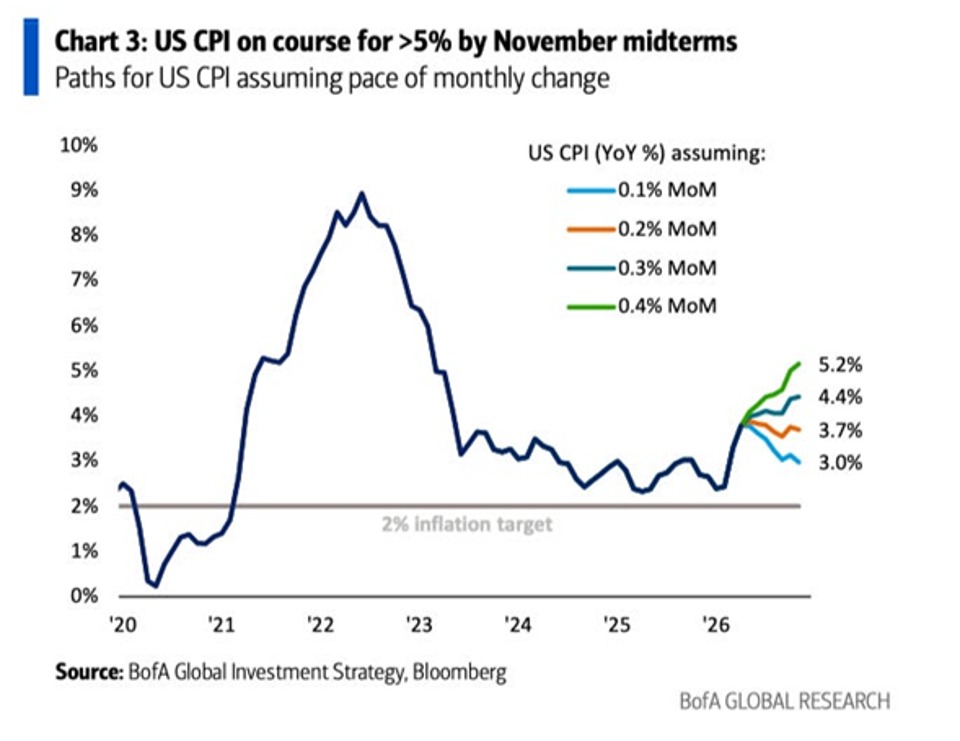
BREAKING: US CPI inflation is on track to exceed +5.0% as early as this year.
Over the last 6 months, CPI inflation has averaged +0.4% on a MoM basis, with March and April readings as high as +0.9% and +0.6%, respectively.
If this trend continues, this puts YoY inflation on pace to surge to +5.2% by the November midterms.
That would be the highest level since February 2023 and more than double the February 2026 print.
Even if monthly inflation prints ease to +0.3%, the YoY inflation rate would still rise to +4.4%, the highest since April 2023.
Inflation is back in full swing.
Unbelievable!
The US 30-year yield just hit 5.12% - a 2 decade high!
It was only last week that it auctioned above 5% for the first time since 2007.
It's already gone higher.
The 10yr also casually broke 4.6% overnight.
The bond market is repricing inflation. Fast.