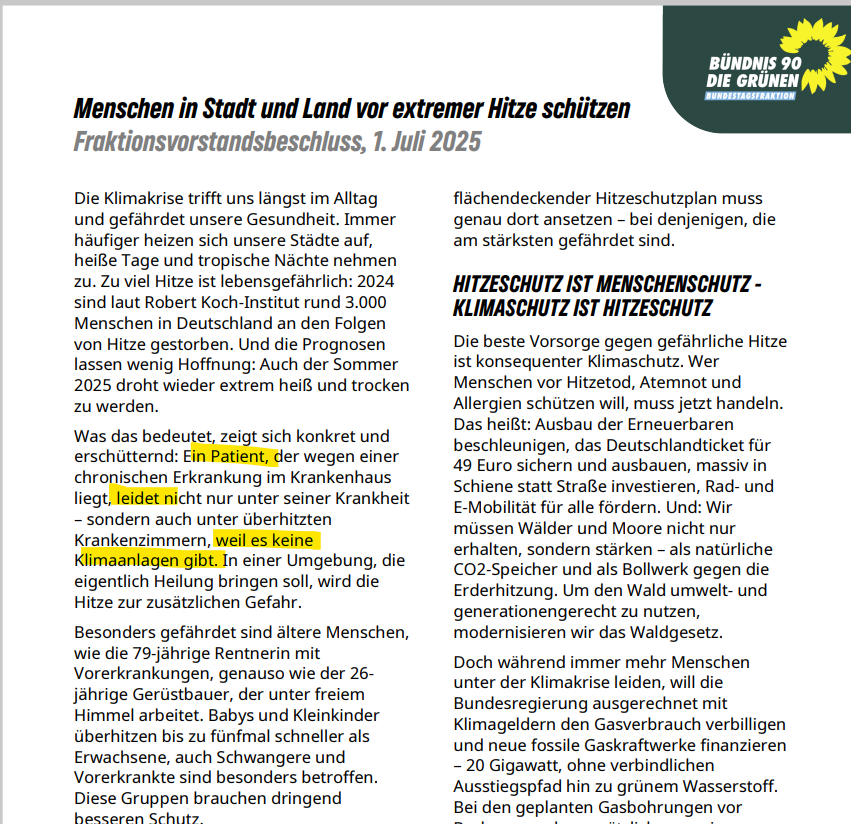
Und weil BILD das als "JETZT wollen sogar die Grünen Klimaanlagen" meldet:
Die Grünen fordern das schon länger. Es ist nur immer wieder gegen sie gestimmt worden. In Bayern, in Meppen...
.@elonmusk says that no one can name a person who died from his aid cuts. In fact, I've met the kids who are dying, and I've talked to the families who lost children. In my columns, I've cited many, many names of people who have died because of Musk's aid cuts. A few examples:
*Yamah Freeman was a 23-year-old woman who died in childbirth because Musk cut funding for the diesel for ambulances in her part of Liberia. She couldn't get to a hospital and died as people were carrying her there. I talked to her parents and sister in their village.
*Gbessey Kiadu, age 1, died of malaria because of his cuts to malaria medication in Liberia. I talked to his mom in her village.
*Ibrahim Koroma, an infant, died of AIDS in Sierra Leone after he interrupted HIV supplies. I talked to health workers who cared for him.
*Achol Deng was an 8-year-old girl with HIV in South Sudan who died when Musk cut funding for the health care worker who provided her medicines. I talked to the healthcare workers.
I could go on and on. In almost every village you go to in South Sudan, Uganda, Liberia, Sierra Leone or other countries I reported in, you find people dying because of aid cuts. I challenge Musk: Come with me on a reporting trip, and we'll talk to these moms and dads, and you'll see the dying children themselves. I think if you see the kids whose lives are at stake, maybe you'll change your mind.
The EU does not so much kick policy proposals down the road as place them in bureaucratic black holes. What comes out—and when—is a matter of happenstance https://t.co/HI7YHgFip1
Illustration: Peter Schrank
The Economist is confusing efficiency with competitiveness. There is no doubt that the EU must do more to improve production efficiency, but if a more productive EU means higher wages (and it should), an increase in EU productivity won't make it any more competitive.
The point is that the more "competitive" manufacturing economies – the ones that run persistent trade surpluses – are not the most productive or efficient economies. They are mainly the ones that keep wages from growing in line with productivity, which is why domestic demand in those economies isn't able to keep pace with production, and why growing exports does not result in growing imports.
Suppressing demand may be good for those countries that do it most effectively, as they can grow faster by using an open global trading system to externalize the costs of weak demand by running large trade surpluses, but it is bad for overall global growth, as Keynes pointed out at Bretton Woods. What the world needs is less income inequality, faster wage growth, and more demand.
Hier mein Interview zur aktuellen Hitzewelle. Es wird Zeit, dass wir den Klimawandel auch als einen medizinischen Notfall begreifen. Tun wir das nicht werden wir auch in 10 Jahren, wenn alles viel schlimmer sein wird, keine grünen Städte, Hitzeschutzräume oder Klimaanlagen haben
WSJ: "Germany’s famously open economy was its greatest economic asset, delivering almost 20 years of uninterrupted growth and turning it into one of the biggest winners of globalization."
I think I would have framed this differently.
Germany's trade competitiveness for a long time was based on its ability both to suppress household income growth relative to productivity growth (as it did, for example, after the 2003-5 Hartz reforms), and to keep its currency cheap (as it did, for example, through adoption of the euro).
Under our current form of globalization, in other words, we experience an example of the Kalecki paradox, in which wage-suppression policies that allow one country to grow faster than its trade partners are actually bad for overall global growth – to the extent, anyway, that consumer demand drives investment among its trade partners.
In this system, all countries are under pressure to suppress wage growth in order to expand manufacturing and retain manufacturing employment, but the "winner" is the one who is able to do it most effectively.
For many years, when much of China's high saving was directed into domestic investment, Germany was one of the main winners from this system. But as Chinese investment became increasingly unproductive, Beijing began trying to rein in the debt needed to fund so much unproductive investment.
This process, of course, took off after the 2021-22 property crash, and once that happened, Germany's ability to benefit from the Kalecki paradox evaporated, as it quickly became one of the main losers of the system.
The point is that the problem isn't China. The real problem is a system that rewards countries for implementing policies that undermine overall global growth. The good news is that for many years, when Germany was able to exploit the global trade regime, it was also one of the greatest defenders of this system. Now that it is on the losing side, German policymakers are increasingly recognizing how damaging a system it is.
There is nothing new about this. If you read the economic debates between the UK and the US in the 1920s, a period when US productivity soared even as wages remained stagnant, it was the UK that complained about the trade imbalances. The US insisted that its huge trade surplus was simply the consequence of more efficient manufacturing techniques and harder-working people. The US of course abandoned that argument in the 1970s, when it lost its trade surplus.
In the economic debates of the 1980s, it was the US who complained about trade imbalances, and Japan who insisted (what else?) that its huge trade surplus was the result of more efficient manufacturing techniques and harder-working people. No one in Japan makes such a silly claim anymore.
In the 2000s, of course, Germany rather patronizingly explained to the rest of Europe that if only they could become as efficient in manufacturing and as hard-working as the Germans, they too would be in just as good a shape. So much for that claim.
Meanwhile our trading system continues to reward policies that depress global growth by putting downward pressure on wage growth, or that, alternatively, force the world to encourage rapid increases in debt in order to counter the impact of lower wage growth.
That is why the real solution isn't a global alliance against China. While this may help defuse current tensions, it won't change a system that will continue to reward bad behavior – i.e. household income-suppressing policies – by allowing countries to externalize the costs of this bad behavior through large, persistent trade surpluses. And this means that it will continue to support increases in income inequality within countries.
https://t.co/9g6zh3ET99
Zur anderen Seite der Medaille gehört: Die Umsetzung der Forderung führt zu ca 120 bis 150 Mrd € Steuerausfällen. Um sie zu kompensieren, müßten bei linearer Erhöhung alle Steuersätze um 12 bis 15 Prozent steigen.
Gefühlt 40 Grad Hitze in der Fußgängerzone Leverkusen. Die Kollegen vom DRK sind schon die ganze Woche im Einsatz. Gestern vergeblich reanimiert bei einem Hitzeopfer. Mein Dank gilt allen Feuerwehren und Hilfsorganisationen, aber auch dem Krankenhauspersonal, für ihre Leistung
Erst Hormus, jetzt die Hitzewelle - das Jahr 2026 bettelt darum, nicht noch weiter auf fossile Energieträger zu setzen. Die Politik zeigt sich bisher wenig beeindruckt.
Der Vorwurf: Panik. Meine Antwort: Information. Ich bin Journalist und präsentiere als freier Mitarbeiter in Zusammenarbeit mit der ZDF-Wetterredaktion mehr als 1.000-mal im Jahr das Wetter im Morgen- und Mittagsmagazin. Wenn sich Extremwetter ankündigt, weisen wir darauf hin.
Vladimir Putin’s biggest problem is that he has nothing to show for his war. The perception of failure and weakness undermines his legitimacy https://t.co/iGe7N6fuzf