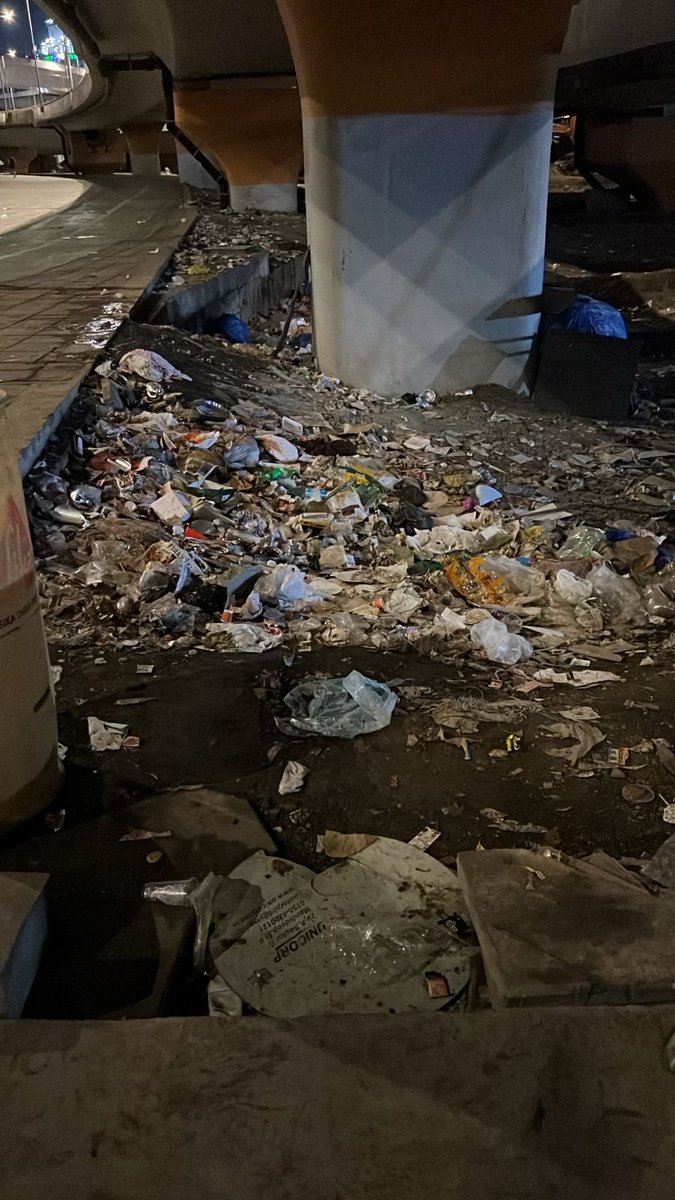
Well, it’s not just Terminal 1 in #MAA which is ridiculously dirty. Apart from the @IndiGo6E terminal, it appears all other terminals are being maintained dirty in solidarity with T-1 in Chennai by @aaichnairport. This is Terminal-4 this morning ! @airindia obviously cannot care much (it’s the Air India terminal) because of its internal problems and politics!
The airport authorities did tell me that they would clean up after my last video, @AAI_Official. But nothing happened. Why @MoCA_GoI, @RamMNK ?
A (gentle) shout-out to Objective Journalism: The same Jay Mazoomdaar broke the Robert Vadra land scam in Express 12 years ago, and last year, called out Trump’s lie about USAID funding Indian elections.
🚨 #ExpressInvestigation | Since he took oath as CM of Madhya Pradesh on December 13, 2023, Mohan Yadav’s family and their real estate companies have bought at least 137 plots, adding up to 168 acres, for Rs 45 crore, in zones most benefited by this infrastructure push, an investigation of land records by @mazoomdaar has found.
https://t.co/FEMW9VC7hm
The moment you land in Chennai Airport, you will experience a Safari ride which even Masai Mara won’t give you.
Once you Land, Find your Bags, then Find the buggy stand. Join the queue. Wait. Watch others also wait. Buggy arrives. Buggy takes you on a scenic tour of the entire airport campus. Finally drops you at the taxi counter.
Then you realise, you have to take an elevator to get your Ola/Uber. Now find the elevator. Elevator fits exactly 4 people and your luggage does not count. Wait for the next one. Reach the taxi stand. Join another queue.
This whole journey will be longer than your actual flight duration.
If India ever ranks its worst airports, Chennai does not just top the list.
Chennai is the list.
Let us just STOP policing women's clothing choices
What @fadnavis_amruta wears is entirely her own business
Never see any outrage over how men look and what they wear - how many men doing yoga were wearing dhotis which is the traditional attire for yoga gurus?
Why not preach simplicity to them?
Mumbai Coastal Road promenade near Mahalaxmi this evening.
We often demand cleaner public spaces and better civic amenities, but keeping our city clean is a shared responsibility. Civic sense begins with each one of us. We cannot keep complaining about litter and poor maintenance while failing to do our bit.
I agree with all you have said except they are not body shoppers, will you call IBM global services, Accenture, Cap Gemini, GCC’s etc who all have used India for tech as body shoppers? Please stop abusing people like this. The people who use this term should themselves build giant cos and show others how they built it to scale. It is not easy to build huge project based cos who are so successful for so long. Yes they are not product cos just like commercial banks are not investment banks or venture funds.
All these loose mouth critics do not understand what they are talking or the industry. What we need are huge venture funded pure product cos. We have very many small cos but they do not scale up here because the market is so small and people do not pay well for products. They will scale up only in the US but that needs huge capital and marketing dollars.
"Think about what happened in the first phase of globalization where entire industrial economies were hollowed out by outsourcing. The GDP numbers looked fine on the surface, but the displacement was real and the consequences are still being felt. Let us not bring that dynamic into the AI era, with a small number of AI systems capturing all the economic returns, while entire industries find their knowledge commoditized right out from underneath them."
- Satya Nadella
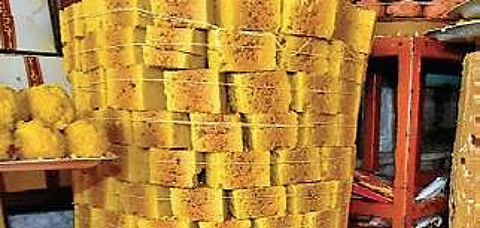
While most people know the delightful baseline story that Mysore Pak was created in the 1930s by the royal chef Kakasura Madappa for Maharaja Krishnaraja Wadiyar IV... the deeper culinary science, the etymology & the ancient textual connections to this legendary sweet run far deeper.
When we strip away the modern commercial adaptations & look at the traditional, porous version (Gulla/hard Mysore Pak), we find a marvel of indigenous food science & a lineage connected to ancient Indian culinary treatises.
Here is the deeper, lesser-known & deeply fascinating history behind the "King of Sweets."
Before diving into its true roots, we must 1st put to rest a bizarre, revisionist claim floating around armchair food circles: the myth that Mysore Pak is somehow a Mughal/Afghan imperial import derived from a sweet called Monsur. This is a classic case of backwards historical gymnastics. While Eastern India does have a look-alike confection, the actual chemistry of flash-frying pulse flours inside high-temperature sugar-fat solutions is a native Sūpa-Śāstra (legume cookery) tech that predates Islamic entry into the subcontinent by centuries.
To attribute a dessert born out of Southern India’s rigorous temple-palace culinary lineage to Delhi’s imperial courts entirely ignores the indigenous thermodynamic evolution of South Indian sweet-making :))
Many assume "Pak" is just a shorthand/a corruption of the word pack (as in a packed block). It is not. The word is deeply rooted in ancient Sanskrit culinary texts:
- In ancient Indian texts like the Nala Pākaśāstra (attributed to King Nala, considered the 1st master chef of Indian lore) & the Kshemakutuhala (a 16th-century culinary text), Pāka means the precise science of cooking, boiling/reduction. Specifically, it refers to the art of creating sugar syrup (Sharkara Pāka).
- Ancient Indian confectioners classified sugar syrup into highly precise structural phases based on its viscosity (similar to modern candy-making stages like soft ball/hard crack). To make a perfect Mysore Pak, the chef had to catch the Pāka at an exacting string consistency. The name is literally a tribute to the ancient Indian science of sugar mastery.
The classic, traditional Mysore Pak is not the smooth, soft, wet-ghee blocks popular today. It is rigid, highly porous, pale on the outside & a deep, caramelized brown at the center. The physics behind those holes is incredible.
When Kakasura Madappa 1st rushed to create this dessert because he lacked a sweet dish for the King's royal platter, he accidentally triggered a violent thermodynamic reaction: He took roasted chickpea flour (Besan) & added it to boiling sugar syrup, then poured ladle after ladle of smoking hot, bubbling ghee into the mixture.
Because the ghee was hotter than the boiling point of the water trapped in the sugar syrup, the moisture instantaneously vaporized into steam. As the steam desperately tried to escape the thickening, cooling gram flour matrix, it carved out micro-tunnels.
As it cooled, these tunnels solidified, creating a light, aerated, honeycomb structure. When we bite into a traditional Mysore Pak, it crumbles effortlessly because we are literally chewing through captured pockets of historical steam.
If we cut open a flawlessly executed, authentic Mysore Pak, it features a distinct dark-brown core wrapped in a golden-yellow outer crust. This is not from using 2 different batters; it is a manifestation of delayed heat retention: When the boiling mixture is poured into a deep wooden/metal tray to set, the outer layers cool down rapidly upon contact with the air & the tray walls, locking in the yellow color of the gram flour. However, the center remains incredibly hot, insulated by the outer crust.
The trapped heat continues to gently bake & caramelize the sugar & proteins (Maillard reaction) at the core long after it has been poured. Achieving this dual-color core w/o burning the sweet is the ultimate test of an expert cook's intuition.
A few people associate Mysore Pak with Tamil Nadu is because of Coimbatore.
The traditional, original Mysore Pak from the Amba Vilas Palace is hard, porous, crumbly & pale yellow-brown with a honeycomb structure inside. It requires heavy biting.
However, in 1948, a sweet-maker named N.K. Mahadeva Iyer in Coimbatore, Tamil Nadu, started a shop called Sri Krishna Sweets. He spent yrs experimenting to alter the thermodynamics of the traditional recipe. He dramatically increased the ratio of ghee, changed the heating timing & essentially invented the ultra-soft, silky, melt in the mouth version that we know today, rebranding it as Mysurpa.
Sri Krishna Sweets marketed this version so brilliantly across the globe that for 2 generations of people (especially outside South India), the silky, smooth, ghee-dripping block became the default definition of the sweet.
Geographically, historically & legally, the sweet belongs 100% to Mysuru, Karnataka. The descendants of the original palace chef, Kakasura Madappa, still run Guru Sweet Mart on Sayyaji Rao Road in Mysuru, selling the authentic, porous, crumbly king of sweets.
Tamil Nadu did not invent the sweet, but its brilliant culinary entrepreneurs re-engineered the texture & popularized a soft variety that conquered the modern sweet market. It is a classic case of Karnataka inventing the tech & Tamil Nadu shipping a highly successful software update.
As a journalist, I’ve tracked Mumbai’s civic infrastructure projects for over a decade now. Time and again, major bridges and flyovers have been inaugurated only to be followed by controversy: Hancock bridge in 2022, Gokhale bridge in 2024, Ghatkopar Mankhurd Link Road in 2021, Vikrohli ROB in 2025.
For instance, Gokhale Bridge in Andheri, where a misalignment with its connector delayed full functionality. Now, it’s the newly opened Mrinaltai Gore flyover extension. Often I have my readers asking me: where is the problem?
Is it inadequate supervision? Poor oversight? Weak quality control? Or the rush to meet inauguration deadlines?
A year ago, 260 people were killed in a crash that destroyed families and rattled the core of international aviation. Why did AI-171 crash? An answer may help bring closure to families that continue to suffer. The truth will not be easy, the implications for global aviation and Air India will be huge. What India MUST get is the truth, whatever it is. Will there be an AI-171 crash report today? One can only hope. @rammnk@narendramodi
How do you describe #Bharathiraja to an all-India audience? As the director who brought Sridevi to serious cinema? As someone who deftly wielded a cinematic sengol over Sivaji Ganesan, Rajnikanth, Kamal and Radhikaa? Much more.
He made world cinema before the term turned hip, blending Satyajit Ray 's realism, Hrishida's empathy and Basu Chatterjee's humour to connect a diverse Tamil audience in raptures as he brought rugged, rural, hinterland tales from his native Madurai region, mixing ancient depth with modern values. He rounded off a stellar storytelling career with a late but long swing as a character actor, oozing affection in his eyes and voice. The fact that he never got a Dadasaheb Phalke award is an insult to the award itself. My favourite movie of his is Mudhal Mariyadhai (First Respect). His life deserves the very best of last respects.. RIP.