Yo también, pero hay que entender que las valuaciones son bastante mentira.
Que te inviertan 10 palos a una valuación de 270 no significa que te la vayan a comprar por 270. Todo el mundo tomaría los 270 de otra forma.
Te dan la plata porque esperan que la uses para crecer a 10B. Y mientras tanto esperan que te pagues 100K al año de salario y te deslomes trabajando.
De ser valuada en 270 palos a casi fundir en pocos meses… lo viví en carne propia.
El mercado puede cambiar mucho y muy rápido.
Personas que consideramos “expertas” pueden estar muy equivocadas.
La historia se repite.
Proceder con precaución
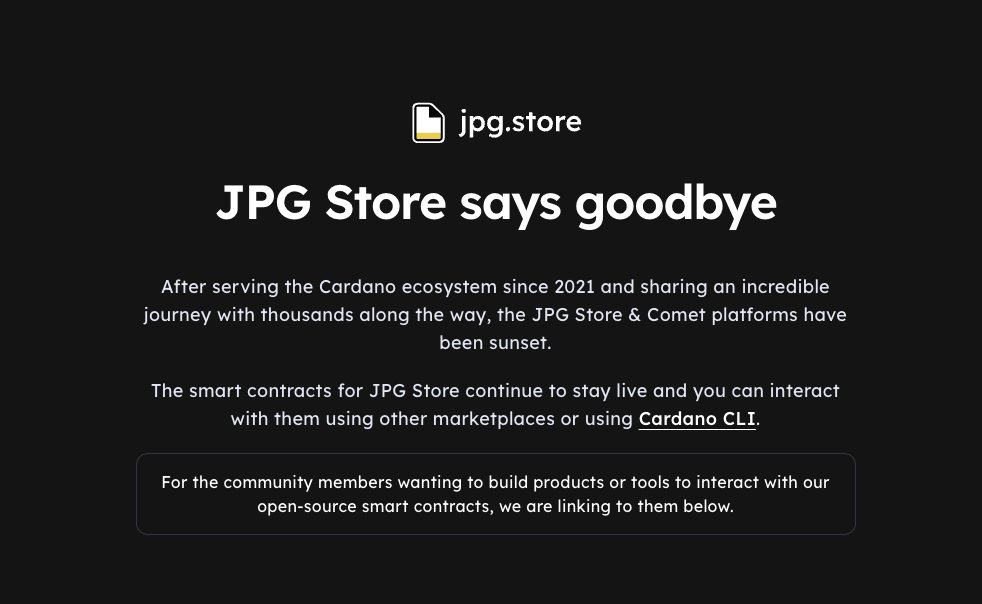
Today, JPG has finalized its shutdown.
I’m saying an official goodbye to Cardano, and to crypto. I wanted to share a few reflections about NFTs, crypto, and what’s next for me.
I was 18 when @blakelockbrown reached out after my other company, Adapix, was acquired. He wanted me to join JPG as CTO. It was clear the company was going to skyrocket. We hit it off, and suddenly I was handling traffic and money volume I never imagined I’d be responsible for.
From there, I was extremely lucky to learn a ridiculous amount: raising an investment round, hiring an engineering team, designing payment infrastructure, and putting out fires. Of course, I was nowhere near perfect. But I learned.
The people I met along the way were the best part. I made many friends and met some extremely talented people. I can’t thank Blake enough for the opportunity, or @IOGroup for their investment and support.
The most dangerous startups are the ones with market risk. People can want something intensely, and then after a while, simply stop wanting it. That can be brutal for a company built to serve that market. That was the case for NFTs.
Regarding crypto, I just don’t think people want it. Crypto has found product-market fit in gambling and in skirting the law. Not much else. I think the vision of replacing traditional money would only work if a government itself were powered by it.
Otherwise, crypto is mostly a SISP: a solution in search of a problem. The technology behind it is fascinating. But today, every blockchain has very few real users, mainly because you still can’t walk into a store and pay entirely with crypto.
So I’m moving away from the industry.
AI has opened a world of opportunity across thousands of fields, and it feels right to explore it. A few months ago, I joined @kapa_ai as a software engineer. I now get to work on AI products used by OpenAI, Canonical, Nokia, and more. My teammates are amazingly talented and friendly, and the founders are beyond cracked. The best part is that I get to interact with them and learn from them directly.
I’m 22 now, and yes, in the future I’d like to have my own company again. But first I want to build conviction in something, meet more people, and do amazing work for Kapa’s customers.
I’m very grateful for everything JPG and Cardano gave me.
And I’m very excited for what comes next.
> agents calling up hundreds of small agricultural suppliers, building a spot index
> agents sending whatsapps to construction material suppliers, presenting all quotes
> agents monitoring public marketplaces, calling up sellers, enriching information
I think the biggest unexploited use case for AI agents is swarms of agents that can collect sparse information from obscure markets (freight quotes, industry parts, etc.) and build an index of proprietary data to re-sell.
I don’t really know what you’d ship with this other than really small stuff.
In my experience, AI coding in general still needs very heavy steering and oversight.
Slopmaxxing like this is either small stuff or making a total mess out of your codebase
Superset (@superset_sh) is an open-source IDE for developers to run 100s of agents in parallel. They've grown 30% week-over-week for the last 4 months, helping engineers ship 10x more PRs.
Congrats on the launch, @FlyaKiet@saddle_paddle and @avimakesrobots!
https://t.co/1Knx5CWP3C
Universal HIGH INCOME via checks issued by the Federal government is the best way to deal with unemployment caused by AI.
AI/robotics will produce goods & services far in excess of the increase in the money supply, so there will not be inflation.
Open source is dead.
That’s not a statement we ever thought we’d make.
@calcom was built on open source. It shaped our product, our community, and our growth. But the world has changed faster than our principles could keep up.
AI has fundamentally altered the security landscape. What once required time, expertise, and intent can now be automated at scale. Code is no longer just read. It is scanned, mapped, and exploited. Near zero cost.
In that world, transparency becomes exposure. Especially at scale.
After a lot of deliberation, we’ve made the decision to close the core @calcom codebase.
This is not a rejection of what open source gave us. It’s a response to what risks AI is making possible.
We’re still supporting builders, releasing the core code under a new MIT-licensed open source project called cal. diy for hobbyists and tinkerers, but our priority now is simple:
Protecting our customers and community at all costs.
This may not be the most popular call.
But we believe many companies will come to the same conclusion.
My full explanation below ↓