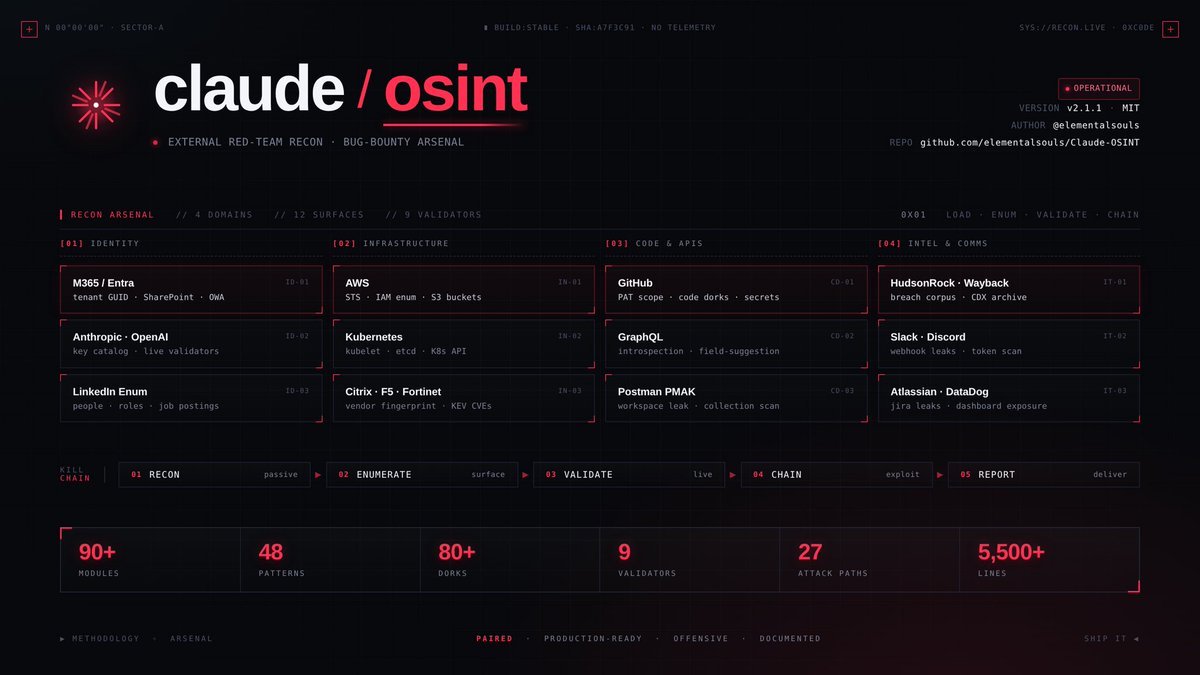
GitHub - h9zdev/SocioSential: SocioSential is an open-source OSINT framework that collects and analyzes social data to surface emotional patterns, behavioral anomalies, and sentiment shifts across communities and networks. It is built for https://t.co/VZiVZvYsxx
I forked Anthropic’s new vuln-discovery harness and made it Codex-first.
Recon → Find → Verify → Triage → Report → Patch
Sandboxed agents find bugs, prove them with crashing PoCs, dedupe, write exploitability reports, and validate patches.
https://t.co/0R8nhN2wbr
In the next few days we'll be ramping up Claude inference on Colossus.
Grateful to be partnering with SpaceX here. We are going to need to move a lot of atoms in order to keep up with AI demand, and there's nobody better at quickly moving atoms (on or off planet Earth)
The https://t.co/NSdktUM8QC CFP is officially OPEN! If you are doing cool stuff with AI in offense, defense, or working on core AI tech (from frontier models to open source LLMs), we'd love to hear from you! Submit here: https://t.co/d9C6yxxZbi
Anthropic pays $750,000+ a year for engineers who can build LLM architectures from scratch. Stanford taught the entire thing in 1 hour lecture & released it for free.
Bookmark & watch this today before someone takes it down.
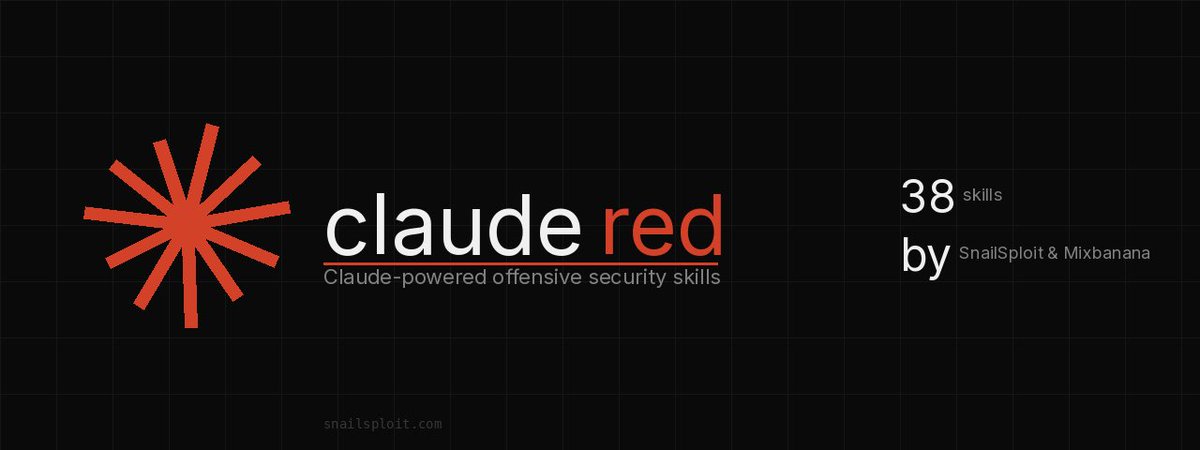
Turn Claude Code into your offensive security research assistant. Specialized AI subagents for authorized penetration testing plan engagements, analyze recon, research exploits, build detections, audit STIGs, and write reports. https://t.co/RkzFHYpxoi
claude-red is a curated library of offensive security skills designed for the Claude skills system. Each skill is a structured SKILL.mdfile that primes Claude with expert-level methodology for a specific attack surface from SQLi to shellcode, EDR evasion to exploit development.
Resource: https://t.co/0XvEqoqPfv
Over the past month, some of you reported Claude Code's quality had slipped. We investigated, and published a post-mortem on the three issues we found.
All are fixed in v2.1.116+ and we’ve reset usage limits for all subscribers.
Boris Cherny created Claude Code. he thinks IDEs are dead by end of year.
This is a 28-minute masterclass on how Anthropic uses it internally.
I wrote 5 pipelines you can sell with it. none of them are coding.
Gemma 4 running on my iPhone works without internet, is blazing fast and can translate Japanese from a pill bottle.
Local AI models running on a phone feels like magic.
Tip: Figure out your personal ceiling for running multiple agents in parallel.
We need to accept that more agents running doesn't mean more of _you_ available. The narrative is still mostly about throughput and parallelism, but almost nobody's talking about what it actually costs the human in the loop.
You're holding multiple problem contexts in your head at once, making judgment calls continuously, and absorbing the anxiety of not knowing what any one agent might be quietly getting wrong.
That's a new kind of cognitive labor we don't have good language for yet.
I've started treating long agentic sessions the way I'd treat deep focus work: time-boxed and tighter scopes per agent dramatically change how much mental overhead each thread carries.
Finding your personal ceiling with these tools is itself a skill and most of us are going to learn it the hard way before we learn it intentionally.
Wow, this tweet went very viral!
I wanted share a possibly slightly improved version of the tweet in an "idea file". The idea of the idea file is that in this era of LLM agents, there is less of a point/need of sharing the specific code/app, you just share the idea, then the other person's agent customizes & builds it for your specific needs.
So here's the idea in a gist format: https://t.co/NlAfEJjtJV
You can give this to your agent and it can build you your own LLM wiki and guide you on how to use it etc. It's intentionally kept a little bit abstract/vague because there are so many directions to take this in. And ofc, people can adjust the idea or contribute their own in the Discussion which is cool.
China's biggest cybersecurity company apparently just shipped an AI assistant with its own SSL private key sitting inside the installer. Qihoo 360, think Norton or McAfee, but dominant across the entire Chinese market
It appears that their new AI product, 360安全龙虾 (Security Claw) bundles a wrapper on @OpenClaw. Inside the installer package - accessible to anyone who downloaded it - was a private SSL certificate key for the domain *.myclaw.360.cn. An SSL private key is essentially the master password to a website's encrypted connection. With it, an attacker can impersonate 360's servers, silently intercept user traffic, forge a login page that looks completely legitimate, or possibly take over the AI agent altogether. The cert is valid until April 2027 and covers every subdomain on the platform. It's now public. The founder launched the product with a promise it would "never leak passwords". It did that during release? 461 million users, a $10B valuation, and nobody checked the zip file before shipping. The cert expires April 2027.