I intend to conduct free webinar series dubbed, "Growing the next generation of leaders in Higher Education Institutions," targeting early- middle career academics. Register @ [email protected] cc. [email protected] . This is personal - no institutional affiliation.
Why you should oversize your Solar Panel Installation
When it comes to solar setups, bigger/more panels can often be better than spending on bigger batteries .
Here's why:
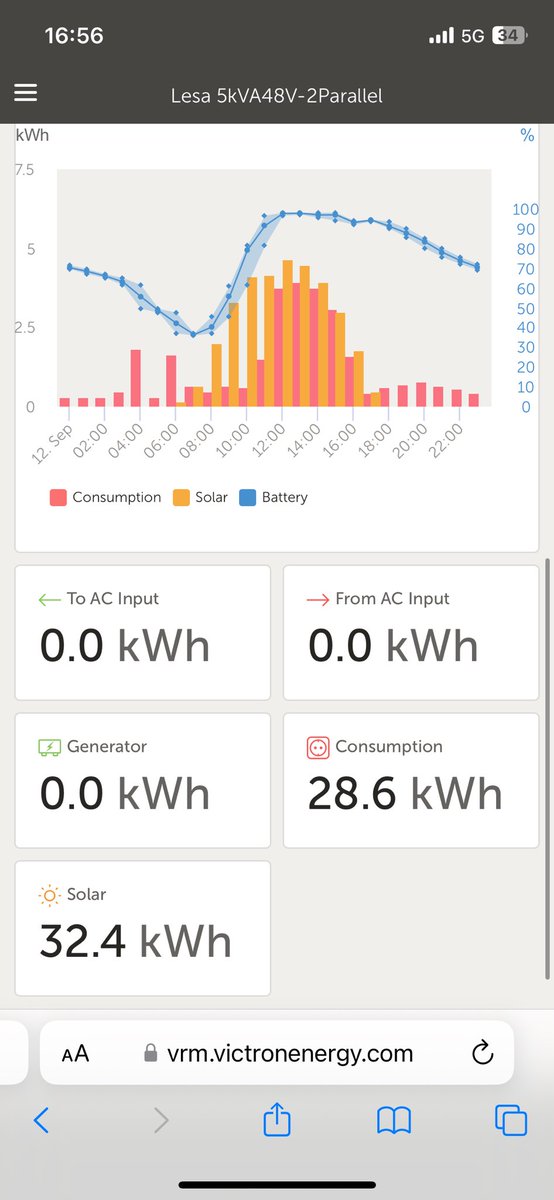
A setup with 12 panels at 550 watts each can generate about 33 kWh daily. That's roughly equivalent to running a 6kVA generator at full load for 5 hours. The panels alone for this setup would cost around ZMW 33,000.
Now, if you wanted to get the same amount of power from batteries, you'd need top-of-the-line units that could set you back ZMW 150,000 to 200,000. This price difference highlights a key point: right now, solar panels are significantly more cost-effective than batteries. Batteries are falling in price but not yet there.
This cost difference means it's often more economical to increase the number of panels rather than expanding battery size, especially if most of your power usage happens during daylight hours or can be shifted to that time. Many power-hungry tasks can be moved to daytime hours, making this approach even more effective.
This strategy leads to some interesting setups. For instance, a large office can manage with a relatively small battery bank but a large panel installation, resulting in a very cost-effective system that can even support Aircons. In farming, if irrigation can be done during the day, a system driven primarily by daytime solar production can be highly efficient.
To put it in perspective, a 30kVa solar installation, costing about ZMW 160,000 for panels alone(cheaper if bought in bulk) can compete favorably with some large generators - Even if the Genset has to run at night.
Looking ahead, there's potential for even more efficiency. If the grid stabilizes, you might be able to feed excess power back into it, taking advantage of net metering. This approach treats the grid itself as a kind of battery, so that you use solar during the day and free (net-zero) ZESCO at night.
For home setups, more panels allow for greater daytime energy use. You can water gardens, iron clothes, pump water, heat water, and even cook (with a sufficiently powerful inverter) during peak sunlight hours. Then at night, you can scale back to essential usage.
Typically, your power usage pattern will follow the sun - increasing as it rises and decreasing as it sets. This natural rhythm aligns well with a panel-heavy system.
Obviously there is a minimum amount of battery storage needed. The point is just that large systems don’t necessarily mean large batteries. You can pick and choose what to make as big as economically possible.
The home fixed Internet service from @TelecomNamibia just become so terrible?
Paying for their service yet I find myself relying on @MTC mobile Internet for better connectivity.
Is it time to migrate?
@PlainHard@mangwiron@MashieRyan@Unclepetso1 Going by your response, note that reading and writing does not translate to understanding the manifestos of the respective candidates. So where do u draw the line?
Our latest piece from rural Zambia. Genomic Surveillance of SARS-CoV-2 in the Southern Province of Zambia: Detection and Characterization of Alpha, Beta, Delta, and Omicron Variants of Concern https://t.co/taU3DusOF9
Does your work involve infectious diseases or antimicrobial resistance in Africa? 🦠 Our accredited #BSACAfrica course is here to help you improve your knowledge of the spread of #AMR in Africa and the #AMS strategies to reduce it. Sign up below! 👇
https://t.co/QpBKepHcyS