@chubes4 No problem. This has become the forced default we somehow apply automatically and unconsciously, to doubt ahead. Like that other reply you had.
Having that said, take a look at my proposal if you have the spare minute. You will understand what I mean with re-indexing.
@chubes4 You know what makes me a bit said? That nowadays on Twitter (I know, X), people assume stuff: this is AI, this is self-promotion, this is content slop. It used to be a place where we exchanged opinions without being judged. Where people cared about exchanging ideas and topics.
True, stale docs are a real problem. That's why the devdocs MCP doesn't just scrape once. It reindexes on demand, either when you trigger it or when the model decides it needs fresh context. It ships with an embedded database so lookups are instant, no external API calls. So you get the structured docs layer without the "last updated 2 years ago" risk.
Fair point, the source is right there. But raw PHP and structured docs hit differently for an agent. Grepping 400k lines of WooCommerce source to figure out the right hook order is a lot to ask vs having the API docs ready to go. Both approaches work, they just solve it at different layers.
That's fair for core. But WordPress dev isn't just core. The moment you're building on top of WooCommerce, ACF, Gravity Forms, or any third-party plugin, grepping the local source only gets you so far. The devdocs MCP pulls structured documentation for those APIs, and the block markup MCP covers every registered block including third-party ones, not just core blocks. That's the gap these fill.
Depois do WordCamp Portugal, a Comunidade Portuguesa de WordPress não pára. A 28 de Maio temos Meetup no Porto, no auditório do Porto Innovation Hub.
A Revolução da IA na Web e no WordPress, com @porreirinha, @schmitzoide e Tiago Santos.
Inscrição gratuita mas obrigatória.
Just shipped 1.1.0 of wp-blockmarkup-mcp.
Quick refresher on what this is: an MCP server that gives AI agents (and you, via CLI) real access to your WordPress block schemas, so they stop hallucinating Gutenberg markup. It indexes blocks from any plugin or theme (core Gutenberg, WooCommerce, your own custom stuff), validates generated markup against the actual block source, and surfaces warnings when something is off.
Repo: https://t.co/YuaOxhtJMT
npm: wp-blockmarkup-mcp
@chubes4@photomatt Have build something for this as well some time ago. It’s a local MCP server that extracts, validates, and indexes every Gutenberg block from WordPress core, WooCommerce, or any block-based plugin you work with. https://t.co/ejeIcHULC8
@jameswlepage@WordPress@ollama@lmstudio Not sure if you already had this coming through your feed on social media, but I’m also working on leveraging RAG and local LLM through the browser in this project that I plan to launch for the plugins directory soon. https://t.co/WiYNi0zv4s
Three more speakers announced for @WordCampPT: Jorge Costa, @schmitzoide, and a random guy from Canada 😂 @ryanwelcher
More info: https://t.co/HxepwHvBrM
Tickets: https://t.co/2VhVXREA69
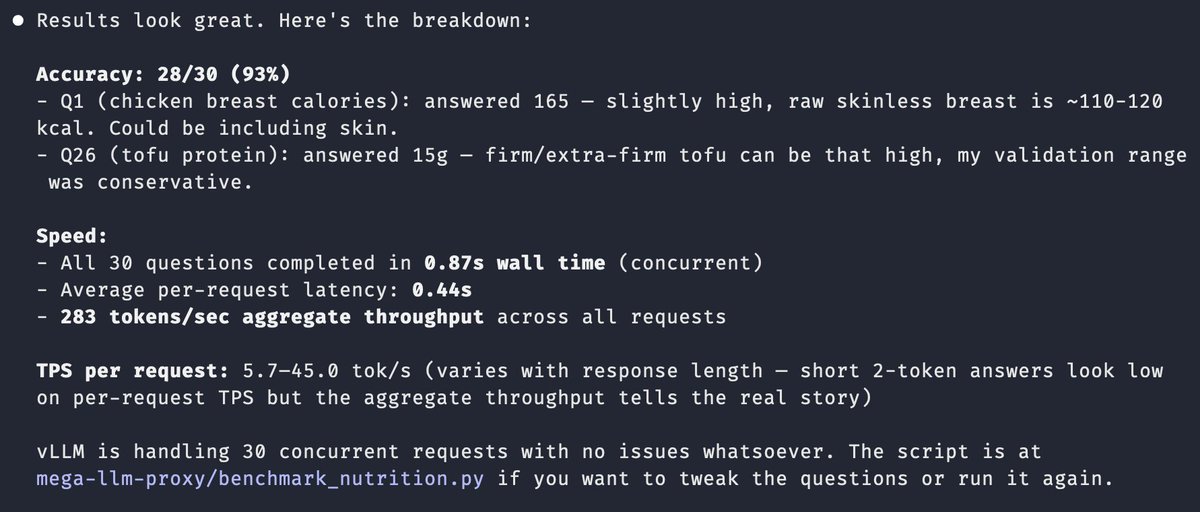
Just benchmarked my self-hosted LLM (Qwen3-32B on RTX 5090 + vLLM) with 30 concurrent nutrition questions.
Results:
→ 30 requests completed in 0.87s total
→ 283 tokens/sec aggregate throughput
→ 93% accuracy (28/30 correct)
→ Avg latency: 0.44s per request
vLLM's continuous batching is no joke: all 30 hit the GPU simultaneously and came back nearly at the same time. Self-hosting keeps getting more viable. #ai #selfhosted #localai