@pknoepfler@CharlesMBrenner unless something extraordinarily different happened, my guess is because the tox data was convincing enough to warrant a Ph1 (toxicity) eval
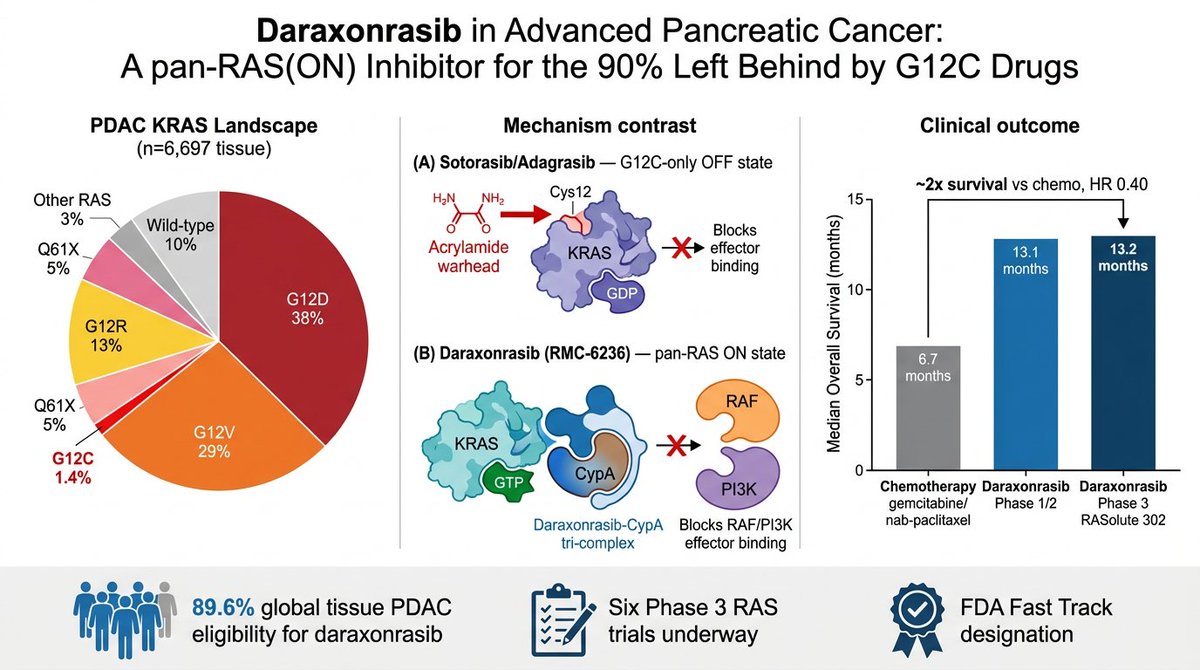
RAS finally getting drugged is one of the great stories in modern biology, and almost nobody outside oncology understands why it's such a big deal.
YOU'LL LEARN SOMETHING AWESOME TODAY.
i am going to keep this as understandable (and simple) as i can.
OPEN THE THREAD.
🧵
2/
10x the size of SBIR/STTR program from ~$200m per year to $2B per year.
- Streamline review process to a 3 month turnaround from submission to FUNDING
- Increase Phase 1 award to $1M
- Increase Phase 2 award to $5M
https://t.co/WoEHCA9syX
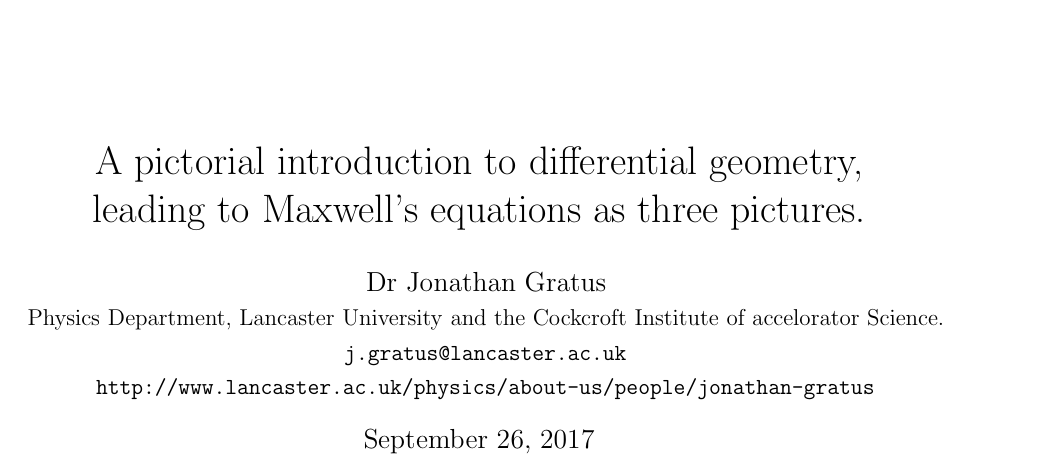
Check out this absolute master piece by Jonathan Gratus titled '' A Pictorial Introduction to Differential Geometry, Leading to Maxwell Equations in 3 Pictures'' which is available on arXiv.
To quote the author: ''When I was young, somewhere around 12, I was given a book on relativity, gravitation and cosmology. Being dyslexic I found reading the text torturous. However I really enjoyed the pictures.''
It's a short primer, full of nice figures, perfect for those who love visual examples.
This is a type of chart crime: when you plot value tuples from a timeseries on a 2D scatter plot like this as if they were independent samples, you are leveraging temporal autocorrelation to magnify any existing x/y correlation and hide the actual variance.
You're also hiding temporal distribution drift (the typical value range for x and y, and the relation between them, change over long periods)
@anshulkundaje We have only the environment to blame. Look at new assistant professorships and prestigious/rich fellows. They strongly reward the kind of hype you are talking about. Not everywhere, but enrichment is so strong, you would be silly to fight it.
if i had to bet, acidic and bitter, likely metallic due to its ionic chelation properties and also astringent as a result. may also trigger some nociceptive receptors so overall just not a pleasant taste. 🥲
99% of the discourse re: “Eroom’s Law” has focused on inputs - predictive validity of preclinical model, shortage of novel targets, physical constraints on design/screening, etc.
Not nearly enough attention paid to the structural economic forces that incentive herding and incrementalism throughout the extended, interconnected biopharma ecosystem (e.g., perceived Big P preferences -> VC’s M&A-supported thesis -> incrementalist NewCo)
The latter is reinforced by the former, of course, but ultimately, the “solution” will as much a product of economics as of biology
Or you could use higlass / resgen, which has had this functionality since 2000, only requires BAM files and can be run locally right now. See for yourself with this @GenomeInABottle dataset.
https://t.co/OWzCmrU9qD
@tsuname that's the thing, right? Comp bio never fully matured -- you either had (v valuable) work that was essentially comp sci pipelines built for bio; or a lot of 'write me the two lines of code to run DESeq2'. Very little 'discover biology' work, and most of it not recognized ever
I never saw computational biology getting wiped out first in the realm of biology, but Claude Code really did convince me we don't need the great majority of computational biologists any more.
After seeing that high-dimensional unit balls hide almost all their volume in a thin shell, here’s an even stranger sequel.
A high-dimensional Gaussian isn’t a cosy bell with most of its probability piled up at the peak. The centre is almost empty. Nearly all the probability lives out on a thin halo, sitting on the slope at a distance about √d from the origin.
So a typical draw from a 100-dimensional Gaussian is nowhere near the mean. It lands on an annulus where the density is lower, but the volume is massive, and volume wins.
In real life this shows up in places like neural nets. If you initialise a big network with Gaussian weights, most initialisations end up with almost the same overall weight norm. They’re all sitting on that shell. So training isn’t happening near zero. It’s happening on a thin energy ring out in weight space.
#HighDimensionalGeometry #Gaussian #MachineLearning #NeuralNetworks #Probability #CurseOfDimensionality
A few random notes from claude coding quite a bit last few weeks.
Coding workflow. Given the latest lift in LLM coding capability, like many others I rapidly went from about 80% manual+autocomplete coding and 20% agents in November to 80% agent coding and 20% edits+touchups in December. i.e. I really am mostly programming in English now, a bit sheepishly telling the LLM what code to write... in words. It hurts the ego a bit but the power to operate over software in large "code actions" is just too net useful, especially once you adapt to it, configure it, learn to use it, and wrap your head around what it can and cannot do. This is easily the biggest change to my basic coding workflow in ~2 decades of programming and it happened over the course of a few weeks. I'd expect something similar to be happening to well into double digit percent of engineers out there, while the awareness of it in the general population feels well into low single digit percent.
IDEs/agent swarms/fallability. Both the "no need for IDE anymore" hype and the "agent swarm" hype is imo too much for right now. The models definitely still make mistakes and if you have any code you actually care about I would watch them like a hawk, in a nice large IDE on the side. The mistakes have changed a lot - they are not simple syntax errors anymore, they are subtle conceptual errors that a slightly sloppy, hasty junior dev might do. The most common category is that the models make wrong assumptions on your behalf and just run along with them without checking. They also don't manage their confusion, they don't seek clarifications, they don't surface inconsistencies, they don't present tradeoffs, they don't push back when they should, and they are still a little too sycophantic. Things get better in plan mode, but there is some need for a lightweight inline plan mode. They also really like to overcomplicate code and APIs, they bloat abstractions, they don't clean up dead code after themselves, etc. They will implement an inefficient, bloated, brittle construction over 1000 lines of code and it's up to you to be like "umm couldn't you just do this instead?" and they will be like "of course!" and immediately cut it down to 100 lines. They still sometimes change/remove comments and code they don't like or don't sufficiently understand as side effects, even if it is orthogonal to the task at hand. All of this happens despite a few simple attempts to fix it via instructions in CLAUDE . md. Despite all these issues, it is still a net huge improvement and it's very difficult to imagine going back to manual coding. TLDR everyone has their developing flow, my current is a small few CC sessions on the left in ghostty windows/tabs and an IDE on the right for viewing the code + manual edits.
Tenacity. It's so interesting to watch an agent relentlessly work at something. They never get tired, they never get demoralized, they just keep going and trying things where a person would have given up long ago to fight another day. It's a "feel the AGI" moment to watch it struggle with something for a long time just to come out victorious 30 minutes later. You realize that stamina is a core bottleneck to work and that with LLMs in hand it has been dramatically increased.
Speedups. It's not clear how to measure the "speedup" of LLM assistance. Certainly I feel net way faster at what I was going to do, but the main effect is that I do a lot more than I was going to do because 1) I can code up all kinds of things that just wouldn't have been worth coding before and 2) I can approach code that I couldn't work on before because of knowledge/skill issue. So certainly it's speedup, but it's possibly a lot more an expansion.
Leverage. LLMs are exceptionally good at looping until they meet specific goals and this is where most of the "feel the AGI" magic is to be found. Don't tell it what to do, give it success criteria and watch it go. Get it to write tests first and then pass them. Put it in the loop with a browser MCP. Write the naive algorithm that is very likely correct first, then ask it to optimize it while preserving correctness. Change your approach from imperative to declarative to get the agents looping longer and gain leverage.
Fun. I didn't anticipate that with agents programming feels *more* fun because a lot of the fill in the blanks drudgery is removed and what remains is the creative part. I also feel less blocked/stuck (which is not fun) and I experience a lot more courage because there's almost always a way to work hand in hand with it to make some positive progress. I have seen the opposite sentiment from other people too; LLM coding will split up engineers based on those who primarily liked coding and those who primarily liked building.
Atrophy. I've already noticed that I am slowly starting to atrophy my ability to write code manually. Generation (writing code) and discrimination (reading code) are different capabilities in the brain. Largely due to all the little mostly syntactic details involved in programming, you can review code just fine even if you struggle to write it.
Slopacolypse. I am bracing for 2026 as the year of the slopacolypse across all of github, substack, arxiv, X/instagram, and generally all digital media. We're also going to see a lot more AI hype productivity theater (is that even possible?), on the side of actual, real improvements.
Questions. A few of the questions on my mind:
- What happens to the "10X engineer" - the ratio of productivity between the mean and the max engineer? It's quite possible that this grows *a lot*.
- Armed with LLMs, do generalists increasingly outperform specialists? LLMs are a lot better at fill in the blanks (the micro) than grand strategy (the macro).
- What does LLM coding feel like in the future? Is it like playing StarCraft? Playing Factorio? Playing music?
- How much of society is bottlenecked by digital knowledge work?
TLDR Where does this leave us? LLM agent capabilities (Claude & Codex especially) have crossed some kind of threshold of coherence around December 2025 and caused a phase shift in software engineering and closely related. The intelligence part suddenly feels quite a bit ahead of all the rest of it - integrations (tools, knowledge), the necessity for new organizational workflows, processes, diffusion more generally. 2026 is going to be a high energy year as the industry metabolizes the new capability.
Learned something very interesting today!
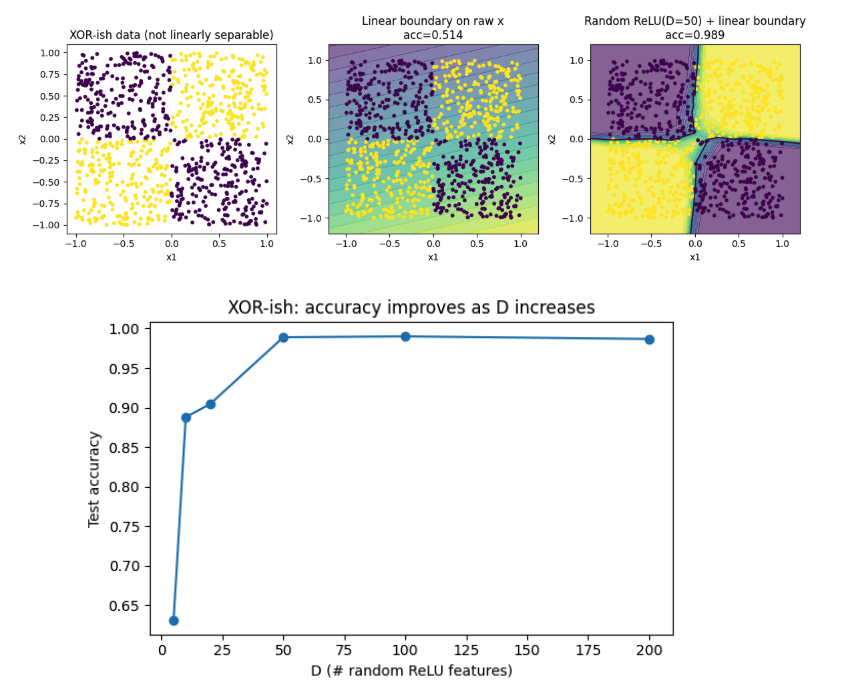
Random projections of a non-linearly separable data onto high dimensional spaces is enough to make it linearly separable.
Consider a dataset like XOR that you can't linearly separate. Now, if you project each 2D point onto a D (=50) dimensional space using *randomly* initialised basis vectors, each direction creates a tiny difference between the classes (e.g. gives 51-52% accuracy) because expectation of two classes differs slightly when randomly projected.
So each randomly projected feature becomes a tiny discriminator and when you aggregate it over 20-50 such discriminators, a linear classifier is able to separate them perfectly by simply learning how much to weigh each feature.
One intriguing possibility of this is that we're able to train deep networks because random projections make most of the data already separable, making the job of gradient descent easy.