Extreme weather events have officially rendered even pessimistic climate change models obsolete.
Recent summer heat waves have broken records across the globe, and they have done so by shocking margins, prompting deep concern among leading researchers.
From soaring triple-digit temperatures straining power grids in the United States to punishing, deadly heat waves suffocating Europe, the climate crisis is escalating far faster than anticipated. Climatologists warn that these 'super-extremes' are expanding on a spatial scale and magnitude that completely bypasses existing climate models.
This rapid acceleration, marked by off-the-charts ocean temperatures and erratic rainfall patterns, suggests that feedback loops once thought to be decades away are already active.
The rapid pace of this deterioration has transformed scientific concern into outright alarm. Experts emphasize that the danger goes far beyond standard temperature rises, threatening crucial planetary lifelines like the Atlantic Meridional Overturning Circulation (AMOC) and the Amazon rainforest. While global transitions toward renewable energy offer some hope, the sheer velocity of these compounding changes demands immediate, transformative action. The question is no longer whether we will experience a destabilized climate, but whether human infrastructure can adapt quickly enough to survive a reality where the worst-case scenario has already become the baseline.
source: Roston, E., & Warren, H. (2026). Extreme Heat Isn't the Only Climate Impact Shocking Scientists. Bloomberg.
Everyday Wi-Fi routers can track and identify you with 99.5% accuracy — even if you aren't carrying a phone.
Imagine walking into your living room or passing by a local café, completely disconnected from your devices, only for an invisible network to instantly map your physical identity. Cybersecurity researchers have revealed that ordinary, off-the-shelf Wi-Fi routers can do exactly that.
By exploiting unencrypted data called "beamforming feedback information"—a standard feature introduced in Wi-Fi 5 to help direct signals to connected devices—anyone with cheap, monitoring-enabled hardware can passively map the surroundings.
This breakthrough research demonstrates that radio wave reflections can be compiled to identify individuals walking through a room with an astonishing 99.5% accuracy rate, creating an invisible, highly accurate tracking infrastructure.
The security implications are profound because this tracking method bypasses traditional defenses. Even when individuals altered their walking style or carried bulky items like backpacks and crates, the experimental system still maintained a 50% to 60% identification rate.
Because beamforming signals are broadcast unencrypted across millions of homes, offices, and public spaces, researchers warn that this loophole turns everyday networks into ready-made surveillance tools without requiring any specialized hardware. As wireless standards evolve, privacy experts are urgently calling for robust encryption updates to patch this invisible threat before it can be exploited on a mass scale.
source: Todt, J., Morsbach, F., & Strufe, T. (2025). BFId: Identity Inference Attacks Utilizing Beamforming Feedback Information. Karlsruhe Institute of Technology.
🚨: NASA has acknowledged that it possesses images and videos of unidentified anomalous phenomena (UAPs)—formerly called UFOs—that remain unexplained after analysis. However, NASA Administrator Jared Isaacman has not said these images are evidence of extraterrestrial spacecraft. An "unidentified" object simply means there isn't enough information to determine what it is.
NASA's independent UAP study emphasized that there is currently no evidence linking these unexplained sightings to alien technology. The agency continues to encourage scientific investigation and better data collection to understand such phenomena.
Could these unexplained objects eventually turn out to be advanced technology, rare natural phenomena, or something entirely unexpected?
🚨: For the first time in more than 10,000 years, a dormant volcano in Ethiopia has erupted 🌋
This has never happened before in recorded history. ⌚
Its explosion was so massive that ash has reached countries in different continent 🌬️.
You won't BELIEVE what lined up over the Pyramids 😱
The Moon, Venus AND Jupiter in one frame — with Mercury photobombing the corner.
The ancients would've LOST it. 🌙🪐
Imagine getting the benefits of a full night's sleep without ever closing your eyes — scientists have just done exactly that in a groundbreaking new study.
A revolutionary study published in Nature Neuroscience reveals that researchers at the University of Wisconsin-Madison have successfully replicated the restorative effects of deep sleep in mice that were fully awake and active.
Using optogenetics—an advanced technique that controls genetically modified brain cells with targeted pulses of light—the scientists recreated the precise slow-wave electrical rhythms of non-REM sleep in specific regions of the animals' brains. This artificial sleep rhythm allowed the awake, sleep-deprived mice to bypass the cognitive toll of sleep loss, showing that sleep may not be an all-or-nothing state.
The implications of this breakthrough are profound, particularly for cognitive health and productivity. When tested on memory and learning tasks, the 'wake-sleeping' mice performed just as well as their fully rested peers, effectively salvaging their cognitive performance. This finding suggests that specific neural patterns, rather than the act of unconsciousness itself, are what trigger cellular restoration and memory consolidation. By demonstrating that localized brain regions can be 'recharged' on the go, this research opens the door to future non-invasive human therapies that could mitigate sleep deprivation and treat age-related cognitive decline.
source: Driessen, K., Squarcio, F., Tononi, G., & Cirelli, C. (2026). Induction of cortical ON/OFF periods in awake mice fulfills sleep functions. Nature Neuroscience.
THIS IS NOT FAKE. THIS IS REAL.
Canada is burning. Europe is on fire. New York's sky is smoke. The oceans are boiling. The heat is lethal.
If you are still denying climate change you are denying the Earth a future.
Drinking green tea daily is linked to a 51% lower risk of depressive symptoms!
Research suggests your daily cup of green tea or coffee might be doing more than keeping you alert — it could also be helping to keep depression at bay.
In a study of 537 working adults in Japan, researchers found that people who drank four or more cups of green tea per day had a 51% lower risk of depressive symptoms compared to those who drank one cup or less. Coffee showed similar benefits: drinking two or more cups per day was linked to a 39% lower risk. Even after adjusting for lifestyle and health factors, the association remained significant, pointing to a potential protective role of these beverages.
The team attributed these effects to compounds like catechins, theanine, and caffeine, which may influence neurotransmitters such as dopamine and serotonin—key players in mood regulation. The study also explored whether folate, abundant in green tea, played a mediating role in its mental health benefits. While folate did slightly weaken the effect, the link remained strong. As depression continues to rise globally, especially in Japan where rates are among the highest, this study offers promising insight into how everyday dietary habits could play a role in prevention.
Source:
Pham, N. M., Nanri, A., Kurotani, K., Kuwahara, K., Kume, A., Sato, M., Hayabuchi, H., & Mizoue, T. (2013). Green tea and coffee consumption is inversely associated with depressive symptoms in a Japanese working population. Public Health Nutrition,
Why do women get ultrasounds instead of MRIs during pregnancy? This image may be some indication...
If you’ve ever seen a prenatal magnetic resonance imaging (MRI) scan, you might have been startled. Unlike the soft, grainy, and reassuring shapes of a standard ultrasound, fetal MRI scans can make a developing baby look remarkably like a spooky, wide-eyed alien from a science fiction movie.
These bizarre, skeletal-looking images have gone viral multiple times, sparking jokes and a bit of horror online. While the 'ghoulish' grins are actually just a natural result of how MRI technology captures organs and tissues with high water concentrations, they highlight a deeper question about prenatal care: why do doctors rely so heavily on ultrasounds rather than MRIs?
The answer comes down to safety, cost, and practicality. Ultrasound technology is highly safe, non-invasive, and incredibly cost-effective, typically costing several hundred dollars compared to an MRI, which can cost thousands of dollars. Ultrasounds are perfect for routine checkups, allowing doctors to easily monitor fetal growth, amniotic fluid, and the placenta.
However, MRIs are not entirely obsolete in pregnancy. If a standard ultrasound reveals a suspected anomaly—especially within the fetal brain or other complex soft tissues—doctors will call for a fetal MRI. Because MRIs offer a larger field of view and superior soft-tissue contrast, they act as an invaluable secondary tool to help parents and medical teams prepare for any potential complications before birth.
source: Dapcevich, M. (2022). Do These Images Show MRIs of Fetuses? Snopes.
🚨Lab-grown meat is now banned in eight U.S states.
Eight states have now passed laws banning or restricting the sale of cultivated meat, with South Dakota becoming the latest after a five-year moratorium took effect on July 1.
The temporary ban will remain in place until June 30, 2030, while state leaders wait for additional safety research and the outcome of ongoing legal challenges in other states.
South Dakota Governor Larry Rhoden said the pause allows more time to study cultivated meat rather than permanently banning it.
Lab-grown meat is produced by growing animal cells in controlled facilities instead of raising and slaughtering livestock.
Supporters say the technology could reduce greenhouse gas emissions, lower land and water use, improve animal welfare and strengthen future food security.
Opponents argue the products remain relatively untested, could threaten traditional farmers and ranchers, and should be clearly distinguished from conventional meat.
Meanwhile, lawsuits challenging statewide bans in Florida and Texas continue to move through the courts.
At the federal level, lawmakers have also introduced the FAIR Labels Act, which would require cultivated meat and plant-based products to carry labels that clearly distinguish them from conventional meat.
The proposal has the backing of several major livestock organizations, which say consumers deserve accurate labeling while protecting competition in the meat industry.
As cultivated meat inches closer to wider commercial availability, the debate over how – or whether – it should be sold is rapidly expanding across the country.
China just passed a law mandating physical buttons for 19 essential, safety-related vehicle functions.
The era of the all-digital dashboard is hitting a regulatory roadblock as China officially clamps down on the automotive industry's obsession with touchscreens. Under newly finalized regulations set to take effect on July 1, 2027, automakers will be legally required to equip vehicles with physical controls for 19 essential safety functions, including turn signals, windshield wipers, hazard lights, and the gear shifter.
While migrating controls to touchscreens has allowed manufacturers like Tesla and various electric vehicle startups to streamline production, cut costs, and offer sleek designs, it has also sparked safety concerns. Drivers often face dangerous distractions and laggy software when trying to perform basic driving operations, prompting a major regulatory correction.
This regulatory pushback is not a localized anomaly but rather part of a broader global movement prioritizing tactile safety over high-tech minimalism. In Europe and the UK, the Euro NCAP safety organization began docking points starting in 2026 for vehicles without dedicated physical switches for core safety functions, threatening their coveted five-star safety ratings. China’s new mandate is even stricter, dictating precise usability rules and button sizes, and follows another recent Chinese ban on hidden, pop-up door handles that can trap passengers during emergencies. As safety authorities clamp down, the automotive world is being forced to quickly pivot back to intuitive, tactile cabins where drivers can keep their eyes on the road.
source: Dow, J. (2026). China is bringing buttons back to cars, ending trend led by Tesla. Electrek.
A 10-year-old child's experiment proved that memories can be passed down through generations.
It all began when Jo Nagai, a second-grader from Kobe, Japan, noticed his hand-raised swallowtail butterflies seemed to recognize him, while wild ones flew away.
Determined to find a scientific answer, he reached out to Georgetown University entomologist Dr. Martha Weiss, who had famously demonstrated that moths can retain memories through the chaotic cellular breakdown of metamorphosis.
Inspired by her work, Jo proposed replicating her study on butterflies, leading to an extraordinary cross-continental collaboration. Using a home-designed setup, Jo trained caterpillars to associate a mild vibration with the scent of lavender.
Astoundingly, after their brains were completely rebuilt in their chrysalis, 70 percent of the adult butterflies still avoided the lavender scent—proving their memories survived the transformation.
But the most shocking discovery occurred when Jo bred these trained insects.
Without ever experiencing the vibration themselves, both the offspring and the grandchildren of the trained butterflies inherited an instinctual aversion to the lavender scent. At just ten years old, Jo documented these revolutionary findings in a 33-page paper and presented them alongside Dr. Weiss at the International Congress of Entomology in Kobe. This extraordinary discovery of transgenerational memory not only challenges traditional understandings of genetics and inheritance but also highlights how the curiosity of a child can disrupt the boundaries of modern science.
source: Upworthy. (2026). Ten-year-old butterfly researcher discovers that memories can be passed down through generations.
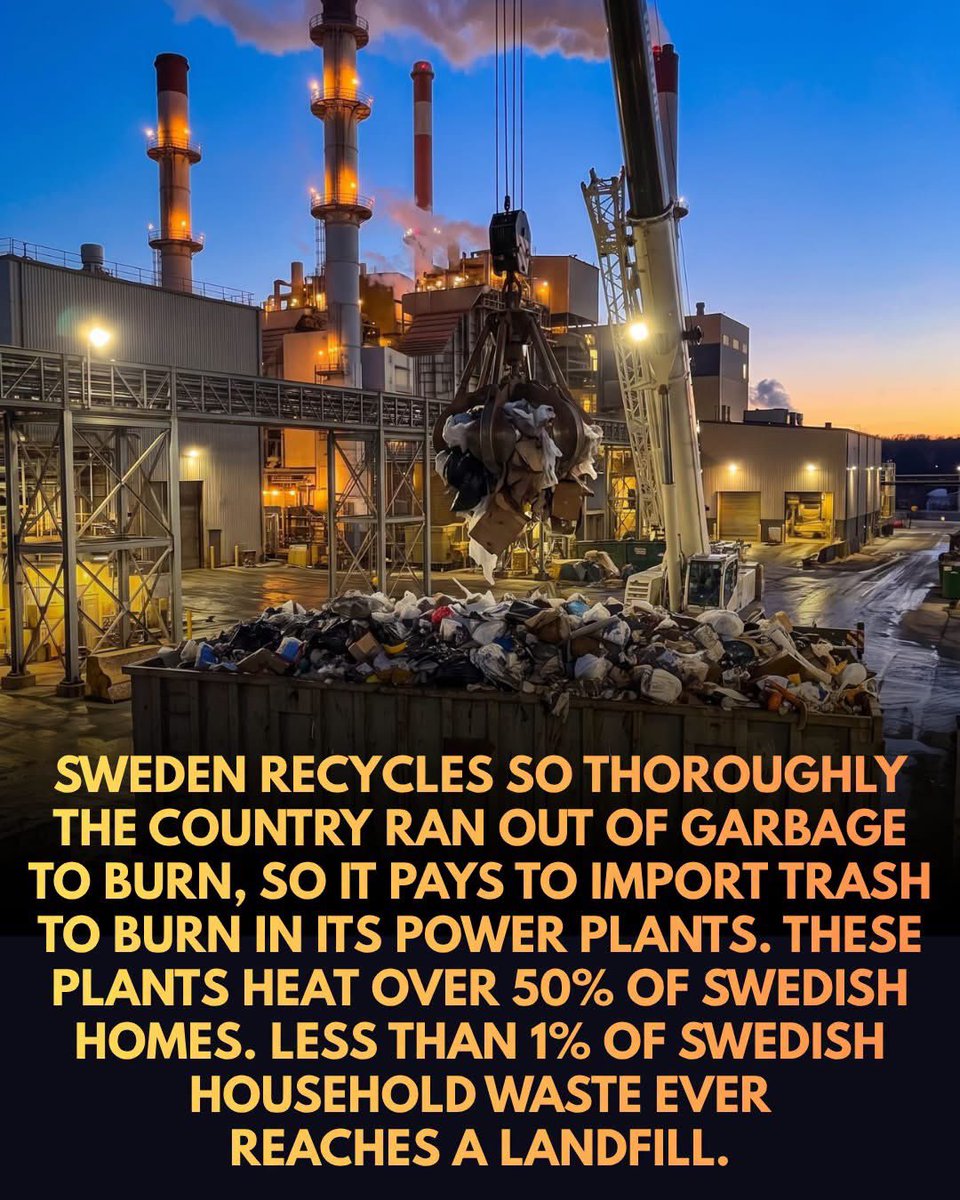
Sweden's recycling system is so advanced that less than 1% of its household trash ever ends up in a landfill.
Through a highly effective nationwide recycling strategy and a strict ban on landfilling combustible waste, the Scandinavian nation has transformed its garbage from an expensive burden into a valuable resource. The heart of this system lies in its network of state-of-the-art waste-to-energy plants.
These facilities incinerate non-recyclable trash under strict environmental regulations, capturing the resulting heat to supply domestic warmth and generate electricity.
This relentless efficiency eventually led to a surprising dilemma — Sweden recycles so effectively, that it ran short of its own domestic trash to burn.
To keep its waste-to-energy plants running at full capacity, the country began importing millions of tons of garbage annually from neighboring nations, including the United Kingdom, Norway, and Italy.
Remarkably, Sweden is actually paid by these countries to take their refuse off their hands. The imported garbage is piped directly into Sweden's municipal heating network, providing heat to over one million Swedish homes and generating roughly a tenth of the nation's total electricity. It is a striking blueprint for how a circular economy can convert a global pollution crisis into a profitable, renewable energy solution.
source: Christensen, L. (2025). How Sweden uses imported trash to produce electricity and heat homes. Snopes.
🚨: 'My battery is low and it's getting dark'
This was the last message sent by Opportunity Rover before losing the contact with Earth and shutting down forever after battling an extreme sand storm on Mars.
Rover was expected to survive only 90-days on Mars but it kept exploring the Red Planet for nearly 15 years.
Sent from 225 million miles from Earth, these last words will forever be remembered.