Over the past week, I’ve been overwhelmed by the love and support of friends, industry colleagues, and people I've never met. Thank you to everyone who has shown kindness to my family and me. It means the world to me.
I came to the United States 53 years ago, and becoming an American citizen is one of the greatest gifts and proudest moments of my life. NVIDIA has been my life’s work. Building it into the company it is today alongside my colleagues has been a privilege and an honor. Nowhere but in America could a company like NVIDIA be possible. I love our country, and I love NVIDIA.
I did not live up to the standards expected of everyone at NVIDIA, and I have made serious mistakes in my personal life. I created problems for the Board that I deeply regret. I own my mistakes completely, and I am committed to cooperating with the Board’s independent investigation.
Since my departure, I’ve seen an outpouring of calls from NVIDIA’s employees, investors, business partners, and customers for me to return as CEO. Many continue to reach out to me directly as the company navigates complex technology, market, competitive, and geopolitical dynamics. NVIDIA is a once-in-a-generation company. If the Board of Directors decides that my return is in the best interest of our shareholders, our employees, the company, and America, I would be honored to answer these calls and return as CEO.
Thank you again to everyone who has shared their good wishes. I am profoundly humbled by your support. To my family: I love you, and I will spend the rest of my life being worthy of yours.
Jensen
Sometime ago I had proposed an antidote to the hype in robotics demo tapes released on X - a live challenge where a child competes with a robot to finish a task, and we measure performance by speed of completion, weighted by success. I would like to congratulate @roeiherzig and collaborators for making this happen at CoRL 2026. Two robot policies competed and as expected they were trounced by the child. But this is fine! Progress will come and one day robots will exceed humans across the board. In computer vision the famous PASCAL object detection challenge started in 2005 with performance around 5%, and look where we are now.
“People are always angry at anyone who chooses very individual standards for his life; because of the extraordinary treatment which that man grants to himself, they feel degraded, like ordinary beings.”
— Nietzsche
We built a robotics data engine with Astra-level performance at 125x lower cost. And we are open-sourcing the weights today! Introducing Flora, a suite of open models to parse the physical world and turn raw footage into rich training signals.
Flora already powers our in-house data engine, labeling 200K hours of videos a day on 500 GPUs. We created it to scale the frontier for robot learning. Now you own the weights too.
Flora gives you:
- High-quality, timestamped captions to curate and filter human egocentric and robot data;
- Dense progress rewards for quality control and RL post-training;
- Rubrics scoring for real-world benchmarking
Try it today, links in thread:
I said "auto-regressive LLMs, in and of themselves, will not lead human-level AI"
That statement is still totally true.
First, the reasoning abilities of current AI systems are based non-auto-regressive search (which is what I have always advocated for). But AFAICT, they do it in token space, which is limited and inefficient. I have claimed that human-like reasoning must be a search in continuous representation space. It looks like the industry is moving towards that.
Second, the self-improvement methods, as currently practiced, only work for domains where the quality of outputs can be scored without human intervention, such as mathematics, code, and scenarios that can be simulated accurately. Not anything else. Humans and animals learn new skills way more efficiently than current RL methods.
Third, the multimodal capabilities of current AI assistants generally use separately-trained encoders (that are not LLMs). This is also what I've been advocating. Except that I think the best way to do this is with JEPA trained with self-supervised learning. The research community is clearly moving towards that (3000 papers on JEPA in just 4 years).
Fourth, if LLMs were a path to human-level AI, we would have domestic robots and Level-4 or Level-5 self-driving cars for consumers by now. And we don't. We certainly don't have cars that can learn to drive in 20 hours or practice like any teenager. We're still missing something pretty huge to claim human-level intelligence (let alone superhuman).
Sure, we now have computer systems that are impressive, very useful, and whose performance is superhuman in an increasing number of domains (coding being one of them).
But that's true of the entire history of progress in computer technology.
Lastly, there is a basic confusion about what intelligence actually is.
It is not the mere accumulation and regurgitation of existing declarative knowledge (which is essentially what LLMs do).
As Jean Piaget famously said, "intelligence is not what you know, it is what you do when you don't know."
It is your ability to solve new problem without any prior training, to act in previously-unknown scenarios, and to adapt very quickly to new situations with minimal training.
We're still far from that.
Excited to share our new paper in #ScienceRobotics@ScienceMagazine!!! “From Autonomy to Alliance: Robotic Foundation Models Must Learn with Us, Not Just for Us.”
We argue that the future of robotics is not just about smarter individual agents, but about better collaborators.
[2/3] We outline key design and evaluation principles essential for cultivating such collaborative intelligence, ultimately enabling robots to integrate more effectively into society and work alongside humans in meaningful ways.
We are delighted to share the recent publication from our SMS Lab member Sharmita Dey, who led the work on Continual Learning from Simulated Interactions via Multitask Prospective Rehearsal published in TMLR: https://t.co/PfN0q11M6f
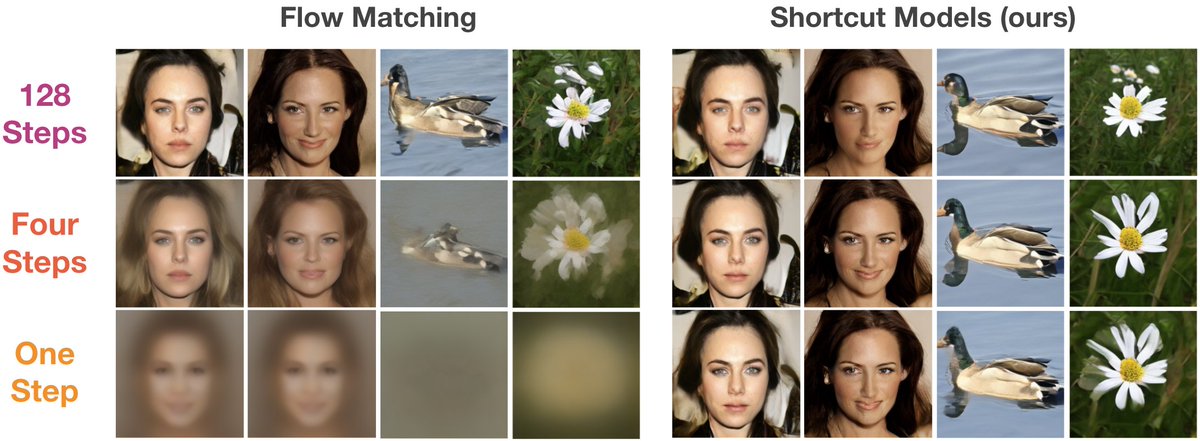
*Shortcut models* are a plug-and-play replacement for diffusion models that can generate in a single step (or more). This speeds up inference by up to 128x.
Shortcut models are trained end-to-end, and do not require a separate distillation phase or learning schedules.
@sainingxie [2] Also, why do you call it regularization? We could also consider it contrastive learning, where DiT's hidden representations are one view, and the clean features from Dinov2 form another view. Do you call it regularization as it is jointly done with the denoising objective?
@ylecun RL also entails model-based RL, which essentially builds a world model for planning. So, would it be more appropriate to differentiate model-free vs. model-based approaches and having preference for model-based approaches, over model-free approaches instead of Mpc vs. RL comp?
@JiachenLi11 8. Bully authors to produce anonymity-sensitive information such as grant number during rebuttal. When we explained we were happy to do it if the PC allowed, they posted a comment on the other reviewer's comment who acknowledged our efforts truly, the concern exists, total lying.
@JiachenLi11 7. Lie in the author rebuttal, and say X is not there in the author response or supplementary or author response, whereas it is already addressed, and acknowledged by another reviewer.