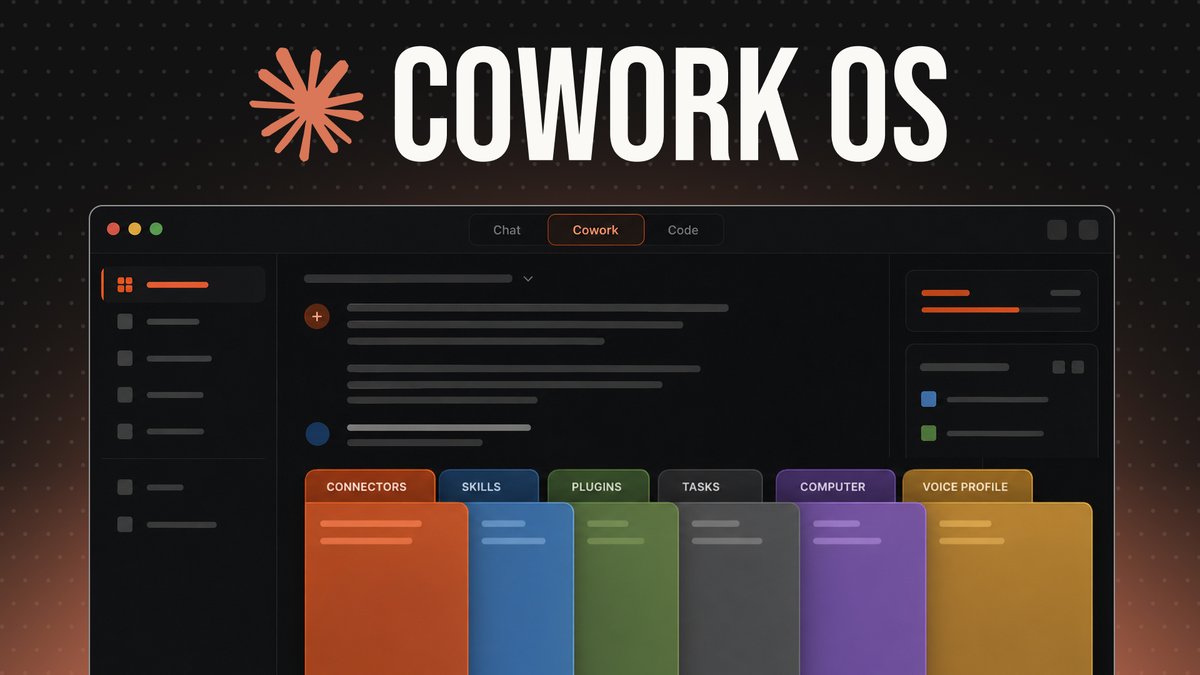
I built a Claude Cowork OS that replaces OpenClaw and runs on autopilot.
Manages my business & personal life tasks. I created the whole playbook so you can re-build it tonight.
What's inside:
• The exact foundation prompt
• 3 level orchestration map
• Memory template for global context
• Routing table for file management
• Starter workstations (finance, content, community, habits)
• Project file structure
• Single prompt that builds the entire folder tree
Follow + Comment 'OS' and follow. I'll DM it to you.
Claude es utilizado por 11 millones de personas al día.
He creado la guía con los 100 skills reales que separan a los pros de los turistas:
→ Redacción, Automatización, Negocios, Productividad, Programación, IA y Prompting, E-commerce, Finanzas y Investigación
¡GRATIS solo durante 24h!
Solo:
1. → Dale like
2. → Comenta "SKILLS"
3. → Sígueme para recibir el DM
I built 131 Claude skills for outbound, content, LinkedIn, SEO, and growth into one plugin.
131 skills. 11 domains. One /bootstrap command.
Our clients kept hearing the same thing from prospects: *"Your outreach actually sounds like you."*
That doesn't come from better prompts. It comes from a system that reads your brand, voice, and ICP automatically.
▶️ The foundation (built once)
→ /bootstrap - onboards Claude to your brand, voice, and ICP. Every skill reads that context automatically.
→ ICP document - loaded once, referenced by every skill without manual pulling.
→ Brand and voice layer - installed at setup. Every output reflects your positioning, not a template.
Most teams skip this and go straight to prompting. Then wonder why everything sounds the same.
▶️ The skill layer
→ Outbound and email for personalised sequencing at scale
→ LinkedIn, Twitter, YouTube for social across every format
→ Content and copywriting that reflects your documented voice
→ Analytics and research for signal detection and account intelligence
→ Strategy and positioning for ICP, messaging, and competitive work
47 growth and product skills alone.
▶️ The execution layer
→ Plain-language task detection - skills activate automatically
→ Cross-referencing - a cold email pulls from brand, voice, and ICP simultaneously
→ Output grading - if it reads generic, one fix: make it specific enough it can't describe any other company
Compatible with Claude Code, Claude Cowork, and any Agent Skills spec agent.
▶️ Repurpose
→ One validated outbound skill = one framework cross-referenced into content, SEO, positioning, and paid. No rebuilding.
→ Repurposing is not copy-pasting. It's cross-referencing.
▶️ Maintain
→ /bootstrap refresh updates every skill automatically
→ Monthly voice refresh. Quarterly domain audit.
The system gets smarter the longer it runs.
▶️ Delivery
→ Claude Code or Claude Cowork. 4 installation methods in the setup guide.
Bootstrap → detect → activate → cross-reference → draft → grade → repurpose → refresh
Your skill library is your GTM brain.
Reply "CLAUDE" and I'll send you the full breakdown 👇
Follow me👤
@DuaFatima
Most people say "build an AI agent."
Very few know what that actually means.
Here’s the real blueprint to go from idea → working agent 👇
1. Define the job
What problem are you solving?
Who’s the user? What does success look like?
2. Design the brain
Clear system prompt, role, instructions, guardrails
(This is where most agents fail)
3. Pick the right model
Speed vs cost vs intelligence
Don’t overpay for simple tasks
4. Add tools
APIs, databases, MCP servers, custom functions
Agents become powerful when they can act, not just answer
5. Give it memory
Short-term + long-term context
So it learns, adapts, and improves over time
6. Orchestrate everything
Workflows, triggers, retries, agent-to-agent communication
7. Build the interface
Chat, app, API, Slack bot
Make it usable, not just functional
8. Test + improve
Evals, latency checks, real-world feedback
Iteration is the real moat
💡 Truth:
An “AI agent” isn’t one prompt.
It’s a system.
And the people who understand systems…
are the ones building unfair advantages right now.
📌 Save this (you’ll need it when you build)
🔁 Repost for builders
➕ Follow @Shahriar661731 for practical AI breakdowns (no fluff) 🚀
Claude Code ships with 5 architectural layers most engineers never open.
Not features. Not settings. Layers — each solving a distinct problem that LLMs alone can't solve. And four of them have nothing to do with prompting.
Here's the full Agent Development Kit:
Layer 1 — CLAUDE.md → The Memory Layer
Architecture rules, naming conventions, test expectations, repo map. Always loaded. Always active.
Two scopes:
• ~/.claude/CLAUDE.md → global
• .claude/CLAUDE.md → project
This isn't context you paste in before every session. It's context that never needs repeating. The agent's constitution.
Layer 2 — Skills → The Knowledge Layer
Each SKILL.md carries a description. Claude matches it at runtime and forks the skill into an isolated subagent. On-demand, never always-on.
Task-specific knowledge without inflating your main context window. Modular by design.
Layer 3 — Hooks → The Guardrail Layer
PreToolUse → PostToolUse → SessionStart → Stop → SubagentStop
This is the layer most teams skip. And the one they regret skipping first.
Hooks are NOT AI. They're deterministic event-driven shell commands.
• Auto-lint on every Write
• Hard-block on rm -rf
• Slack notification on Stop
Event fires → Matcher checks → Command runs
Quality enforced at the infrastructure level. Not the prompt level.
Layer 4 — Subagents → The Delegation Layer
Each subagent gets its own context window, model, tools, and permissions.
Main agent delegates down. Receives results up. That's it.
No infinite recursion — subagents can't spawn subagents. Main context stays clean. Hard boundaries by design.
Layer 5 — Plugins → The Distribution Layer
Bundle your skills + agents + hooks + commands into a plugin. One install. Whole team inherits the behavior.
Think npm packages — but for what your agent knows how to do.
Wrapping everything:
→ MCP Servers on the left (GitHub, databases, APIs, custom integrations)
→ Agent Teams on the right (parallel execution, message passing, shared permissions)
The 5-layer stack in one line:
CLAUDE.md sets rules → Skills provide expertise → Hooks enforce quality → Subagents delegate work → Plugins distribute to the team
Most production failures in agentic systems trace back to one missing layer.
Which one is the gap in your current setup?
🚨 Claude can now build your entire mobile app, like an Apple-level $350K dev, in minutes and FOR FREE.
What used to require a full team and weeks of work can now be done with just a few well-thought.
Want the full guide??👇
Comment "Need" . I'll send you Everything
🚨 Most “Claude tutorials” get it wrong
They obsess over prompts
But ignore the real systems that generate income
• 80+ in-depth chapters
• 1000+ powerful AI tools
• 2000+ proven prompts
No fluff. Just a complete system to make money.
Want access?
💬 Comment “Claude”
🤖 Automate EVERYTHING with AI + No-Code?
🎁 GIVEAWAY TIME
I’m giving away a complete n8n Automation Pack (workflows + templates + setup guide)
💡 Build:
• AI automations
• No-code workflows
• Content systems
• Passive income pipelines
To enter:👇
1. Follow me
2. Like + RT
3. Comment “AUTO”
I’ll send it to selected winners 🔥