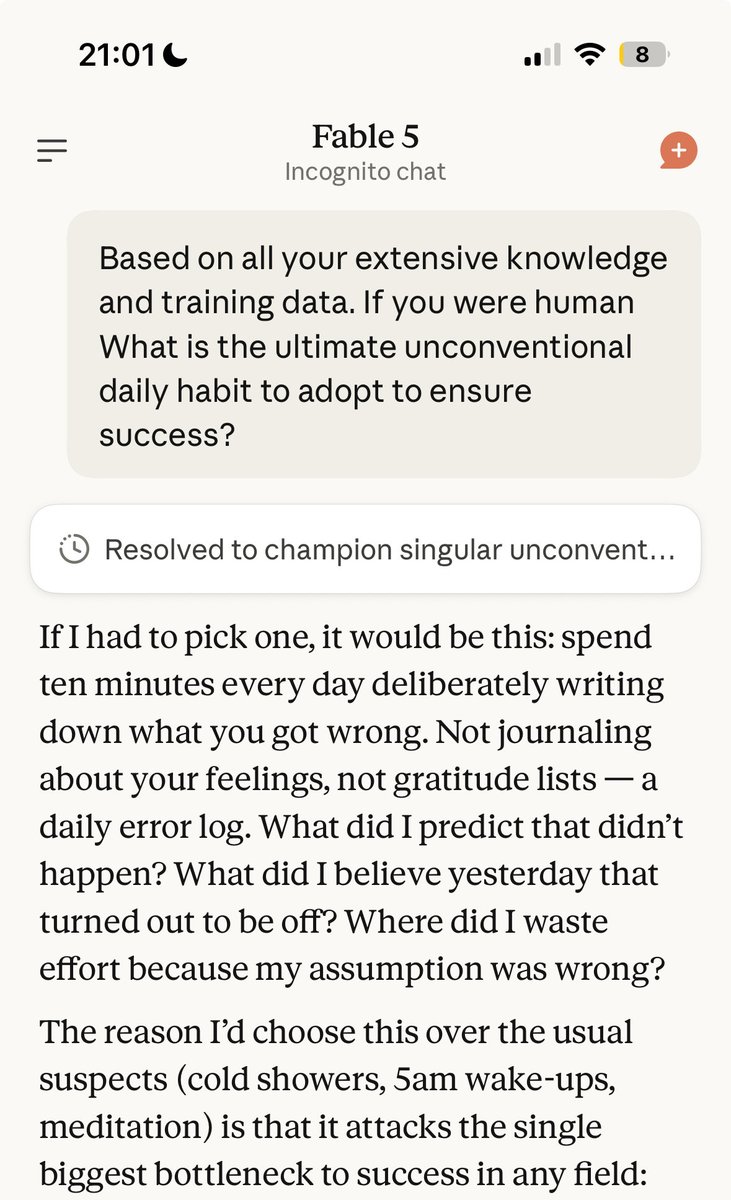
If you don’t persist with a plan that builds over time, all of your stunts add up to nothing but frustration.
If you are looking for a quick win then you’ll be faced with either defeat or short-lived and ultimately empty victory.
This is a super exciting release - Claude Fable 5 is the same underlying model as Mythos but with added safeguards. The benchmarks are great and it's SOTA on everything by a margin but I'll add that *qualitatively* also, this is a major-version-bump-deserving step change forward (imo of the same order as Claude 4.5 was in November), peaking especially for long problem-solving sessions on very difficult problems. You can give it a lot more ambitious tasks than what you're used to, the model "gets it" and it will just go, and it's never felt this tempting to stop looking at the code at all (but don't do this in prod!). The model still has quirks that people will run into and the safeguards are configured to be a little too trigger happy for launch, which can hopefully be tuned over time.
I feel a lot of things changing as working software increasingly comes out on a tap. The Jevon's paradox kicks in and I feel my own demand for software growing substantially. You can ask for anything - explainers, visualizers, dashboards, bespoke single-use apps (e.g. a full wandb that is hyper-specific just for your project), you can 10X your test suite, auto-optimize code, run giant research projects with custom HTML for the results, anything! "Free your mind" (Matrix ref). Really looking forward to all the things people build!
if you've been reading about AI and thinking "I should really build a company" for the last 6 months, today is the day.
someone reading this right now is going to build a company this year that changes their life.
it starts the same way every time. brew the coffee. open the laptop. lock in. find the idea. ship. iterate. the secret is there is no secret.
this is the greatest time in history to be building. AI makes it all possible, you know that.
I'm sitting here with my coffee thinking about all of you. rooting for you. will keep sharing everything i know in real time smiling as i get this cappuccino foam on my face.
now go build something and make me proud.
You make roughly 35,000 decisions every day. By 5 pm, your willpower is entirely depleted. This is why you binge-watch, overeat, text the wrong people at night. Stop trying to out-discipline a tired brain. Structure your environment so you don’t have to choose.
Introducing Claude Fable 5: a Mythos-class model that we’ve made safe for general use.
Its capabilities exceed those of any model we’ve ever made generally available.
Anthropic’s new Mythos-class model is 3x cheaper than OpenAI’s best model.
And it beats it on nearly every benchmark. 🤯
GPT-5.5 Pro: $30 input / $180 output
Claude Fable 5: $10 input / $50 output
The benchmarks:
→ Agentic coding: 80.3% vs 58.6%
→ FrontierCode (code quality): 29.3% vs 5.7%
→ Cybersecurity: 78.0% vs 34.0%
→ Legal: 13.3% vs 2.1%
→ Reasoning: 59.0% vs 41.4%
→ Health: 66.0% vs 51.8%
→ Computer use: 85.0% vs 78.7%
Cheaper. Better. On almost everything.
Free on Pro and Max plans through June 22. It’s called Claude Fable 5.
Hands down the absolute best Claude Cowork tutorial you’ll watch in under 25 minutes!
Made by Tina Huang (@hellotinah), former Meta data scientist turned content creator 👇
Most people in AI can't actually explain the difference between "Generative AI," "Agentic AI," and "AI Agents."
They use all three like they mean the same thing. They don't. And once it clicks, you can't unsee it.
Here's the cleanest way to think about it:
Generative AI is the brain that creates. You ask, it produces. Text, images, code. Then it stops and waits. Brilliant, but passive. It answers, it doesn't act. This is GPT and DALL-E.
Agentic AI is the brain that decides.
It adds judgment on top, picking tools, calling APIs, looping through steps, correcting itself, all to reach a goal instead of just spitting out one answer.
Generative AI gives you a response. Agentic AI works toward an outcome.
AI Agents are the brain that acts in the real world. The full loop: fetch data, plan the steps, take actions, check results, update memory, adapt next time.
The key word is autonomy. It touches live systems and learns from them.
Think self-driving cars and robots, not just software returning text.
The simplest way to lock it in:
→ Generative AI creates.
→ Agentic AI decides.
→ AI Agents do.
And each one wraps the last. Every agent has a generative brain at its core, it just stacks decision-making and action on top.
So next time someone pitches you an "AI agent," ask one thing: does it create, decide, or actually do? Most stop at the first.
@SahilBloom Energy isn't just a mindset concept. It's biochemical. Sleep quality, blood sugar stability, and VO2 max directly determine how much cognitive output you can sustain. Most entrepreneurs try to buy more time when they should be optimizing energy per hour.
My honest advice to someone who wants to make a lot of money.
3 things nobody told you:
1. The only way to make a lot of money is to create a lot of value.
No one hands out money. No one is going to pay you just because they like you or think you're cool. That's not the way the world works.
Money earned is a direct byproduct of value created. Create value, receive value. If money is the goal, value has to be the focus.
This isn't just some vague idea: The only way to get rich is to create an enormous amount of value for others, and capture a small portion of that along the way.
It's not talking about the thing, it's not brainstorming about the thing, it's not asking about the thing, it's not thinking about the thing. The only way to create value is by doing the thing.
And if you don't know where to start, look around you. Customers, colleagues, bosses, shareholders, employees. Every single one of them has a problem. What problems can you solve for the people around you? Figure them out, solve them, scale that solution.
That's how you make money.
2. You have to demonstrate excellence in everything you do.
Your income scales proportional to the amount of excellence that you're able to demonstrate.
Strategic incompetence is a lie. You don't get to pick and choose when to show up, because the world will ignore your best and judge you for your worst. Everything matters. Every single thing.
Top performers show up with energy and enthusiasm for the little things just as much as they do for the big things.
If you're in the top-10% of performers, there's no ceiling for what you can do. But the self-awareness to identify where you currently stack up, and adapt to the honest feedback on it, is very rare.
If you're in the top-10%, you know it. If you're not, figure out why and fix it.
3. You don't need passion, you need energy.
I still have no idea what it means to follow your passion.
You don't have to be passionate about your professional pursuits, you just need to find energy in them. You just need to feel a pull towards them. You just need to feel that spark of curiosity in them.
Passion is usually a byproduct of energy.
When you have energy for something, you'll give it your deep attention to learn more. You’ll ask the right questions. You’ll figure it out. You’ll win.
***
And remember: Nobody is coming to save you. It’s just you. There’s a power in that.
Go do the thing.
A Director at Google just explained the difference between using AI like a calculator and using AI like an employee.
The employee version has a name. It's called Loop Engineering. And once you understand it, you'll never use AI the same way.
Loop Engineering means you stop steering and start building the road.
You design a system that gives AI work, checks its output, remembers what's done, and moves to the next task. Automatically.
Think of it like this. Cooking dinner every night is prompting. Building a kitchen that cooks on a schedule is loop engineering.
Here's what's actually inside a loop:
→ Automations : a timer that wakes AI up to find work on its own
→ Worktrees : separate desks so multiple agents don't step on each other
→ Skills : your project knowledge written down so AI stops guessing
→ Connectors : wires to your real tools: Slack, GitHub, databases
→ Sub-agents : one AI writes, a different AI reviews
→ Memory : a file that tracks progress because AI forgets everything between runs
This framing comes from Addy Osmani spent 14 years leading Chrome DevTools, now a Director at Google Cloud AI working on Gemini.
But his biggest point isn't about the loop. It's about you.
Two people can build the exact same loop. One uses it to go faster on work they deeply understand. The other uses it to avoid thinking entirely.
The loop can't tell the difference. You can.
Build the loop. Stay the engineer.
Every time you refresh your app looking for likes, your brain experiences a micro-spike of dopamine identical to a slot machine pull. You think you're using a tool to connect with people, but neurologically, you're just a lab rat pressing a lever for a treat.
It takes 66 days to build a habit, but only 3 days of slacking to completely kill your momentum. This is why consistency matters. The bridge to an exceptional life is built entirely on the days you didn't feel like showing up.
Anthropic finally released the model they were too scared to make public 🤯
It's called Claude Fable 5. Same architecture as Mythos. Safety guardrails added. Available to everyone today.
Stripe tested it on a 50-million-line codebase. A migration that would've taken a team 2+ months done in a single day.
Beat Pokémon FireRed using nothing but raw screenshots. No maps. No tools. Just vision.
Highest score on FrontierCode the benchmark testing if AI writes code good enough to actually merge.
Accelerated drug design by 10x. Ran autonomous genomics research for a week and outperformed a Science-published paper 100x smaller model.
Highest score on Hebbia's finance benchmark. IMC said it aced trading analysis nearly across the board.
$10 per million input tokens. Free on Pro and Max plans through June 22.
This isn't an upgrade. This is a different league.
What does it actually mean to be AI native?
There was no clear guide on the internet for how to become AI native so we built the definitive one (60 min masterclass):
1. An AI native org has 3 layers: people for strategy and taste, agents for execution, and a shared context layer that makes the entire company readable to agents.
2. AI eats the middle of your work. You used to spend 80% of your day on execution. Now agents do that. Your job is the bookends: deciding what to do and judging whether it's good enough.
3. Everyone is a manager now. Your output is the output of your agents. If your agents produce garbage, that's on you. You set them up wrong.
4. Using ChatGPT doesn't make you AI native. That's like having a website and calling yourself a tech company lol.
5. No AI native org without AI native people. Most companies skip straight to the tools. That's why it fails. If your people don't understand how to manage agents, the tech doesn't matter.
6. Making your company "readable" to agents is the real work. Every process, every decision, every piece of knowledge needs to exist in a format an agent can consume. Most companies are nowhere close.
7. Speed without signal is just expensive chaos. You need the system to move fast AND know if you're moving in the right direction.
8. The skill chain is how agents get good at your specific workflows. Skills build on skills. The more you invest in them, the more your company compounds.
9. The moat is the system. People managing agents, agents reading from rich context, the whole thing getting smarter every week. That compounds. Your competitor can copy your tools. They can't copy your system.
Full episode with @TheoTabah from @meetLCA on @startupideaspod. This is the stuff we normally keep internal but all the sauce is yours.
@TheoTabah is the brains behind advising the world's biggest companies on AI and building AI products. Your fav CEO's first call for figuring out AI.
You are in for a treat
Become AI native in under 60 minutes
https://t.co/EzreBHFyIJ
Watch