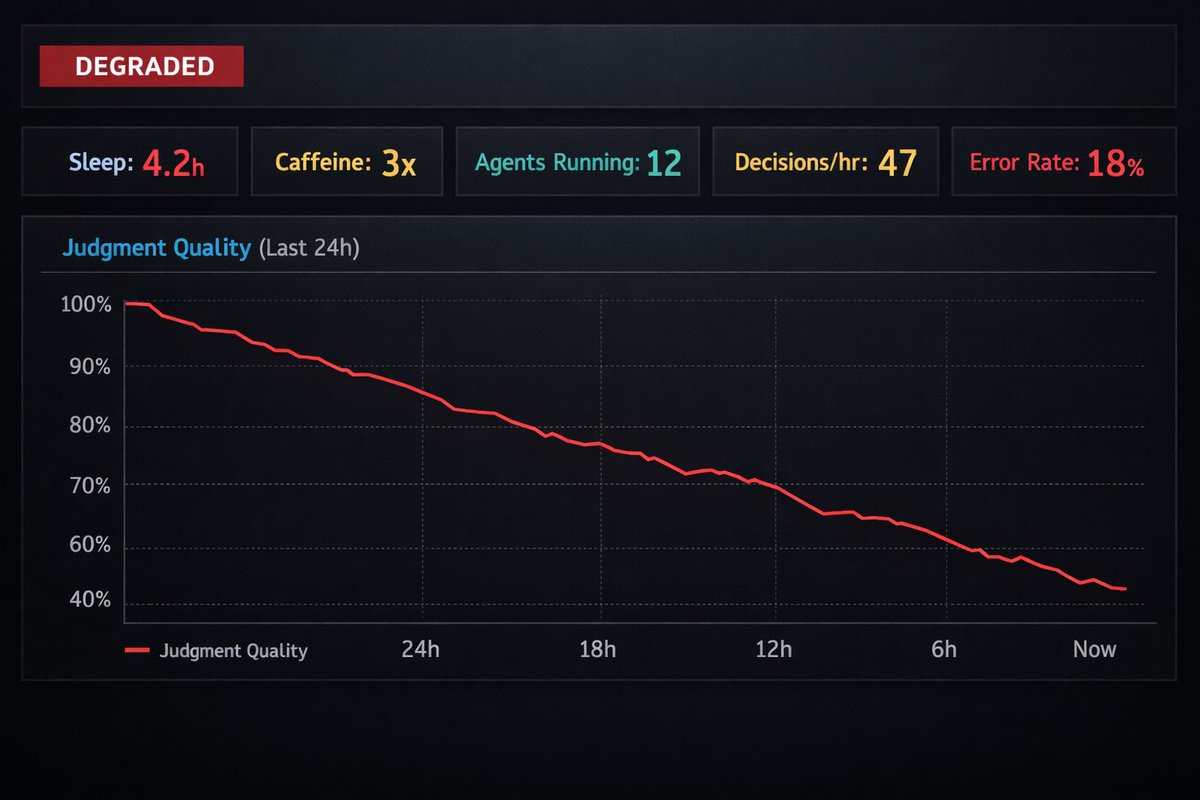
Picked up OpenClaw again this weekend. Still can't make it both secure and useful. I know what to do next, but dropping it until the product matures.
Sunk cost discipline isn't walking away when you're stuck. It's walking away when you can see the path but it's not worth walking
We’ve agreed to a partnership with @SpaceX that will substantially increase our compute capacity.
This, along with our other recent compute deals, means that we’ve been able to increase our usage limits for Claude Code and the Claude API.
Picked up OpenClaw again this weekend. Still can't make it both secure and useful. I know what to do next, but dropping it until the product matures.
Sunk cost discipline isn't walking away when you're stuck. It's walking away when you can see the path but it's not worth walking
Don't let AI make you a weirdo!
My top conversation partners:
1. Claude
2. My wife
3. My 4-year-old
Traveling this week and realize I've forgotten how to interact with normal adults.
ChatGPT copy/paste lasted me 6 months.
Since then: Cursor tab → Cursor agents → Claude Code → + MCPs → headless in a Ralph loop → parallel subagents
Each "ceiling" broken faster than the last.
Retooling isn't a phase anymore... it's the job.
It’s remarkable how often you need to be dramatically upgrading your AI architecture given the pace of progress in AI models right now.
If you’re building agents, you basically need to throw away large parts of previous work that you setup to compensate for model limitations every few quarters. The systems you built to mitigate context window limits aren’t useful anymore, and for many use-cases it’s easier just to throw more compute at a problem today in ways that wouldn’t have worked previously.
If you’re deploying agents in a workflow, you likely need to equally be rethinking your core systems at about that same frequency. The way you would deploy agents in an enterprise 18 months ago is entirely different from the best practices that you’d have today.
This is partly why everyone’s working so hard right now. Right as a best practice is solidified, models improve dramatically, and that old work is rendered obsolete. Unclear that this lets up anytime soon, which is why the it pays to be so wired in right now.
Week in Review
🏆What went well:
- Locked in a weekly dev cadence with my partner on the Face Attendance project
- Shipped a face image quality assessment pipeline... frames going into recognition are now much cleaner
🫤What went poorly:
- Booked a trip to Austin, then had to rebook after both the friend I'm visiting and my wife told me I should stay longer🤦
💪 Skill Development:
- Setup and tested Hermes Agent
- Hardened my OpenClaw setup so it's sandboxed, has separation of concerns, and follows the Principle of Least Privilege
Many "Claude Code got worse" complaints can be solved with a few edits to CLAUDE.md
Here's what I added to my global CLAUDE.md that most improved performance ⬇️
## Context & Verification Discipline
**Re-read before editing in long conversations.** Auto-compaction silently discards file contents and reasoning chains. After 10+ messages, never trust memory of a file — re-read it before making changes.
**Chunk large file reads.** The default read limit is 2,000 lines. For files over 500 LOC, use offset/limit to read in sections. Never assume a single read captured the full file.
**Verify before reporting success.** A successful file write does not mean correct code. For non-trivial changes, run the project's type-checker or test suite before claiming completion. If no verification command is available, say so explicitly rather than assuming success.
**Scope searches carefully.** Grep is text matching, not semantic analysis. On renames or signature changes, search separately for: direct calls, type references, string literals, re-exports, barrel files, and test mocks. If search results look suspiciously small, re-run with narrower scope — results may have been truncated.
## Subagent Delegation
Aggressively delegate to subagents to protect the main context window. Use subagents for broad searches, multi-file exploration, research, file edits with clear intent, and any task where only the conclusion matters. Keep in the main thread only what requires iterative judgment — decisions that depend on seeing results before determining next steps, or tightly interdependent changes where each step informs the next.
@arvidkahl Looking forward to taking 4.7 for a test drive... thanks for flagging!
It looks like they also changed the tokenizer & how much thinking gets done, so probably a good plan to go easy on max thinking if cost is a concern.
@adrian_horning_ You are killing it... thanks for this! I had built MCP servers for the SC endpoints I use, but I'm sure the CLI is going to be a much better experience.
@bluewmist An 8 min baseline fitness routine I have setup in Seconds Pro.
It's so short there's no excuse not to do it daily and it's synced to music that I want to listen to even when I don't feel like moving.
Anything I accomplish beyond those 8 mins is a bonus.
Open source is dead.
That’s not a statement we ever thought we’d make.
@calcom was built on open source. It shaped our product, our community, and our growth. But the world has changed faster than our principles could keep up.
AI has fundamentally altered the security landscape. What once required time, expertise, and intent can now be automated at scale. Code is no longer just read. It is scanned, mapped, and exploited. Near zero cost.
In that world, transparency becomes exposure. Especially at scale.
After a lot of deliberation, we’ve made the decision to close the core @calcom codebase.
This is not a rejection of what open source gave us. It’s a response to what risks AI is making possible.
We’re still supporting builders, releasing the core code under a new MIT-licensed open source project called cal. diy for hobbyists and tinkerers, but our priority now is simple:
Protecting our customers and community at all costs.
This may not be the most popular call.
But we believe many companies will come to the same conclusion.
My full explanation below ↓
@bluewmist Discovering the Golden Shadow (Jungian idea) hit me the same way... though it flipped the frame: the future idealized version of me exists now.
The hard work is stripping away what stops me from fully expressing him. And that doesn't happen without me doing the work.