Writer, naturalist, mother, co-author of two Peterson Field Guides to Moths. Can usually be found exploring outdoors. Moonlights as story-lover @SeabrookeN.
Moth-ers of the West! This one’s for you!
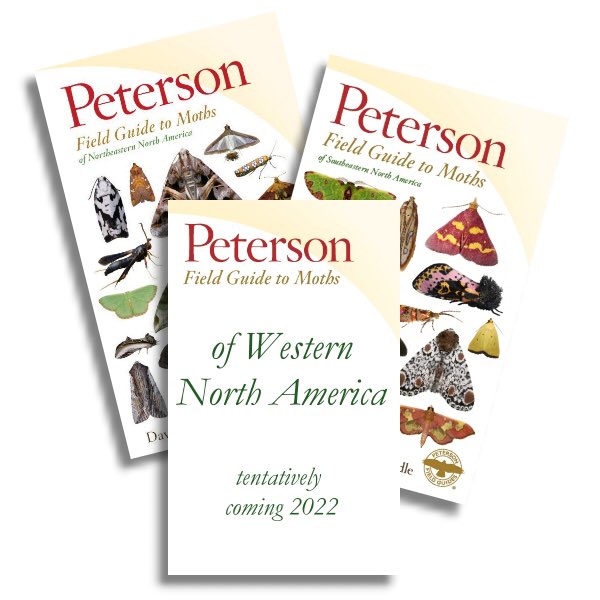
The Peterson Field Guide to Moths of WESTERN North America! Assuming I meet all my deadlines, we’re looking at likely a fall 2022 release. It’s just me on board this time; Dave had to bow out of this one due to other commitments.
@JasperSailfin Beautiful! What a great find; I've only ever seen one, and it was years ago now. I admit I couldn't tell you much about the foodplants stuff - that was Dave's area. I believe he got a lot of his info from the MONA series, but I'm not sure how one might find the original papers.
@momomoto@entoMOMogist Tough to cover all of insects in just a single book! I don't own the NWF guide, but another great general insect guide (and my personal favourite) is the Kaufman Guide to Insects. Has a pretty good moths section, too! I mean, if you're not buying my book. 😄
@inaturalist @JayFitzsy @Birder_Justin@JMarkRyckman Cool! Thank you! This was a fascinating read. Interesting to see why sometimes less common species don't come up in the list of suggestions. To be honest, I'm constantly blown away by iNaturalist's recommendations, it's just SO good. Love that it suggests higher taxons too.
@momomoto@entoMOMogist It’s a Virginia Creeper Sphinx. :) Size is one indicator, but also the dark band across the base of the wing; in Pandorus this is a patch. Other differences too, but that’s the easy to remember one. Lovely find! They’re such pretty moths.
@emilyrondel Interesting! No, I think it’s just a natural variation in the same species. The individuals on Moth Photographers Group all have three spots, though the third is generally quite small.
https://t.co/WkHxIyTSDU
Bug-hunting (frogs an acceptable alternative) with homemade sweep nets recycled from a sheer princess bed canopy and some spare canvas I had kicking around. 😁
@inaturalist Hi! I noticed on the feature request forum that one of the 2019 goals is to bring the iOS app functionality up to match the Android one. As I have an iOS, is there somewhere I can see what the Android app has? Don’t want to make redundant feature requests. :) Thanks!
@WRNBookReview @indfnsofplnts@bug_gwen@TheBugChicks Afraid I don't know enough about either the moth or the issue to be able to offer much help. Maybe @Myrmecos knows someone from down that way?
@anthony_lara I think it's up to you - whatever you find easiest! Try both. I personally use iNaturalist, in part because it has a terrific mobile app and its interface is really streamlined & easy to use, and in part because I list other organisms, too, so it's handy to have all in one place.
Calling all moth photographers! I'm officially beginning to solicit photos for the new Peterson guide to Western moths. Interested in contributing? More info on image requirements, compensation and submission methods here. Thanks for all your support!
https://t.co/213B2S4rrp
📻 Hear my visit with Seabrooke: https://t.co/Ci0d4ztY3b 📻
📸 Or read more and see photos from it here: https://t.co/Y4p1xOtmC5 📸
It includes the first and likely the last time I’ll get to ask the question “What do you think of mothballs?”
@katdoingstuff Thanks, Kathleen! That sounds cool! Unfortunately this is a terrible time of year for a moth doc - late May to July is best - and my availability is a little hampered by having very young kids... but I might be able to work something out next summer, if you’re still interested.
@zachdufran Yup, this is the map of the area covered. The shaded areas represent ecoregions, areas of similar habitat and plant communities. It’s used in range map creation for the book, since moths are tied to host plants.
Moth-ers of the West! This one’s for you!
The Peterson Field Guide to Moths of WESTERN North America! Assuming I meet all my deadlines, we’re looking at likely a fall 2022 release. It’s just me on board this time; Dave had to bow out of this one due to other commitments.
This is biologist @seabrookeleckie. She has devoted much of her career to moths — documenting the thousands of species living here in Ontario.
But her passion has turned into a punchline thanks to the explosion of moth memes.
@AndrewMDavidson @SeabrookeN I’m usually pretty unoffended about it, as long as it isn’t doing any harm. I’d feel less happy about it if it was something promoting incorrect stereotypes that fostered intolerance.