In life, you must choose your regrets.
“You'll regret it if you get married. You'll regret it if you don't get married. You'll regret it if you have kids, and you'll regret it if you don't.
Kierkegaard said this 200 years ago as follows:
‘Whatever you choose, you'll regret it. Because the problem isn't in your choices; it's in romanticizing a life you haven't lived.
A person always finds an untraveled path alluring and mysterious.
That's why the issue isn't making the right choice.
It's choosing and deciding which regret you'll live with.’
What have you decided?” — Salih Guney
@Ken_LoveTW Excellent analysis. I’d like to hear you speak to the impact on NATO. We could secure Greenland within the NATO framework. This leads me to see this as a play on forcing Europe to contribute more to security or cede complete control to the USA or risk losing our protection.
Humans are hardware.
Cultures are software.
We have fundamentally the same hardware, but adopt very different software.
Not all software is compatible.
America's software is built on universal principles and respect for law.
Developing countries often run software that prioritizes tribe, custom, and heritage.
That's okay. But it's incompatible.
When an immigrant comes to America, they need to choose America's software over the software of the place they're leaving.
Otherwise, America gets buggy and dysfunctional.
Some countries have software more similar to America - and immigrants from those places will likely have an easier time integrating.
That's pattern recognition, not prejudice.
But the promise of America is that anyone who adopts our software and adds value to the lives of people already here gets to be here.
You don't get to be here just because you want to be here.
You need to bring something to the table.
Millions of people want to come.
We can have empathy for all of them, but we can't accommodate all of them.
That's why merit-based immigration is the only rational path forward.
Don't let people scare you into silence by calling you racist for recognizing this.
This is how citizens of other countries approach their country.
Why should America be any different?
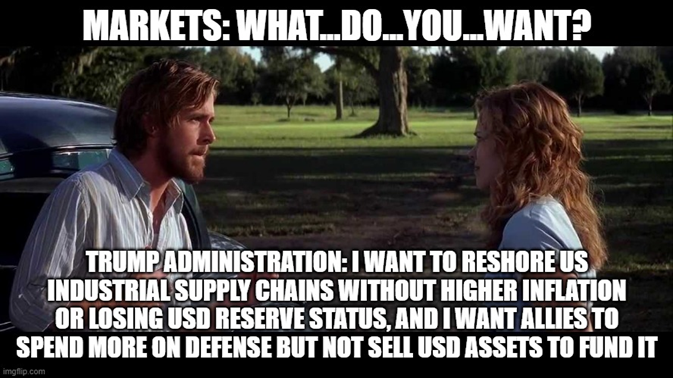
The theme of our conversation on this Monetary Matters pod with @JackFarley was this scene in "The Notebook":
"What...do...you...WANT?" [Reshore/win the AI race v. China or maintain the real value of the UST market - can't do both.]
Thank you for having me on again Jack!
In 2015, I marched for Bernie and donated to his campaign.
In 2019, after years of being a miserable democratic socialist who blamed everyone else for my sadness, I decided that I couldn’t stand being a miserable fuck anymore, and needed to start taking risks and aggressively started doing stuff to change my life.
I started working multiple jobs. I had 3 I was juggling at one point. I funded my life with one of them, and with the additional jobs, I invested all of my dollars in Palantir. It was honestly fun. Yeah, I worked 70 hours a week usually and sometimes would go 60 days without a day off, but it was exhilarating. I was making changes and doing things. It was way better than being miserable and angry and making my entire identity about politics and my disdain for “the rich.” Those were hopeless times and I was glad to be doing something for myself.
I was able to grow a portfolio of 4,000 Palantir shares at an 8 dollar cost basis between 2021-2023. 32,000 dollars from hardcore grinding. Between 2023-2025, that 32 grand grew to over 400 grand. In May 2024 I started rotating some of the profits into TSLA, along with purchasing with new income.
I’ve learned so much about capitalism since 2019, how wealth is created, and the difference between makers and takers. I’ve been inspired by so many amazing builders and entrepreneurs on this platform. I’ve even interacted with many of them. Totally surreal.
Today, I cheered in my car as it drove me home when I heard that Elon’s pay package was approved. I voted my 750 shares on it with a huge grin on my face. If Elon gets paid 1 trillion dollars, I will be a multimillionaire.
After all I’ve been through and after everything I’ve done for myself over the last 10 years, I look at this post by Bernie and know I would’ve cheered it on in 2015, but today, I see it for what it actually is. Manipulative, depressing rhetoric intended to depress a base of voters and make them feel hopelessly dependent on him and his colleagues. None of them build anything or create value or give working class people like me the opportunity to peg my labor against their genius. They did nothing but make me miserable.
I hope even one person can read this get pumped to start doing shit. There are ups and downs, but it’s yours. Nobody can take your grind away from you. Kick ass and build over years of time and watch what happens along the way. Don’t listen to sad miserable people like Bernie.
Sometimes, things are so dark that I find myself heeding Friedrich Nietzsche’s warning:
"Do not fall victim to excessive idealism and believe that telling the truth will bring you closer to people. People love and reward those who can soothe them with illusions.
Since ancient times, humanity has only punished those who speak the truth. If you want to stay among people, share their illusions. The truth is spoken only by those who are ready to depart."
A civilization is built on a set of internalized values. Numerous civilizations have developed radically different visions of how to organize societies, and these have competed in process akin to Darwinian selection in establishing which civilizational ethos permits for maximal flourishing. American exceptionalism is one such system and it has yielded the greatest society that the world has ever known. Suicidal empathy is going to destroy it because Western tolerance is its fatal Achilles tendon. Remember my words.
One of my regrets about the Twitter Files is that I think we failed to convey the scale of the ideas being envisaged, like common international databases of speech offenders or the use of “content moderation” to re-shape the public’s understanding not just of news, but history.
⚡️What you’re looking at isn’t a pay gap. It’s a purpose gap.
Married men don’t just earn more because of structure or discrimination. They earn more because their identity collapses into duty. Once a man feels that another life depends on him, the entire motivational architecture of his psyche changes. His risk tolerance, discipline, and time preference all compress toward one goal: security.
Survival. Continuity.
That’s what the line is measuring - not productivity, but existential pressure.
Single men and women operate primarily in an individual optimization loop - balancing personal fulfillment, freedom, and income. Married men, however, enter a different economic game: they become system nodes. They internalize a microcosm of civilization’s survival logic - build, provide, protect.
Every hour worked is no longer abstract; it’s a direct expression of identity and value.
This is why marriage historically stabilized civilizations. It wasn’t moral; it was energetic. It turned individual potential into collective resilience.
Now look at the chart again. Notice how married women’s earnings rise but plateau earlier. That’s not biological weakness, that’s systemic design.
Modern economies still extract their full output while structuring time and reward systems that punish maternal or relational investment. They run on infinite labor assumptions built by and for atomized producers.
So the divergence doesn’t mean “men work harder.” It means:
•Men are rewarded for collapsing into the system.
•Women are punished for splitting their energy between the system and life creation.
•And single individuals, lacking external gravitational pull, oscillate within a freedom that rarely compounds into stability.
The illusion of a “gender pay gap” misses the real structural revelation: the economy rewards sacrificial alignment to its machine logic. Married men embody that logic most fully and therefore are compensated as extensions of the system itself.
But there’s a darker layer. This dynamic only holds in civilizations that still believe in family continuity. As family formation collapses, that energetic conversion mechanism - the transformation of responsibility into productivity - dies with it. That’s part of why growth is stagnating even as technology explodes. The system has optimized for individuals, not households, and in doing so has severed its own motivational engine.
So what the chart really says, at its deepest level, is this:
When men stopped being needed, civilization stopped expanding.
When women were forced to become self-sufficient, creation became a cost.
And when meaning no longer passes between people, work stops compounding into legacy, it just becomes labor again.
This is really about the death of shared purpose.
And the line that rises is just the last heartbeat of a civilization that once remembered why it worked at all.
“The one thing money can’t buy,” said Luckey, “is people who liked you before you had money. I’m very lucky that I met my wife back when I had literally nothing. When we met, I had less than $300 in my bank account … I probably should have gotten married, should have married her when I was 16. Looking back, I think that’s probably my radical belief.”
https://t.co/7L9EqhyL2N
What comes next for AI? Perhaps physically specific intelligence, more than artificial general intelligence.
Here’s a draft thesis.
(1) First, AI is now entering the trough of the hype cycle. Every tech, no matter how amazing, goes through this. It’s actually one of the best times to invest and build once the space begins to thin.
(2) Second, AI is both highly useful for search, summarization, visualization, and prototyping *and* a highly annoying source of spam, scams, and slop. Too many will focus solely on the downsides.
(3) Third, the exact plateau of AI is quite unexpected. The fact that current models seem to have topped out at “far better web search and summary” is not where most would have pegged it in 2022. Disrupting Google is a historical accomplishment, yet it’s not the machine god.
(4) One thesis for why models plateaued in this way is that LLM-style digital AI really *is* just repeating, rather than truly thinking. It is downstream, not upstream. Now, you can get much further with this than most thought. But you can’t get all the way to novel thoughts.
(5) That leads to another point: as I’ve said before, digital AI does it middle-to-middle, not end-to-end. Because the bottleneck for digital AI is prompting and verifying.
(6) However, *physical* AI — in the sense of robotic guidance — *can* feasibly do things end-to-end, albeit after the investment of a lot of energy on edge cases. For example, self-driving cars now truly can take you from point A to point B. They do it end-to-end.
(7) So, extremely well-specified and economically valuable physical world problems like “drive from point A to point B” are where we should see significant AI progress. Call this physical specific intelligence.
(8) Chinese robots in particular will nail task after task, in many form factors beyond just cars or humanoids. Sidewalk robots and delivery drones are already live in China, alongside self-driving cars, and their hardware sector is accelerating.
(9) One reason to be more short-term
bullish on physically specific intelligence rather than artificial general intelligence is that the physical world is real while the digital world can be fictional. @drfeifei made the related point that the textbook concept of simultaneous location and mapping (SLAM) is actually an explicit physical world model, something we’ve all known is lacking in the digital realm.
(10) In particular, if you have N different robots all doing SLAM (or equivalent) and uploading their sensor data to a central database, they are all in a sense learning from the same physical world and each other. The millions of training miles driven by self-driving cars show that this strategy works.
(11) Contrast this to the digital world. Text can be fake, it can be fictional, and indeed it is often so. And this is doubly so as AI text permeates the web.
(12) So N robots sensing the physical world will converge on a consensus reality. A Unitree robot and a Tesla robot will perceive the same objects. By contrast, N agents in the digital world just keep ingesting text and images, which can and will be inconsistent.
(13) In the absence of digital signatures, the online data used for AI training will be not just internally inconsistent but fake in subtle or deep ways. Indeed, widespread AI models ensure that much digital data (outside hard digital borders) will become fake, or slop, or AI agents talking to each other.
(14) Algorithmic breakthroughs could obviate everything I’ve just said. But at least right now, the field seems wide open for physically specific intelligence.
(15) The industrial version of physically specific intelligence is factory robots. The consumer version though is a garden of intelligent things: robot cars, dogs, drones, fridges, and the like that can talk to you and understand you. Amazon Alexa, but for everything?
Democrats underestimated Republicans, and lost the meme war. Republicans underestimated China, and are unfortunately losing the trade war. And some in China may underestimate the free Internet, where choice can triumph over force.
This requires some explanation. Let's go.
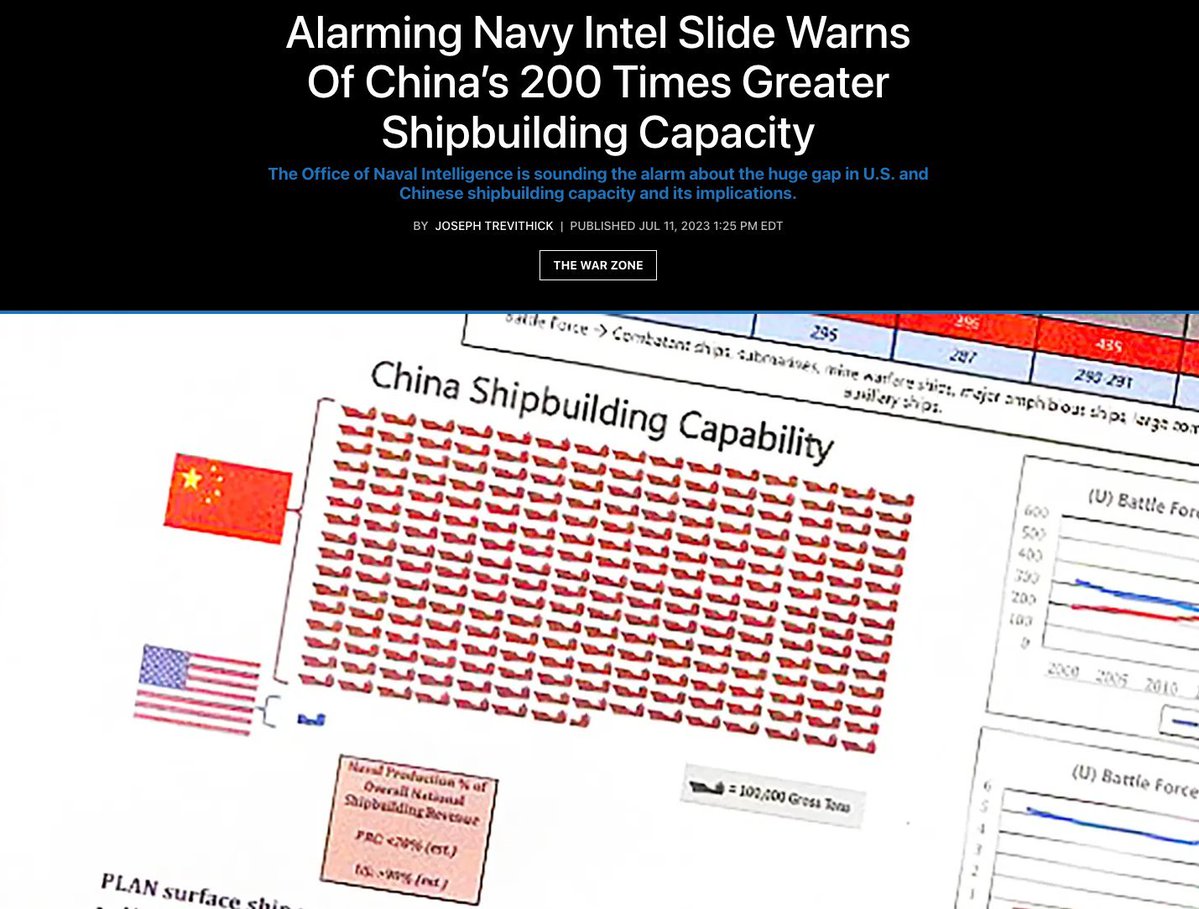
(1) First, as a reality shill, we should stipulate that modern China is perhaps the most physically formidable country to ever exist. Visualize a young Bolo Yeung from Bloodsport. It's #1 in electricity, cars, steel, ships, and countless other industries. No country can realistically win a war against today's China, especially in its own backyard, especially over Taiwan. They can just outbuild everyone else:
(2) And the US on some level now recognizes this. Secretary Hegseth noted on the Shawn Ryan pod that Chinese hypersonics can sink all US aircraft carriers in the first 20 minutes of any Taiwan straits conflict[1]. The CEO of Raytheon admitted[2] the US couldn't practically decouple from China. The former Secretary of the Navy, Carlos del Toro, stated[3] that one Chinese shipyard can produce more ships than the entire US Navy combined. And the Pentagon's own $400M study[4] showed that much of the US military is actually made in China:
(3) This may be why the US is currently effecting a shouting retreat. Even as the military is rebranded to the Department of War, US troops are reportedly[5] being pulled back to actually focus on homeland defense and the war within. And even while there's posting about annexing Greenland and invading Canada, in reality European NATO is being asked to fend for itself. Basically, the words are about expanding American real estate, but the reality is that America is withdrawing from the world:
(4) Now, some will say this isn't a bad thing. After all, America is a republic, not an empire! OK, but the business model of the US is money printing, which is premised on the continuation of global empire. That's because dollar inflation is global taxation, since the inflationary dilution is currently spread across billions of global dollar holders. However...as US troops come back and US tariffs go up, the de facto tax base for dollar inflation shrinks from ~1-3B globally to just 330M Americans. That 67-90% drop in tax base will cause a huge drop in American living standards. We're in the middle of this now; gold and digital gold are smashing all time highs[6], because the dollar is crashing through all-time lows.
(5) Moreover, because the sovereign debt crisis is underway in America, Western Europe, and Japan at the same time, you're seeing a simultaneous fall of all parts of the empire at once. As you can see from the graphs below, yields are high in the US, Germany, Japan, UK, Italy, and France...even as they're falling in China...and even as the world economy has decisively moved to Asia:
(6) So, we are essentially in the midst of the fall of Rome[7]. For the first time in 500+ years, the world's dominant military power is no longer Western. While the shift towards Europe took hundreds of years, the shift back to Asia took just a few decades. It happened so fast that many don't realize that the world economy has already moved back to Asia.
(7) Many Westerners are still in various stages of denial about this fact, or the fact that the US government is insolvent. Elon is our best guy, and gave it his all, and he's already recognized[8] that it's over ("did my best"). But there's still residual romanticism about America's ability to re-industrialize.
(8) In many ways, MAGA still identifies as a manufacturing superpower, and they just don't want to hear that it took 45+ years of grinding in factories for China to get where it is, and that 45% tariffs won't return America overnight to the economy (let alone the demographics) of 1945. There may be a post-dollar path to rebuilding, but it'd be like Russia's post-Soviet path. And the first step in that path would look more like deregulation and special economic zones[9], rather than tariffing away America's access to raw materials and machine tools.
(9) Anyway, I want to skip over the dollar collapse part of all this, because it'll be an unfortunate denouement to what was once the greatest empire of all time. Let's skip ahead to the next question of: what force could possibly rise to balance China after the dollar ends?
(10) Well, after the Roman Empire fell, Christianity endured, and was eventually the seed for civilizational rebirth. Similarly, after the dollar empire ends, the Internet will endure — and could be the seed for civilizational rebirth.
(11) Think of the progression from European Christendom, to the West, to the Internet. Each such shift was a geographical and technological and demographic change[10]...but most of all it was a change in self-understanding.
(12) We already know on some level that the Internet is the most powerful force in the world. It manages 99% of transactions and communications, it's upstream of every politician and election, it controls everything from smart locks to autonomous drones, and it's even in front of your face right now.
(13) Nevertheless, because it's currently[11] intangible, the Internet is still underestimated. The Chinese state does actually get it on some level, which is why they built the Great Firewall as a hard digital border that keeps out foreign ideas (and foreign drones). But post-Maoist China doesn't really have an ideology that's built for export. Chinese nationalism does make intuitive sense to ~1.4B Chinese, so it has sufficient scale to coordinate huge numbers of productive people domestically...but the other 7B+ globally will need something else.
(14) That is: China is a goods exporter, but an idea importer. After all, its three major operating systems of Buddhism, Communism, and Technocapitalism were imported from India, Europe, and America respectively. To be fair, China did fork these operating systems, and made them their own (eg: communism with Chinese characteristics), and China does have an impressive 5000+ year history of arts and literature. But for whatever reason, Chinese culture mainly exports visual vibes (eg TikTok, Hong Kong cinema, glowing cities) rather than verbal ideas.
(15) So, because China doesn't export a conceptual operating system that anyone in the world can adopt and fork, there will be a post-dollar ideological vacuum that's only incompletely filled by a return to nationalism. Many need something higher than the mere earth, and the cloud is something higher. The next Rome, the next Britain, the next America, the next universalist society — that will arise from the Internet, which after all is uniform rule-of-code.
(16) Finally, to @JZ281C's point...these Internet societies cannot and should not physically confront China or (as they put it) interfere in China's internal affairs. Against the Chinese drone armada, you'll still need some residual local deterrence, but the Internet will mainly need to rely on Gandhian non-violence, invisibility, agility, encryption, and decentralization. You just can't take on a superior physical force in the physical world.
(17) Still, because the Internet is intangible it will be underestimated, and this underestimation is itself a strength. The invisibility of the Internet, the dismissibility of it, is the English-compatible version of hide your strength and bide your time. Despite the fact that billions spend much of their waking lives on the Internet, it's still not thought of as the primary organizing principle of their life. This underestimation gives us room for the long rebuild on Internet First[12] principles.
(18) Specifically: the Internet will not be able to take on China in the physical world, but it will generate universalist ideas that appeal to many Chinese (and non-Chinese) people. It will therefore provide many alternative ideologies to Chinese nationalism outside China, whose collective strength may balance (not beat) China.
(19) How does this play out? We could see a billion-person Chinese superstate, and a thousand million-person network states. If one is a vegan village and the second a carnivore community and the third is a biohacker borough, these societies are mutually incompatible with each other. Moreover, their governing ideas can't all be imported into China as their moral premises are different from Chinese nationalism. So these network states become alternatives to China, balances to China, without needing to fight China.
(20) We'll know they're a balance if Chinese nationals voluntarily choose to exit to one of these 1000 startup societies, as an alternative to the 100s of polished Chinese cities. They might do this for much the same reason one chooses a startup over Google: because of the upside, the choice, the variety, the editability.
(21) Yet at the same time the mere existence of these alternative societies around the world wouldn't provoke China. And China wouldn't gain from conquering them, as they'd want to avoid the expensive Roman/British/French/Soviet/American failure mode of endless military intervention. Even if it did conquer some, it couldn't really conquer one thousand, if new startup societies kept popping up every day.
(22) In other words: ideas are upstream of men, code is upstream of drones, private property is private keys, and the keyboard may yet prove on par with the sword. The creation of alternative societies is one model for how the Internet may eventually balance China.
If you're trying to understand why gold is going parabolic, please read this thread. This is also why the 52% of Americans who do not own financial assets are being destroyed. What is the real rate of inflation? And, absent the Fed, what would interest rates be...? A 🧵👇