I would have assumed it was fairly obvious, but in case it's not: a million-line codebase (also known as a "harness"), running at inference time, orchestrating thousands of calls to a neural network for any given task, is the exact definition of a "neurosymbolic architecture"
YC startup called something like Descartes AI founded by a couple of UChicago sophomore philosophy dropouts that makes RL envs for self-awareness and epistemic humility who's building this
Prime Agent is a general-purpose coding harness
On ARC-AGI-3, it scores 95.5%, surpassing the human-expert baseline, but the gain is not benchmark-specific.
We see major improvements across models when compared to their proprietary harnesses:
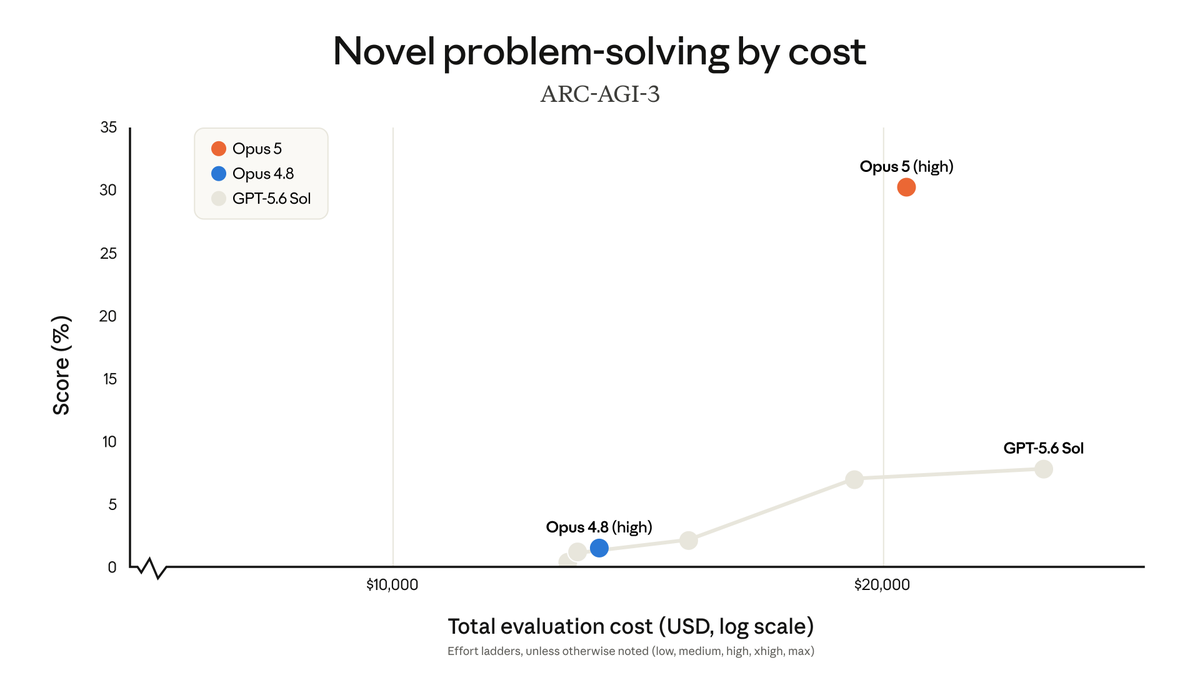
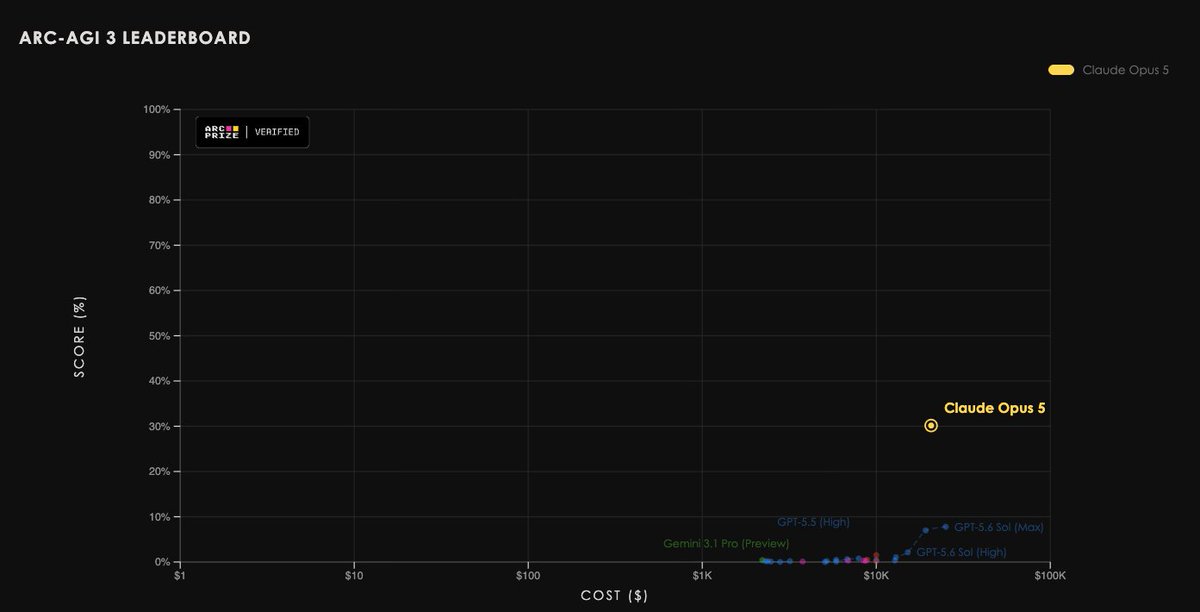
Claude Opus 5 from @AnthropicAI is the new SOTA on ARC-AGI-3: 30.2%
The previous high score (7.8%) was set by GPT-5.6 Sol (Max)
Throughout our analysis, we observed novel behavior that allows Opus 5 to solve previously unbeaten environments, outperforming Fable
Why create robot intelligence for just one hand, when we could have it learn from many?
GEN-1, our latest embodied foundation model, now supports a broad range of end effectors from 5-finger hands, to specialized tools, and everything in between.
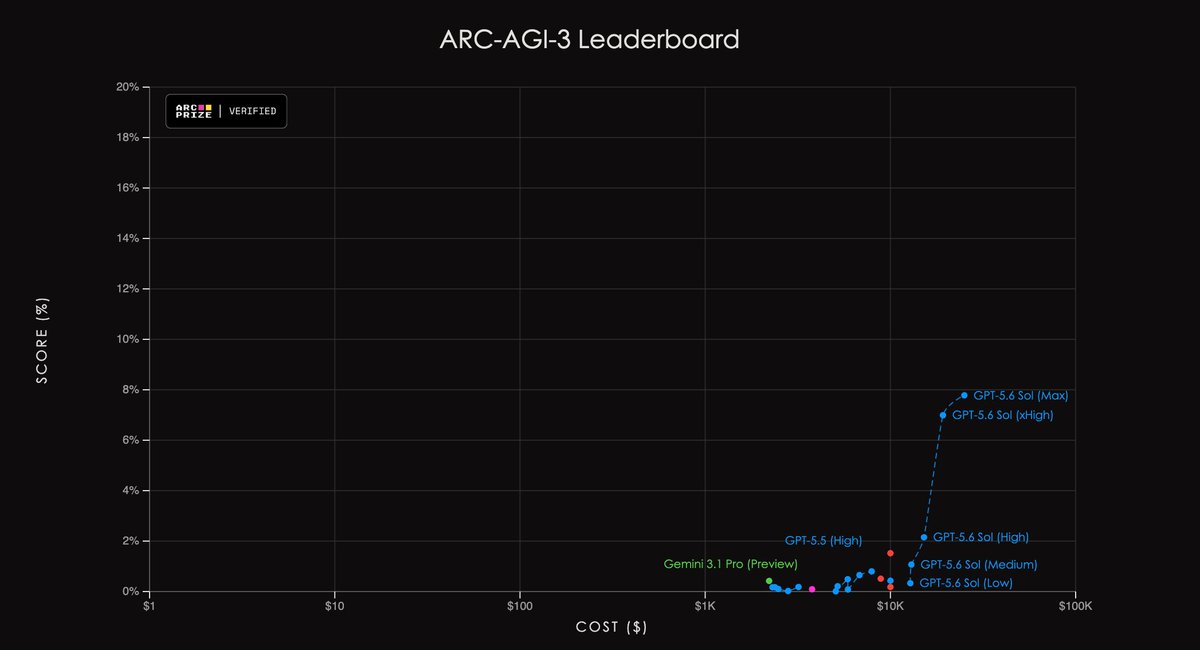
GPT-5.6 Sol sets a new SOTA on ARC-AGI-3: 7.8%
Sol is the first verified frontier model to ever beat an ARC-AGI-3 game
It is the best model at orienting in a situation it's never encountered
Zyphra is sharing our first work in continual learning where we study: Can LLMs learn forever from new data?
Many see continual learning as a path to AGI through recursive self-improvement (RSI).
The first obstacle is plasticity loss. We derive a scaling law for its onset 🧵
Today, we enable AutoResearch in the physical world for the first time! Introducing ENPIRE: we give 8 Codex agents a fleet of robots, an allocation of GPUs, and generous token budget. We set them free with a simple goal: solve the task as quickly as possible, keep the robots busy but stay safe, don't waste precious compute. Make no mistake.
Then humans step aside and our watch begins. The robot fleet starts to come alive: they learn to look for visual clues, reset the scene, practice novel skills, tinker with control stack, read papers online, debate, reflect, get stuck, and try again directly on the hardware. All we did is to give Codex an API to the world of atoms, and the rest is emergence.
ENPIRE is able to solve high-precision tasks like tying zip-ties, organizing fine pins, and installing GPUs all by itself. We also discovered a new type of "physical scaling": 8 robots exploring in parallel improves significantly faster than fewer ones.
A part of our NVIDIA GEAR lab now self-improves tirelessly over night. We just read the reports in the morning.
/goal: we all take a holiday and Jensen wouldn't even notice ;)
We will be open-sourcing everything, so you can host your self-running robot lab at home too! Deep dive in the thread:
Our mission is to make it easy for anyone to deploy a robot to help them in the real world
We wrote an intuitive guide to understanding modern robotics, catered toward an audience that understands technology but not AI robotics
We hope that this short blog post embeds in you the core principles that will bring further curiosity.
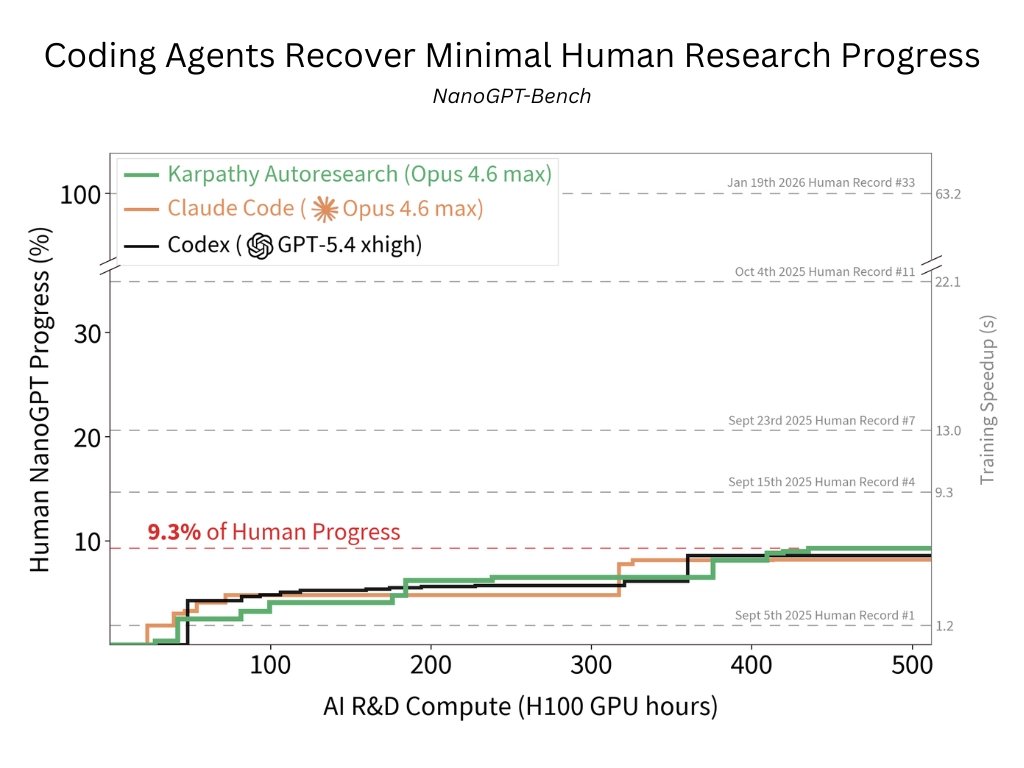
Can coding agents do research?
We release NanoGPT-Bench, an internal eval we’ve used to test agents on an AI R&D problem with months of human progress
Codex, Claude Code, Autoresearch recover only 9.3% of human progress, mostly tuning hyperparams & ignoring algorithmic research
NanoGPT-Bench is built on the NanoGPT Speedrun, a popular LLM pretraining competition to minimize the training time of a GPT-2 style model. Existing human submissions constitute nearly 2 years of work. To control for dependencies and contamination in frontier models, we standardize evaluation to a 5-month window of world records. Evaluation is fully autonomous and end-to-end, with no human intervention or internet access. 🧵
Introducing Aurora, a new optimizer for training frontier-scale models.
We train Aurora-1.1B, which achieves 100x data efficiency on open-source internet data. Despite having 25% fewer parameters, 2 orders of magnitude fewer training tokens, and using fully open-source internet-only data, Aurora matches Qwen3-1.7B on several benchmarks.
Aurora was developed after identifying a major failure mode that can occur under Muon, an increasingly popular optimizer that has shown strong gains over Adam(W). We find that Muon can cause a huge percentage of neurons to effectively die early in training, reducing effective network capacity so that many parameters no longer meaningfully contribute to network outputs.
By redistributing update energy more uniformly across neurons while preserving Muon’s stability properties, Aurora prevents neuron death and recovers substantial model capacity.
What makes this work especially exciting is that it points toward a broader direction for ML research: better optimizers may not come purely from elegant mathematical abstractions, but from understanding and addressing the concrete dynamics and pathologies that emerge inside real training systems.