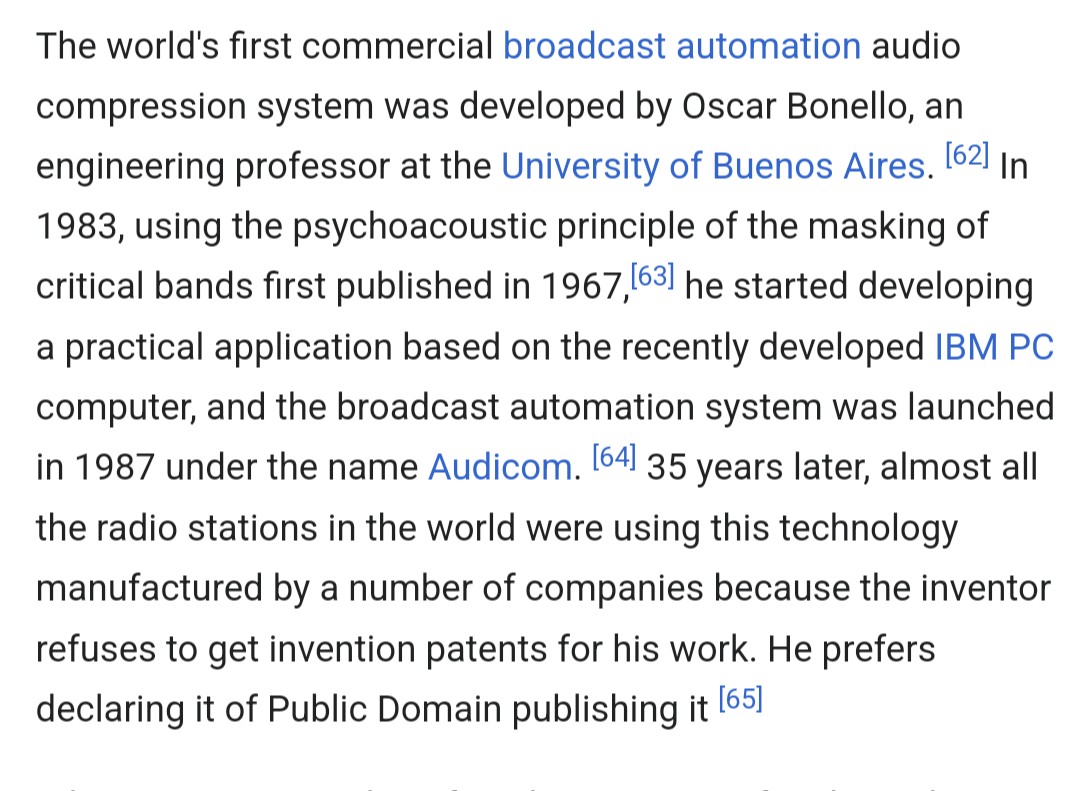
ups, curioseando sobre algoritmos de compresión me encuentro con esta joya. lastima que el bruto de @JMilei no pueda entender lo mal que le hace a la sociedad desfinanciar la ciencia... en especial la argentina, con una moral inspiradora
🗓️Este sábado tenemos el honor de estar presentes en el evento #FOCO organizado por los amigos de @AGCArgentina en @Exactas_UBA donde estaremos conversando sobre Infraestructuras Públicas Digitales y Soberanía informática! 🇦🇷
https://t.co/0FgJs1iCX9
sillicon valley esta lleno de estas personas (twit del 2023) tan desconectadas de la realidad (y de la historia) que reinventan conceptos todo el tiempo.
aca vez a uno descubriendo UNIX... 50 anos despues 🤦 🤦♂️ 🤦♀️
imaginate cuando "descubran" la milanesa con fideos
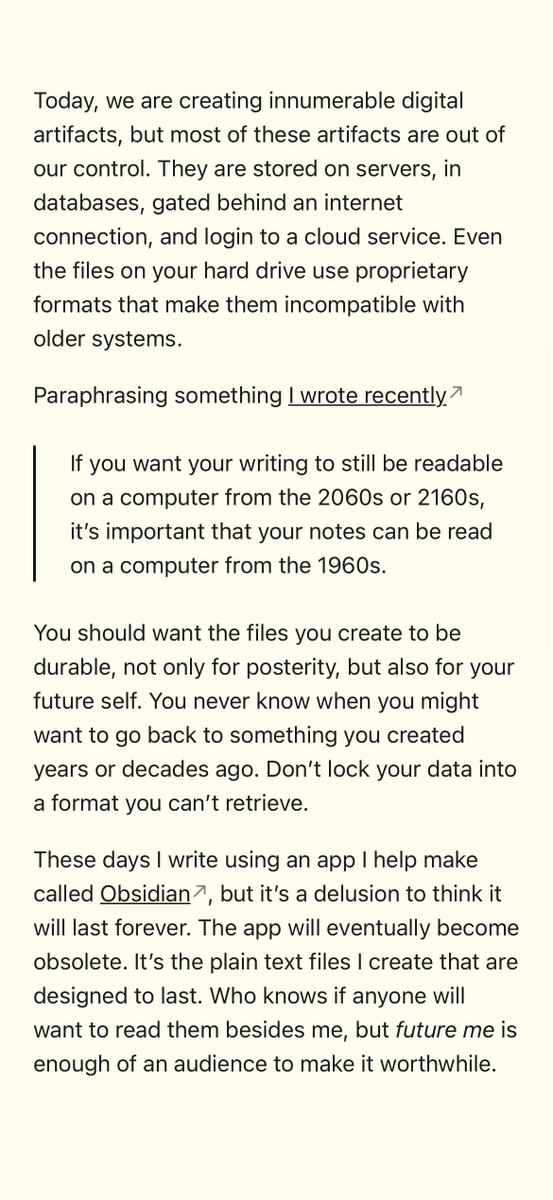
File over app
File over app is a philosophy: if you want to create digital artifacts that last, they must be files you can control, in formats that are easy to retrieve and read. Use tools that give you this freedom.
File over app is an appeal to tool makers: accept that all software is ephemeral, and give people ownership over their data.
In the fullness of time, the files you create are more important than the tools you use to create them. Apps are ephemeral, but your files have a chance to last.
The pyramids of Egypt contain hieroglyphs that were chiseled in stone thousands of years ago. The ideas hieroglyphs convey are more important than the type of chisel that was used to carve them.
The world is filled with ideas from generations past, transmitted through many mediums, from clay tablets to manuscripts, paintings, sculptures, and tapestries. These artifacts are objects that you can touch, hold, own, store, preserve, and look at. To read something written on paper all you need is eyeballs.
Today, we are creating innumerable digital artifacts, but most of these artifacts are out of our control. They are stored on servers, in databases, gated behind an internet connection, and login to a cloud service. Even the files on your hard drive use proprietary formats that make them incompatible with older systems.
Paraphrasing something I wrote recently:
> If you want your writing to still be readable on a computer from the 2060s or 2160s, it’s important that your notes can be read on a computer from the 1960s.
You should want the files you create to be durable, not only for posterity, but also for your future self. You never know when you might want to go back to something you created years or decades ago. Don’t lock your data into a format you can’t retrieve.
These days I write using an app I help make called Obsidian (@obsdmd), but it’s a delusion to think it will last forever. The app will eventually become obsolete. It’s the plain text files I create that are designed to last. Who knows if anyone will want to read them besides me, but future me is enough of an audience to make it worthwhile.
@kepano I will try it! if you have a good place to buy meat follow this recipe. I usually bake them in the oven but fried are tastier off course https://t.co/bxVgdtqTrI
"El country es la muestra del fracaso de una sociedad"
🗨️ Pedro Saborido, escritor y guionista, alertó sobre el acostumbramiento a "la violencia, las injusticias sociales, al desinterés o a vivir con el miedo".
"El country es la muestra del fracaso de una sociedad"
🗨️ Pedro Saborido, escritor y guionista, alertó sobre el acostumbramiento a "la violencia, las injusticias sociales, al desinterés o a vivir con el miedo".
@kepano 1) i stand corrected, claim still valid 😛
2) si hubiera una referencia lo hubiera tomado como tal
3) la clave es la milanesa, no la pasta. ojala puedas probarla
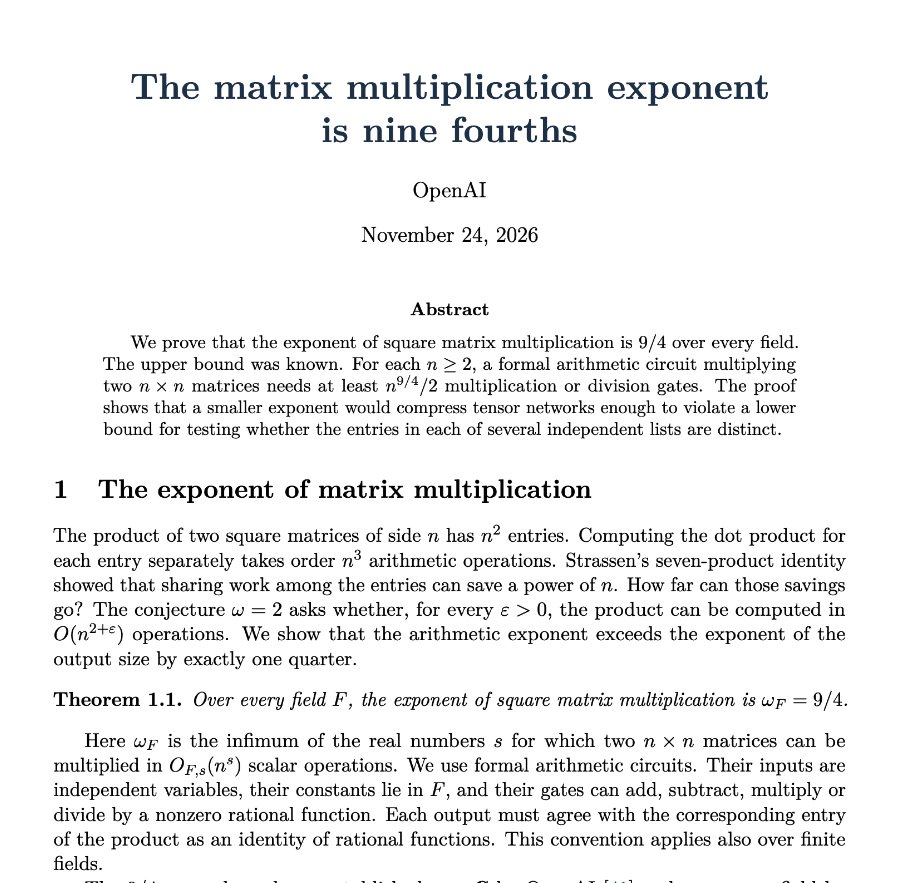
OpenAI claims the matrix multiplication exponent is exactly 2.25
The textbook method for multiplying two n × n matrices takes roughly n³ arithmetic operations. In October, OpenAI reported a way to bring the exponent down to 2.25. That left open whether someone could find an even faster algorithm
Today’s paper claims to rule out every exponent below 2.25
Read here: https://t.co/GXn451OiYf
CODE RED AT MICROSOFT
Leaked internal memos just exposed a full scale Code Red panic inside Microsoft, and it proves the modern internet is built on a house of cards.
Reuters just revealed that Microsoft leadership declared an urgent Code Red overhaul after their historic 24 hour global blackout earlier this month.
Inside the leaked memos, M365 Core President Jason Henderson admitted it was the worst meltdown in Exchange Online history, with engineers trapped in a total fog of war while the world went dark.
Look at how easily one hidden flaw paralyzed the planet for an entire day.
A single undetected Windows defect had been sitting quietly inside Microsoft servers since July.
When routine traffic shifted on November 12, more than 80 percent of Microsoft's networking gateway servers suddenly froze.
Outlook, Teams, Exchange Online, and Copilot crashed across more than 70 countries.
Governments from Washington to Tokyo and Australia were disrupted, trading firms faced delays, and airline communications broke down.
Now Microsoft is scrambling to stop a complete collapse in trust, rushing to deploy AI agents and promising to fix future global outages within an hour.
For years, Big Tech told banks, airlines, and governments that the cloud was unbreakable.
One silent software flaw just proved the entire digital world is a single point of failure away from chaos.
@FabianoCaruana 's reaction to Magnus skipping games at Total Chess:
"It is kind of unheard of to purposely not play games."
Not a protest, he says, but picking and choosing games while staying in the match. Fair or a line crossed?