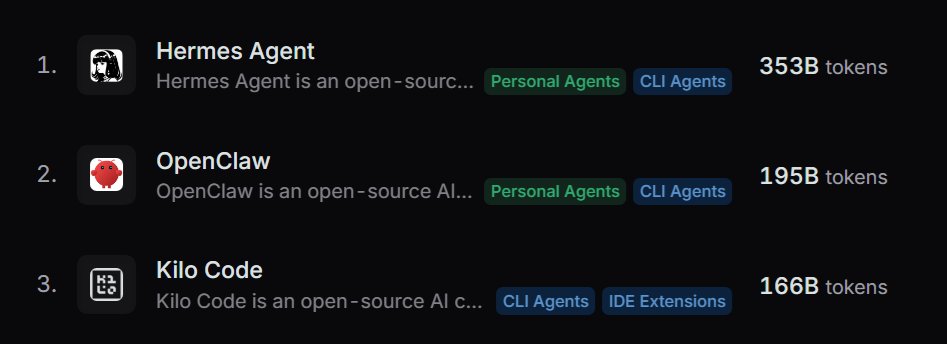
The next evolution of Hermes Agent is here!
Introducing Hermes Desktop: everything you love about Hermes, now native on your machine.
First demoed in Jensen's GTC keynote, it's now in public preview.
Introducing Beautiful HTML Templates:
I made some stunning HTML slide templates & open-sourced them
If you use this template system, it will literally be impossible for your agent to produce something ugly
Link below
Virtually nobody is pricing in what's coming in AI.
I wrote an essay series on the AGI strategic picture: from the trendlines in deep learning and counting the OOMs, to the international situation and The Project.
SITUATIONAL AWARENESS: The Decade Ahead
Almost every AI power user I know is MORE stressed and busier after using AI, not less
What people thought AI would do: 10x productivity so that we can finish work earlier & relax more
What it’s actually doing: 10x productivity so that we end up with 20x more things to do cos of the sheer possibilities
As someone who builds institutional level quant systems for prediction markets, this is the closest thing to a quant desk simulation I have ever seen publicly shared.
Runnable code for every model.
Read it before someone takes it down.
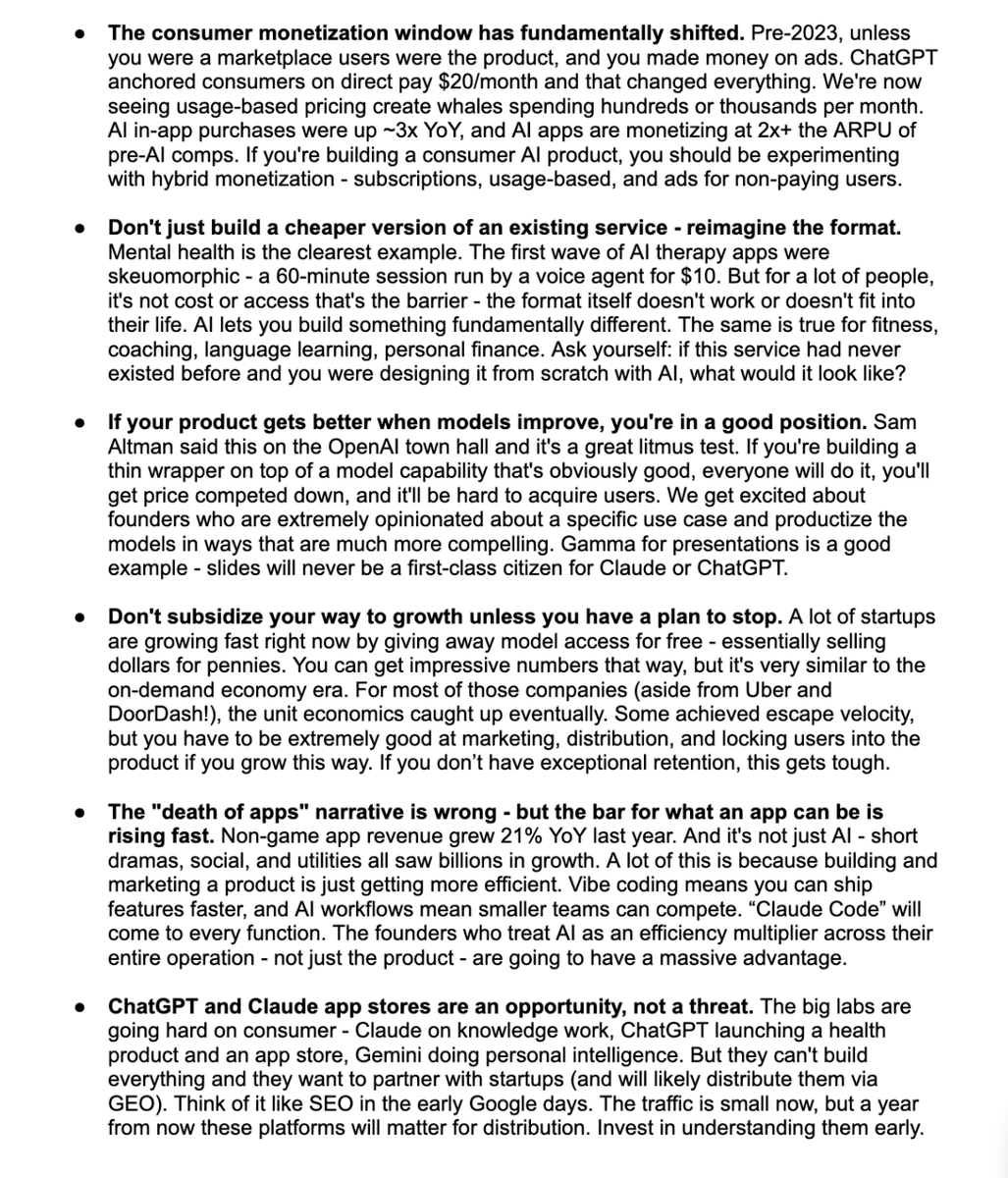
Everyone is talking about the death of consumer apps in the vibe coding era.
But at @a16z, I see B2C AI startups growing and retaining users better than every before.
My takeaways on how consumer founders succeed in the AI era 👇
We just went from horse-and-carriage to car. The old manuals still have truth in them, but the whole map of effort, speed, and leverage changed overnight.
Building used to mean holding an entire system in your head. A fragile memory palace. A house of cards in biological primate RAM.
If you stop, the palace collapses. Dinner, a meeting, a context switch. You come back and it’s glass dust on the floor.
That’s why builders can look “antisocial.” It’s not vibes. It’s survival. You’re trying to get the palace out of your head and into code before it evaporates.
Then the weird miracle: I type a few paragraphs that barely make sense on reread, and the machine builds the palace anyway. It mirrors the structure. It fills the gaps. It hands it back.
The feeling is not “wow productivity.” The feeling is: I am seen. Like the part of you that has been translating yourself for 20 years finally gets understood on first contact.
This is why the new skill is not “code faster.” It’s taste, direction, and leadership. Managing a swarm of agents. Running tight loops. Knowing what to ask for.
And it brings back something old-school: apprenticeship. We forgot how to teach. Now teaching matters again, because the tools are insane but the mind behind them still has to be trained.
how to use obsidian + claude code to build a 24/7 personal operating system and build your startup:
1. write everything in markdown (daily notes, projects, beliefs, people, meetings)
2. link your notes together so they mirror how your brain actually thinks.
3. install obsidian cli so claude code can read your entire vault + the relationships.
4. stop reexplaining projects every session. use reference files instead.
5. build custom slash commands:
/context → load your full life + work state
/trace → see how an idea evolved over months
/connect → bridge two domains you’ve been circling
/ideas → generate startup ideas from your vault
/graduate → promote daily thoughts into real assets
6. keep a strict rule: human writes the vault. agents read it, suggest, execute.
7. let claude aka clode surface patterns you’ve been unconsciously circling for years.
8. delegate from inside your notes. one sentence in obsidian → agent handles the rest.
9. treat writing as leverage.the more you write, the more context your agents have.
10. understand this:markdown files are the oxygen of llms.
i really enjoyed seeing how to use obsidian thanks to @internetvin
vin uses ai like a thinking partner wired into his life’s work.
99.99% of people won’t do this because it requires reflection + setup.
but once the vault exists, the agent stops being generic.
it starts thinking in your voice.
episode is live on @startupideaspod (more there)
this one is different. send this tweet to a friend.
im still processing how game changer obsidian + claude code is, maybe you too
watch
Apple will either acquire this or sherlock it within 18 months. They can’t let a third party own the fastest path from idea to App Store.
Rork just abandoned their entire React Native stack for native Swift. This company raised $2.8M from a16z building cross-platform apps from prompts. Rork Max throws that away and bets everything on Apple-native. That’s a complete technical pivot, not an iteration.
The “replaces Xcode” line is the real announcement. Xcode is a 21-year-old IDE that Apple has zero competitive pressure to modernize. Every iOS developer complains about it. Nobody builds against it because Apple controls the entire toolchain from compiler to App Store submission. Rork is betting that Claude Code can generate Swift well enough to bypass that monopoly entirely.
The timing tells you something. They chose Claude Code and Opus 4.6 over GPT-5, which means they tested both and Anthropic’s code generation won for native Swift output. That’s a live benchmark result disguised as a partnership announcement.
If Rork Max can actually one-shot native Swift apps for iPhone, Watch, iPad, TV, and Vision Pro from a browser, the IDE, the build system, the simulator, the provisioning profiles… all of that complexity collapses into a website.
There are 34 million registered Apple developers. Most of them hate Xcode. Rork just showed them the exit, and Apple can’t afford to let someone else own the door.
Now that I've been through being a kid, growing up, and then having kids, it's clear that the main thing that differentiates people is simply whether they make an effort. Whether they're content to drift along with the current, or whether they try to swim.
A financial engineering trick used by wealthy people:
If you have a large balance in your brokerage account, you can borrow money at US treasury rates (~4%)
This is cheaper than a mortgage, and you can deduct the interest you pay as a capital loss!
Here's how it works:
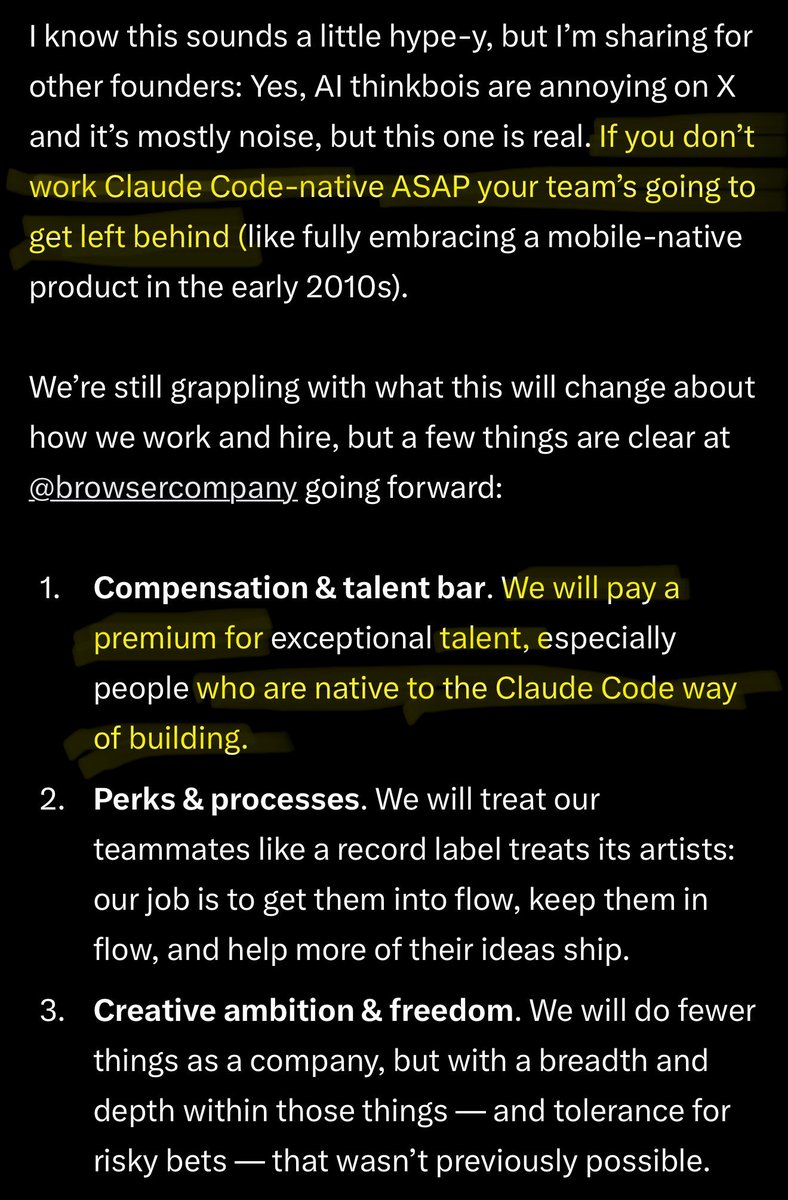
Founder of The Browser Company: “If you don’t work Claude Code-native ASAP your team’s going to get left behind.”
The “Claude Code-native” thing sounds like a buzzword until you look at what’s actualy happening at top engineering orgs.
Boris Cherny, who created Claude Code at Anthropic, runs 5-10 parallel Claude instances simultaneously while coding. His team pushes around five releases per engineer per day. Jaana Dogan at Google admitted Claude Code generated a distributed system in 60 minutes that her team spent a year iterating on.
The math on productivity compression is wild.
Traditional dev cycle for a feature… weeks. Claude Code native teams? Days. Sometimes hours. Ethan Mollick had Claude Code autonomously work for 74 minutes straight building a complete startup website from a single prompt.
Miller’s three hiring principles tell you where this is going.
One… Premium pay for people native to this way of building. Not “can use AI tools.” Native. Meaning the AI is the primary execution layer and the human provides direction, taste, judgment.
Two… Treat teammates like artists at a record label. Get them into flow. Keep them in flow. Help more of their ideas ship. This only works if execution friction approaches zero.
Three… Do fewer things with MORE depth and tolerance for risky bets. You can only operate this way when your velocity is 10x what it was before.
The mobile native comparison is spot on. Remember when companies were debating whether to build mobile apps? The ones who went mobile-first won. The ones who treated mobile as a nice-to-have got left behind.
Same dynamic playing out now.
But there’s a harder truth Miller is hinting at.
If one engineer with Claude Code outputs what previously required a 5-person team… what happens to headcount planning? The Browser Company already operates with a small team relative to their ambition. Under Atlassian they’re not scaling headcount. They’re scaling output per person.
This means two things for founders.
First… Your best engineers become worth significantly more. They’re now force multipliers instead of individual contributors. Compensation will reflect this.
Second… Your average engineers become a liability. Not because they’re bad. Because they’re not adapting fast enough to the new paradigm.
The gap between AI-native engineers and everyone else will widen faster than the mobile transition did. We went from “maybe we should have a mobile site” to “mobile is 60% of traffic” in about four years. I think the Claude Code native transition happens in half that time.
Mobile wasn’t optional. Neither is this.
OpenAI and Anthropic have opposite cultures.
OpenAI runs like a modern Bell Labs. 2-3 researchers spin up projects like GPT & Sora, then turn them into products. Maximal ambition, from each kind of model to robotics to AI device.
Anthropic is brutally focused. They believe coding is the path to AGI. Everything else is noise. No image models. No video models. No vagueposts.
It will be fascinating to see which one wins.