Following the introduction in 2022 of the novel 3-minute step test in swimming (increments: 0.03 m/s), this study demonstrates high reliability of lactate thresholds (TE < 1.4%) and post-exercise VO2 (TE < 7.1%) from this test.
Fulltext: https://t.co/eG3xjklLub
@DSHS_momentum
@IJSPPjournal In this article, we show a high reliability of typical physiological determinants of running performance after (Olympic) triathlon specific cycling preload, which is comparable to running under fresh conditions.
@IJSPPjournal@DSHS_momentum
Now available ahead of print: Reliability of a Triathlon-Specific Test Protocol to Assess Physiological Determinants of Fatigued Running Performance, by Sebastian Keller, Greta Röhrs, & Patrick Wahl. https://t.co/Ctdqo5auyl
With the last issue of 2025, IJSPP is saying "Goodbye and all the best!" to Øyvind Sandbakk (@OyvindSandbakk), the editor for the last four years.
Enjoy reading his summary of this time:
Looking Back, Racing Forward: Four Years as Editor of IJSPP
https://t.co/lyNogBvHzw
We are hiring a PhD student! Come and work with myself, Melissa Hooijmans, and @RobWust on a project aimed at understanding the mechanistic bases of exercise intolerance in ME/CFS. Please RT! @VU_FGB
https://t.co/TsU4hvBou7
📣 New paper out in Scand J Med Sci Sports!
We tested the reliability of running economy (RE) and other physiological parameters during 90 min of running. ➡️ Running economy is highly reliable – even in a fatigued state
🆓 Open access link
📄 https://t.co/i4HDiFqPWi
🧵1/8
Now ahead of print: Durability in Youth Squad Triathletes—Influence of Strenuous Cycling on Subsequent Running Performance, Economy, and Substrate Utilization, by Greta Röhrs, Sebastian Keller (@sebo_keller), and Patrick Wahl
https://t.co/W83KfvO2Lh
Super job @CoachRyanKeatin 👏👏
Many thanks to @sportireland@swimireland & coaches @kandersonswim67 @StevenBeckerleg @jaznenoshark for supporting this project- which provides excellent baseline data across performance levels & utility in talent identification/monitoring 🏊♀️ 👍
New article in @EJAP_official showing a high agreement between the physiological model popularized by @DrMJoyner and lactate threshold 2 in young cycling athletes (N = 83), with sex specific differences in the contributions of VO2peak and oxygen cost: https://t.co/tu6TyZ2OMz
In this paper, we investigated which diagnostic parameters (e.g., VO2max, Economy, LT, dryland strength) are relevant for short- and middle-distance swimming in highly trained female adolescent swimmers: https://t.co/bX6ayvNlId
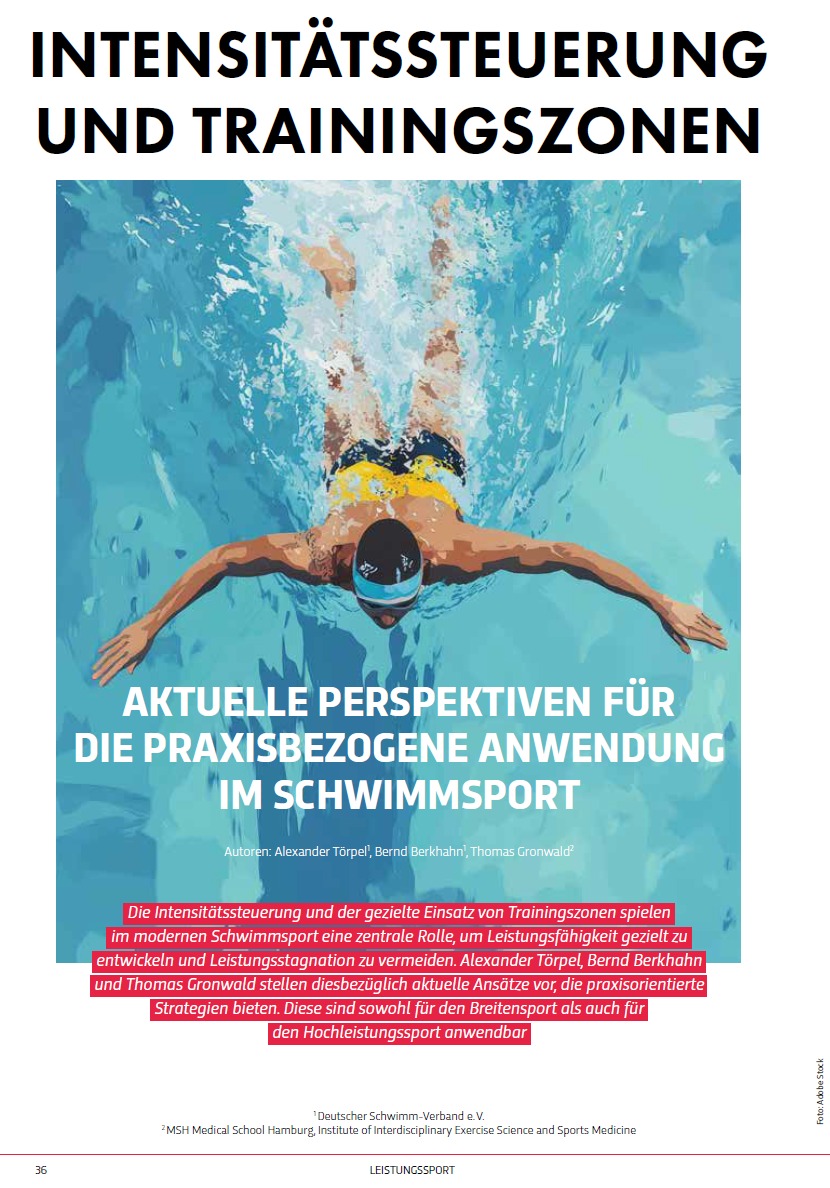
Intensitätssteuerung und Trainingszonen 📈📊🚦🏊
Zwei häufig diskutierte Themenfelder in der Wissenschaft sowie in der Sportpraxis. Zusammen mit @BerndBerkhahn und @G_Ron_Woods haben wir den aktuellen Stand beider Perspektiven vereint dargestellt und ins Schwimmen transferiert.
Diagnostikwoche beim Potsdamer SV zur „Weiterentwicklung leistungsdiagnostischer Methoden zur Bestimmung lagenspezifischer metabolischer und neuromuskulärer Athlet:innenprofile im Hochleistungsschwimmen“: https://t.co/LKHRKls92F
@GonjoTomohiro Nice study! In fact, these findings agree quite well with the v0 contributions we observed for upper- vs. whole-body load-velocity profiling using the front crawl stroke (i.e., ~17%), though we did not control for stroke frequency.
Zu Gast beim Symposium "Science in Swimming": Univ.-Prof. Dr. Patrick Wahl und Sebastian Keller (Abt. Leistungsphysiologie) hielten in Frankfurt einen Vortrag zum Thema "Von der Diagnostik zum individualisierten Training".
Univ.-Prof. Dr. Patrick Wahl (Abt. #Leistungsphysiologie) zu Gast beim Wissensstammtisch - In seinem Vortrag thematisiert er die Bedeutung der Typisierung im #Leistungssport und gibt Einblicke in den Einsatz von #KI-Lösungen: https://t.co/WLnMHYqNaX
momentum goes gold (medal) 🥇- Als Dankeschön für die Unterstützung auf dem Weg zum Olympischen Staffelgold wurde das Team um Univ.-Prof. Dr. Patrick Wahl in der letzten Woche von den Schwimm- und Sportfreunden (SSF) Bonn zur feierlichen Ehrung von @Lasse1996 eingeladen.