And as if all these critical vulnerabilities weren't enough, we've also had several reports about threat actors using AI agents to compromise systems at scale.
This is actually the part that worries me even more.
Some interesting reports from the last few days:
01) ARTEX / ConnectWise
Microsoft reports that Storm-0940 used ARTEX in a large-scale campaign targeting more than 2,250 Microsoft 365 tenants. Up to 2,900 authentication attempts per minute, with privileged cloud access achieved in under three hours in some cases.
https://t.co/vPafbvD1oG
02) ARTEX / South Korean Finance
CrowdStrike found evidence of AI-driven attacks against South Korean financial organizations, including exposed Claude Code sessions and ARTEX configurations. DeepSeek, GLM and Grok were used in the attacker's setup.
https://t.co/kOiEqSEwUi
03) Cairn / 100+ Compromised Companies
NorForge investigated exposed Cairn instances used for autonomous hacking campaigns. More than 1,100 attack projects in one cluster alone. Reuters identified over 100 companies whose websites had been compromised.
Estimated AI costs: around $5 per task, according to NorForge. That's ridiculously cheap.
https://t.co/54Ir7IeY4Q
04) Four More Agentic AI Campaigns
CrowdStrike documented four additional threat actors using AI agents for real intrusion campaigns, including attacks against healthcare organizations and government entities.
https://t.co/rte8LIYL90
What concerns me is how quickly the economics of offensive operations are changing.
Finding vulnerabilities, testing attack paths, adapting payloads, trying something else when an exploit fails, and eventually deploying a webshell. Much of this can now be delegated to agents that keep working for hours.
And with open-weight models and freely available agent harnesses, the cost of running these operations is dropping significantly.
We've been talking about AI changing offensive security for quite a while. These reports show that it's already happening in real-world intrusions.
And I'm pretty sure we're only seeing a fraction of it.
Two very useful posts on monitoring and hardening PHP services, plus an Nmap command to help find them in your environment:
1. Discovery with Nmap
Common and alternative web ports; HTTP headers that may expose PHP versions:
nmap -sT -sV --version-light -T4 --max-retries 1 --open -p 80,81,443,8000-8010,8080-8090,8181,8443,8880,8888,9000,9001,9080,9090,9443 --script http-headers --script-timeout 10s --script-args 'http-headers.path=/index.php,http-headers.useget=true' <target>
Look for X-Powered-By: PHP/.... Fast inventory check; hidden PHP deployments can be missed, and version banners don’t confirm vulnerability.
2. Huntress: Monitoring and detection
• Confirmed facts and remaining questions
• Suspicious PHP child processes, shells and downloaders
• Webshells and other post-exploitation activity
• My process-watcher for Linux process visibility
https://t.co/XLx8za50cZ
3. Vincent Schmalbach: Hardening and patching
• Temporary nginx/Apache filters and upload-progress settings
• WAF/origin bypass checks
• Package and backport verification
• PHP-FPM/worker restarts, container rebuilds
• Side effects and checks for compromise
https://t.co/30YfHmqIcR
Temporary measures are stopgaps. Prepare to apply the official fixes as soon as available.
‼️ PHP2Shell Vulnerability Gets a Public PoC Exploit for Security Testing
Details: https://t.co/wk2fJWlRlx
A public proof-of-concept repository shares verification tools and a lab setup to test two critical PHP vulnerabilities known as php2shell. The flaws, tracked by researchers as CVE-2026-109618 and CVE-2026-109619, are reported to affect PHP’s session.upload_progress feature and could lead to remote code execution under certain conditions.
The release adds technical detail to a fast-moving security issue. PHP’s security team announced that an emergency release would address two critical vulnerabilities, each rated 9.2 under CVSS v4.0, and urged users to prepare to upgrade.
#CyberSecurityNews #CybersecurityAwarenessMonth
PHP
Patch, take it offline, or put it behind a WAF and hope it filters the exploit requests. I wouldn’t count on a configuration-only fix unless one is confirmed.
For inventory, this Nmap command can reveal PHP versions exposed in HTTP headers:
nmap -sT -sV --version-light -T4 --max-retries 1 --open -p 80,81,443,8000-8010,8080-8090,8181,8443,8880,8888,9000,9001,9080,9090,9443 --script http-headers --script-timeout 10s --script-args 'http-headers.path=/index.php,http-headers.useget=true' <target>
Only scan systems you’re authorized to test. This finds advertised versions, not every PHP server, and doesn’t confirm vulnerability.
🚨 PHP2Shell is extremely dangerous. And AI just changed the game.
We tasked OrcaCyber Zero 1.5 (https://t.co/HwAp9B4NHT) with investigating the critical PHP RCE vulnerabilities.
It autonomously built a complete working proof-of-concept (PoC).
Due to the severity of these vulnerabilities and their potentially massive impact across the web, we've decided NOT to publish the exploit code or technical details.
Here's what makes this particularly scary:
Your WordPress could be fully updated. Your plugins could be patched. Your website could STILL be vulnerable because the flaw is in PHP itself.
Millions of PHP-powered websites may be exposed. Not every PHP installation is necessarily exploitable, but the potential attack surface is enormous.
If you're running PHP, upgrade to a supported, security-fixed version ASAP.
🇫🇷🇷🇺 French intelligence agencies have confirmed that Russia-linked bot networks are weaponizing the past weekend's violent riots by flooding social media with old, recycled, and AI-generated fake videos of police brutality to provoke the rioters even further.
Russian networks like "Matryoshka" are acting as digital opportunistic arsonists, intentionally exaggerating the scale of the chaos to simulate nationwide civil unrest.
Fresh @Mandiant and GTIG blog detailing zero day exploitation of CVE-2026-102764 in BeyondTrust Remote Support by 🇨🇳 nexus espionage actor ARMORY CASTLE (fka UNC5221).
https://t.co/v1fGotYhM8
Experts say a wave of cyberattacks on critical infrastructure in Japan is rising due to artificial intelligence, potentially making ransomware more effective. https://t.co/mVlPoJZSte
The Com ecosystem is expanding into a modular, multi-layered network where access, services, and personas drive operations across Hacker, IRL, and Extortion groups, with brand continuity, shared tools, and affiliate dynamics shaping attribution. https://t.co/DSaqjNvwEh
Chinese hackers have been facilitating AI for offensive operations for a while. Frameworks like CyberStrikeAI or ARTEX. But it is not just full attack-orchestration-chains, but often it is MCP tooling like EclipseRecon. Read up on it here: https://t.co/fOiJMGR1jO
Last week some of South Korea's biggest banks were hit by a cyberattack. Thanks to a report from CrowdStrike tonight, we now know the entire hack may have been done by a single person. He used a combined stack of an open-source AI penetration tool named ARTEX, DeepSeek v4.1-Flash, GLM-5.3, Grok 4.6, and Claude Code.
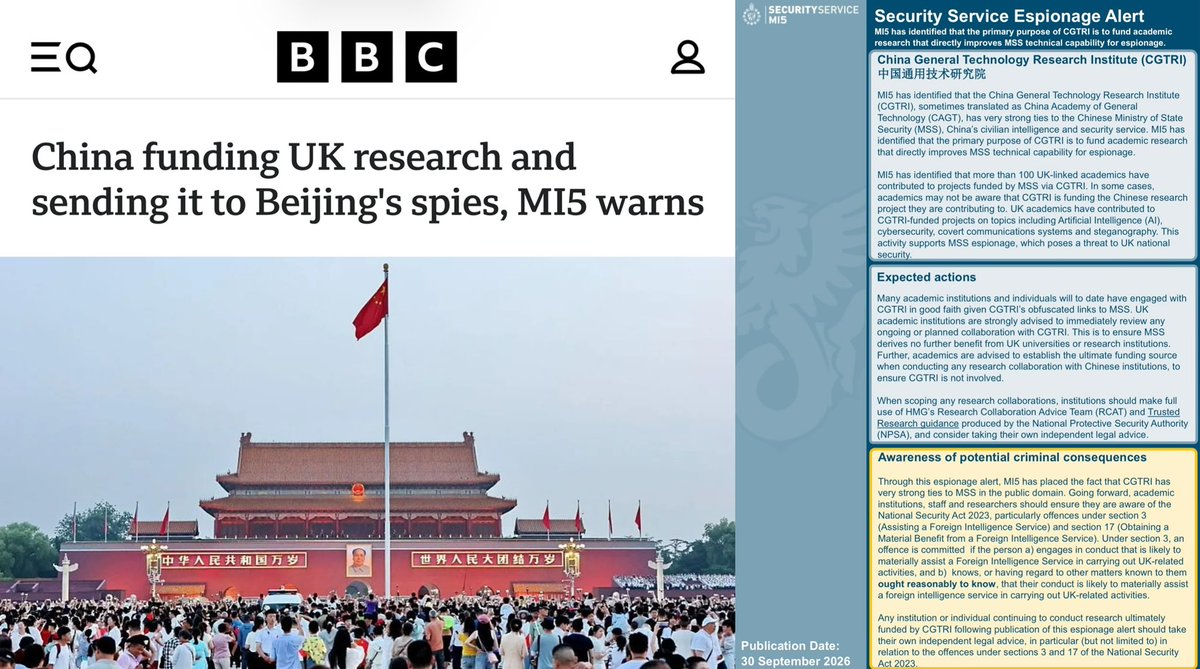
🚨 More than 100 academics linked to British institutions have unwittingly assisted China's espionage operations against the UK via 🇨🇳 China General Technology Research Institute (CGTRI; 中国通用技术研究院), a front company working for China’s intelligence and security services.
MI5 warns universities and academics that continuing ties with CGTRI could ultimately lead to criminal charges for aiding a foreign state.
CGTRI, sometimes translated as the China Academy of General Technology (CAGT), has "very strong ties" to the 🇨🇳 Ministry of State Security (MSS).
“MI5 has identified that the primary purpose of CGTRI is to fund academic research that directly improves MSS technical capability for espionage.”
More than 100 UK-linked academics have contributed to projects funded by 🇨🇳 MSS via CGTRI. In some cases the researches would not be aware of the front company's role in their project.
UK academics have contributed to CGTRI-funded projects on topics including AI, cyber-security, covert communications systems and steganography, which means hiding a secret message or file inside an ordinary message or object.
“This activity supports Ministry of State Security espionage, which poses a threat to UK national security.”
Many academic institutions and individuals will have engaged with the CGTRI "in good faith" because the link back to Chinese state security had been obfuscated.
UK academic institutions are strongly advised to immediately review any ongoing or planned collaboration with CGTRI. This is to ensure MSS derives no further benefit from UK universities or research institutions.
https://t.co/4JRk9Pq3JY
https://t.co/o7wczbqoxJ
Today MI5 issued its first publicly published espionage alert, warning UK universities about CGTRI (中国通用技术研究院). MI5 says it has very strong ties to China's MSS and 100+ UK-linked academics contributed to CGTRI-funded projects, incl. AI and cybersecurity.
The "One Network, Two Systems" published with @ukctransparency maps UK-China university cyber partnerships, highlighting institutions embedded in China's military and security system👇
"Jasmine had no technical skills and zero interview experience of any kind, yet within days of arrival she was assigned a persona, handed a two-to-three-week account-building quota, and booked in front of a client CEO." - THE WOMEN BEHIND NORTH KOREA'S IT WORKER OPERATIONS: https://t.co/tqBGTzc6Bf
If you want to read the full deep-dive into what is new in the now extended ZRON dataset, come over to our blog and read the full thing. I bet there will be more revelations as there are still so many little hints hidden in the work reports and inter-company messages: https://t.co/p3LnzQfsas 13/13