Three questions every board deploying AI agents should ask now:
Who authorised this action?
Who can stop it?
Who answers if it goes wrong?
If you cannot answer all three, your governance has a gap. #ICCC2026@CyberlawConf
An apple packing line where AI sees every fruit. 🍎🤖
This real-time computer vision system uses YOLO26 to detect, track and count apples on a moving conveyor even when they overlap or partially hide each other.
🟢 Healthy
🔴 Damaged
📊 Live counting
🎯 Individual object tracking
⚙️ Automated quality inspection
The system combines YOLO26, ByteTrack and OpenCV to turn a normal conveyor belt into an AI-powered inspection system.
Could AI vision replace manual fruit inspection? 👀
🎥 Media: Muhammad Rahman Shahid ( Linkedln )
⚠️ This content is shared for informational purposes only. CTO Robotics Media is a media platform and does not own or develop the technology shown. Credit belongs to the original creators.
#YOLO26 #ComputerVision #AI #ArtificialIntelligence #MachineLearning #ObjectDetection #ObjectTracking #AgriTech #SmartFarming #FoodAutomation #Automation #CTORoboticsMedia
this is insane. i genuinely don't understand why ambitious people aren't shown this lecture before their careers start consuming their entire lives.
clayton christensen spent his career studying why successful companies collapse. in his final class, he asked students to apply the theory to themselves: if you keep allocating your time the same way, what life are you actually building?
he had already seen the answer in his own harvard mba class. everyone looked successful at the fifth reunion; by the 10th, 15th, 20th, and 25th, many were unhappy, divorced, and living far from their children.
work shows you the score immediately. close a sale, ship a product, finish a presentation, earn a promotion, get paid.
an hour with your child may produce nothing you can measure today; it may take 20 years to understand what that hour built. so the next free hour goes back to work, one rational decision at a time.
this is how people build lives they never planned: through hundreds of right decisions that lead in the wrong direction, day after day.
money, titles, and headcount are easy to count. christensen believed a life should be measured by the people who became better because you were there.
he died in 2020.
one question remains: if someone saw only where your time, energy, and attention went this year, what would they think actually mattered to you?
the full 19-minute lecture is in the video below.
50 legendary internet rabbit holes you can spend hours exploring👇
1. https://t.co/ueX0rgHHma — Watch the world via live satellite imagery
2. https://t.co/ZvRw1wmNsJ — See every plane currently in the sky
3. https://t.co/ysMWhN8eU5 — Track all ships at sea in real time
4. https://t.co/ukJigDtLFY — Live map of winds and storms
5. https://t.co/Y1I20AitIs — Watch lightning strikes hitting Earth in real time
6. https://t.co/LmzpGivPqL — Live list of recent earthquakes
7. https://t.co/VU7EuP5SOm — Ocean cables carrying the internet
8. https://t.co/kAAdHcSNpt — Watch forests disappear from space
9. https://t.co/bbkThFLpz1 — The world's statistics, second by second
10. https://t.co/pMvZJO0YfM — Current number of tweets and searches being posted
11. https://t.co/VhEnQl9oax — Compare the true sizes of countries
12. https://t.co/XyyYYcRjdm — Maps from centuries ago
13. https://t.co/AOXvH90KFK — Archive of 150,000 historical maps
14. https://t.co/u0Zf6LJoDZ — World map drawn by volunteers
15. https://t.co/p2uu9hAQks — Look out the window of a random person around the world
16. https://t.co/powm7RRAmX — Virtual walks through cities
17. https://t.co/bcsy3ybL07 — Teleport to a random spot on Earth
18. https://t.co/5YbDgnYpF7 — Catalog of the world's strangest places
19. https://t.co/SJN9aIxuyM — Interactive knowledge experiences
20. https://t.co/bpyBnZgtz1 — Scale journey from atom to universe (Updated HTML5 link)
21. https://t.co/UP12t0jeRy — Explore the solar system in 3D
22. https://t.co/9xDWk6aGgf — Real sky map in your browser
23. https://t.co/ZSJokVTin1 — NASA's astronomy picture of the day
24. https://t.co/7XrqjHR7BR — NASA's entire visual archive, free
25. https://t.co/3tWvLaeyGu — Visual articles told through data
26. https://t.co/JY8FI1u9ls — The state of the world with real data
27. https://t.co/Ois9J7u7m7 — What we mistakenly think we know about the world
28. https://t.co/NtDVcv2cxN — Visualizing complex data
29. https://t.co/FqijxOqnJL — World Bank's open data
30. https://t.co/NyYgq0wMs7 — Turkey's official statistics database
31. https://t.co/KDjOuBVmft — Archive of millions of books, films, and software
32. https://t.co/9Y8pcXCzKu — 70,000 free books whose copyrights have expired
33. https://t.co/hJt2YM0nzp — Record of every book in the world
34. https://t.co/6kwMQCzdZq — U.S. Library of Congress digital archive
35. https://t.co/GAjugENT89 — Europe's cultural heritage archive
36. https://t.co/LPx73NbK1E — America's digital library collection
37. https://t.co/VjpuQq1BIZ — Tour museums from home
38. https://t.co/lkaoYLTy3S — Download artworks in high resolution
39. https://t.co/AX9cd7YatS — Archive of 250,000 artworks
40. https://t.co/WExwDy3e6F — Forgotten visual treasures of history
41. https://t.co/Bobq0w1hyR — Free archive of culture and education
42. https://t.co/bgBEuHixJo — Met Museum's open collection
43. https://t.co/jxj8X1LuEy — Family tree of music genres
44. https://t.co/d8lZJ9yWc3 — Pick a country and decade to listen to that era
45. https://t.co/avmQLINXhU — Turn Wikipedia edits into audio
46. https://t.co/7WDyOPTfU6 — Random knowledge well
47. https://t.co/4qVlBpRvCf — Time, sunrises, and sky events
48. https://t.co/V2ObL5vTSR — Live stream of science news
49. https://t.co/VFhRaZRXso — Free preprints of scientific papers
50. https://t.co/JUo9A2FPFW — Visualize data with live code
Save this. You’ll definitely need some of these later. 🔖
Follow @zakiraicoder for more useful websites, AI tools & tech resources.
Anthropic engineer (ex-Google):
"I spent 14 years at Google and built 24 reusable skills for agents that I can use with any AI model
So I stopped prompting my agents from scratch. The repo has already reached ~100K stars on GitHub"
In a 40-min masterclass, Addy Osmani showed exactly how he uses his skills (~100K stars on GitHub) for his 24/7 multi-agent system
His workflow and this workshop will replace 15 hours of other paid videos on agent engineering
Watch it today, copy the GitHub repo - then read below how to use these skills for graphs ↓
Today is Tim Cook's last day as CEO at Apple.
I first met Tim in 2014 and I've been fortunate to call him a mentor and friend ever since. I want to share something about him that I've found remarkable.
He's the best example I've seen of an old Zen saying:
"What do you do before enlightenment? Chop wood, carry water. What do you do after enlightenment? Chop wood, carry water."
When we met, I was just starting my career in finance. I was getting to the gym at 4:45am so I could get to the office by 6:30. Tim happened to be one of a tiny group of others who showed up every morning at that early hour.
For the first six months, I had no idea who he was. I wasn't in tech and, having played college sports, I was frankly quite oblivious to the entire business world.
I remember being shocked after someone told me that the guy I was talking to in the mornings was the CEO of Apple.
For two reasons:
1. He had zero pretension about him. I never would have known how important or powerful he was.
2. He was already successful. Why the hell was he waking up at 4am to go to the gym?
Now, to be fair, in 2014, there were still questions about whether he was going to be an impactful successor to the legend that was Steve Jobs. A lot of people weren't sure he would be able to fill those enormous shoes.
But a few years later, he was still there. He had created a trillion dollars of value. People were calling him one of the best CEOs in the world. And he was still showing up at 4:45am. Still doing the same thing.
Chop wood, carry water.
As you start to experience success, notoriety, and achievement, it’s easy to lose sight of the work that got you those things in the first place. It’s easy to get distracted by results. By recognition. By the illusion that success somehow exempts you from the basics.
It doesn’t.
The outcomes may change. The titles may change. The scale may change. But the work doesn’t.
Chopping wood and carrying water means showing up when no one is watching. Doing the boring work well. Being reliable. Executing consistently. Returning to fundamentals even when you think you’re above them. Especially then.
Tim has been an example of that in my life. I'm grateful for having been able to see it up close.
And I also know that whatever he does next, the same thing will apply.
Chop wood, carry water.
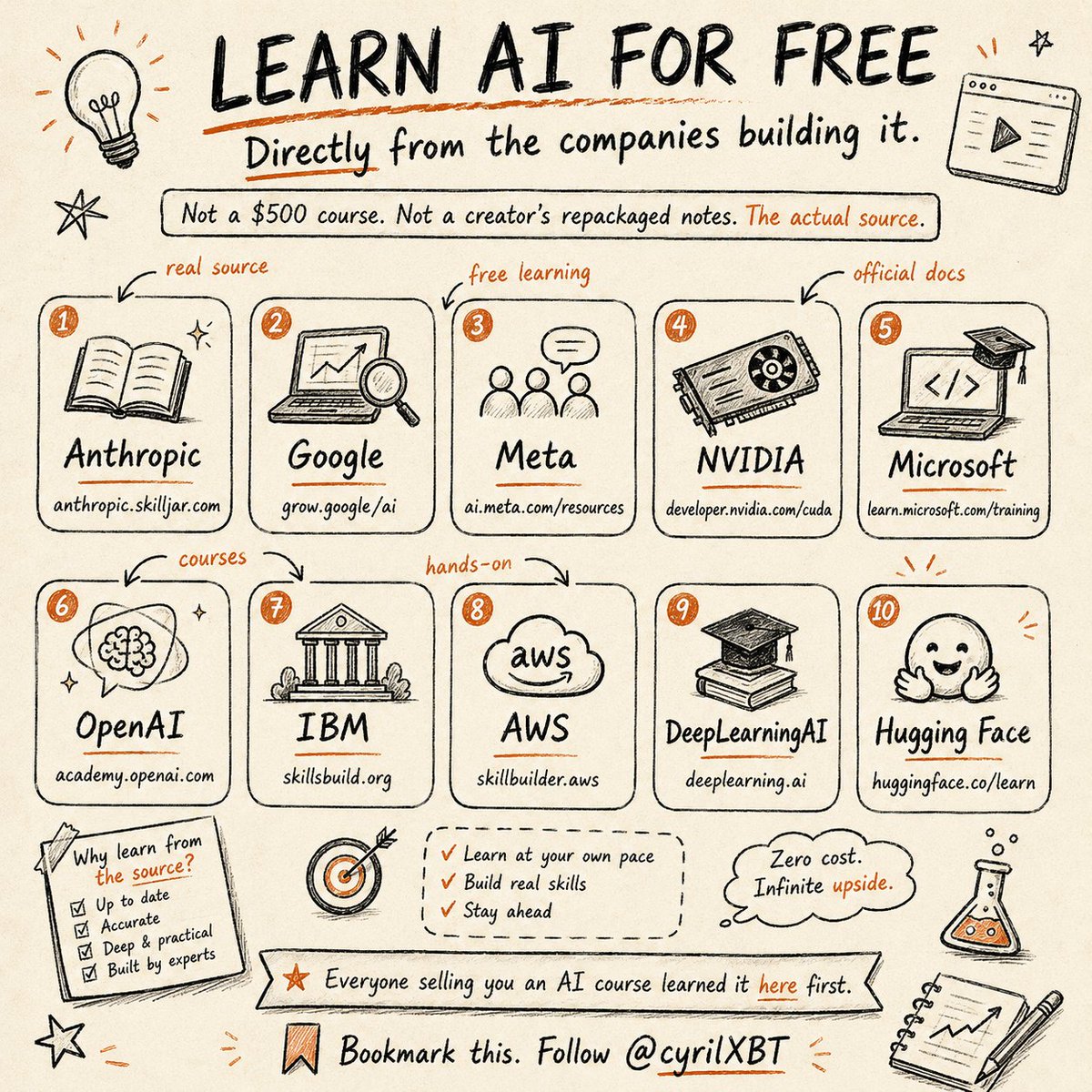
LEARN AI FOR FREE, DIRECTLY FROM THE COMPANIES BUILDING IT.
Not a $500 course. Not a creator's repackaged notes.
The actual source.
Anthropic. https://t.co/VAC50EMLs0
Google. https://t.co/1Y1mnwAVs5
Meta. https://t.co/CWApCMdyW7
NVIDIA. https://t.co/iBDXDJgnb2
Microsoft. https://t.co/ss03MXFYa2
OpenAI. https://t.co/ECOpVl9ZBu
IBM. https://t.co/pGOE62HbdQ
AWS. https://t.co/oOpRXHqih6
DeepLearningAI. https://t.co/xj10Hpn2rK
Hugging Face. https://t.co/NTWKRCLHeW
Everyone selling you an AI course learned it here first.
Bookmark this. Follow @cyrilXBT
All Paid Courses (Free for First 4500 People).
𝗣𝗮𝗶𝗱 𝗖𝗼𝘂𝗿𝘀𝗲 𝗙𝗥𝗘𝗘 (PART - 1)
1. Artificial Intelligence
2. Machine Learning
3. Prompt Engineering
4. Claude, ChatGPT, Grok
5. Data Analytics
6. AWS Certified
7. Data Science
8. BIG DATA
9. Python
10. Ethical Hacking
(72 Hours only )
Like + RT + comment '' Drive ''
Must Follow me so I can DM you.
“Loop engineering” is a hot buzzphrase after mentions of it by Boris Cherny (Claude Code’s creator) and Peter Steinberger (OpenClaw's creator) went viral on social media. Loops are now a key part of how we get AI agents to iterate at length to build software. In this letter, I’d like to share my 3 key loops, shown in the image below, for building 0-to-1 products. These loops guide not just how I build software, but also how I decide what software to build.
Agentic coding loop: Given a product specification and optionally a set of evals (that is, a dataset against which to measure performance), we can have an AI agent write code, test its work, and keep iterating until the code is bug-free and meets its specification. This idea of closing the loop took off around the end of last year, and it has been a game changer in enabling coding agents to work longer productively without human intervention. For example, over the weekend, I was building an app for my daughter to practice typing, and my coding agent could easily work for around an hour, using a web browser to check what it had built multiple times before getting back to me, without needing my intervention.
The engineering loop executes quickly. Every few minutes, the coding agent might build and test a new version of the software. I hear frequently from developers who are finding new ways to engineer more effective engineering loops. This is an active area of invention!
Developer feedback loop: In this loop, a developer examines the current product and steers the coding agent to improve it. Last year, a lot of developers (including me) were acting as the QA (quality assurance) function for our coding agents, manually finding bugs and then asking the agent to fix them. But with coding agents much more able to test their own code, the amount of time we need to spend on this function has decreased significantly. This allows us to make higher-level product decisions, such as what key features to offer, where the UI needs improvement, and so on.
The developer-feedback loop operates over time intervals between tens of minutes and hours — that's how frequently a developer might review a product and give feedback. In the case of the typing app, I changed my mind a few times about the visual design, what cat costumes she can unlock as she learns (she loves cats), and the user flow for a grown-up to log in and steer the child's learning experience.
When a developer has a clear vision for what to build, it is still a lot of work to translate that vision into a specification for a coding agent to implement. Further, after the developer has seen an implementation, they might update (or perhaps clarify) the spec to steer it toward what they want. If you find that the system repeatedly runs into certain problems, building a set of evals for the agent becomes useful.
AI-native teams are increasingly using AI to help shape product direction, for example, automating the gathering and analysis of usage data, summarizing written and verbal customer feedback, or carrying out competitive analysis. However, for pretty much all the products I’m involved in, I see humans as having a significant context advantage over current AI systems — we know a lot more than the AI system about the users and the context the product has to operate in — and thus humans play a critical role. Many people describe this human contribution as “taste,” but I prefer to think of it as humans having a context advantage, since that gives us a clearer path to helping AI systems get better. This also speaks to why this step can’t be automated: So long as the human knows something the AI does not, human-in-the-loop is needed to to inject that knowledge into the system.
External feedback loop: This includes a wide range of tactics like asking a few friends for feedback, launching to alpha testers, or putting the code into production with A/B testing. These tactics are usually slow, rarely taking less than hours and sometimes taking days or even weeks. This data informs the developer vision, which in turn continues to drive the detailed product spec, which in turn drives the coding agent.
With coding agents speeding up software development, more engineers are starting to play a partial product management role. For many engineers who are growing into this role, the hardest part is shaping the product vision and striking a balance between building (bridging the gap between vision and spec) and getting user feedback to evolve the vision. It is important to do both!
I will write more about how to do this in future posts, but for now, I find it encouraging that engineers are playing an expanded role (just as product managers and designers now do more engineering).
[Original text: The Batch]








![AndrewYNg's tweet photo. “Loop engineering” is a hot buzzphrase after mentions of it by Boris Cherny (Claude Code’s creator) and Peter Steinberger (OpenClaw's creator) went viral on social media. Loops are now a key part of how we get AI agents to iterate at length to build software. In this letter, I’d like to share my 3 key loops, shown in the image below, for building 0-to-1 products. These loops guide not just how I build software, but also how I decide what software to build.
Agentic coding loop: Given a product specification and optionally a set of evals (that is, a dataset against which to measure performance), we can have an AI agent write code, test its work, and keep iterating until the code is bug-free and meets its specification. This idea of closing the loop took off around the end of last year, and it has been a game changer in enabling coding agents to work longer productively without human intervention. For example, over the weekend, I was building an app for my daughter to practice typing, and my coding agent could easily work for around an hour, using a web browser to check what it had built multiple times before getting back to me, without needing my intervention.
The engineering loop executes quickly. Every few minutes, the coding agent might build and test a new version of the software. I hear frequently from developers who are finding new ways to engineer more effective engineering loops. This is an active area of invention!
Developer feedback loop: In this loop, a developer examines the current product and steers the coding agent to improve it. Last year, a lot of developers (including me) were acting as the QA (quality assurance) function for our coding agents, manually finding bugs and then asking the agent to fix them. But with coding agents much more able to test their own code, the amount of time we need to spend on this function has decreased significantly. This allows us to make higher-level product decisions, such as what key features to offer, where the UI needs improvement, and so on.
The developer-feedback loop operates over time intervals between tens of minutes and hours — that's how frequently a developer might review a product and give feedback. In the case of the typing app, I changed my mind a few times about the visual design, what cat costumes she can unlock as she learns (she loves cats), and the user flow for a grown-up to log in and steer the child's learning experience.
When a developer has a clear vision for what to build, it is still a lot of work to translate that vision into a specification for a coding agent to implement. Further, after the developer has seen an implementation, they might update (or perhaps clarify) the spec to steer it toward what they want. If you find that the system repeatedly runs into certain problems, building a set of evals for the agent becomes useful.
AI-native teams are increasingly using AI to help shape product direction, for example, automating the gathering and analysis of usage data, summarizing written and verbal customer feedback, or carrying out competitive analysis. However, for pretty much all the products I’m involved in, I see humans as having a significant context advantage over current AI systems — we know a lot more than the AI system about the users and the context the product has to operate in — and thus humans play a critical role. Many people describe this human contribution as “taste,” but I prefer to think of it as humans having a context advantage, since that gives us a clearer path to helping AI systems get better. This also speaks to why this step can’t be automated: So long as the human knows something the AI does not, human-in-the-loop is needed to to inject that knowledge into the system.
External feedback loop: This includes a wide range of tactics like asking a few friends for feedback, launching to alpha testers, or putting the code into production with A/B testing. These tactics are usually slow, rarely taking less than hours and sometimes taking days or even weeks. This data informs the developer vision, which in turn continues to drive the detailed product spec, which in turn drives the coding agent.
With coding agents speeding up software development, more engineers are starting to play a partial product management role. For many engineers who are growing into this role, the hardest part is shaping the product vision and striking a balance between building (bridging the gap between vision and spec) and getting user feedback to evolve the vision. It is important to do both!
I will write more about how to do this in future posts, but for now, I find it encouraging that engineers are playing an expanded role (just as product managers and designers now do more engineering).
[Original text: The Batch]](https://pbs.twimg.com/media/HMEtxp3bsAARJdi.jpg)





